The State of Modern Television Marketing: Spending Trends and Viewer Shifts
When we look at media budgets today, a surprising pattern emerges. Despite endless headlines proclaiming the total demise of traditional media, television marketing remains the bedrock of top-of-funnel advertising. Advertisers are channeling $139 billion into linear TV ads in 2026, while streaming and connected TV (CTV) platforms capture $33 billion.
Why does linear TV still command nearly four times the ad spend of streaming? The answer lies in mass reach and viewer behavior. Digital video channels excel at capturing existing demand, but linear broadcast television excels at creating broad demand from scratch. When performance search and social channels hit saturated competition and rising cost-per-lead inflation, smart brands turn back to television to expand their customer universe.
At the same time, viewer fragmentation is real. Broadcasters are adapting by building multi-platform distribution systems that blend live over-the-air signals with ad-supported streaming networks. Consumers now split their watch time across broadcast channels, subscription services, and free ad-supported streaming networks. Yet, television maintains an unrivaled level of consumer trust. Local broadcast TV news ranks as the single most trusted media source at 70%, compared to just 47% for social media and 46% for email newsletters.
Linear TV vs. Digital Video in Driving Consumer Awareness
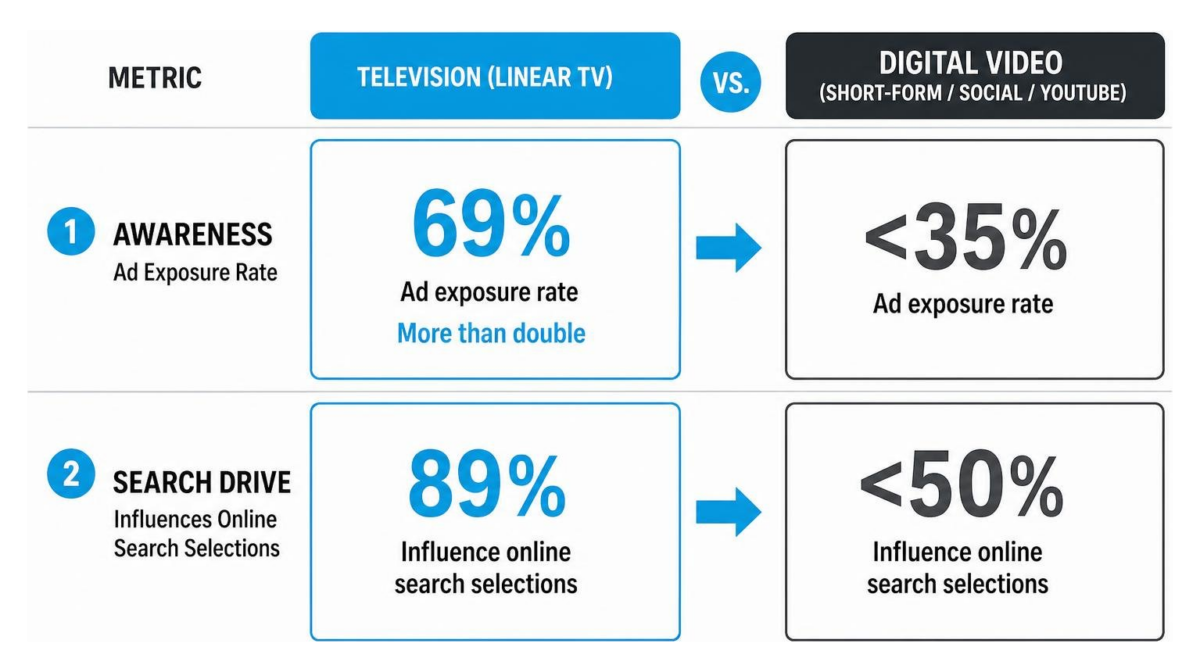
When it comes to capturing viewer attention, traditional television continues to outperform digital video feeds. Research demonstrates that television generates a 69% ad exposure rate—more than double that of short-form video platforms like YouTube or social feeds.
Television does not operate in a vacuum; it acts as a primary catalyst for lower-funnel digital actions. According to the 2026 Purchase Funnel Study, 89% of consumers report that linear TV advertisements actively influence their online search selections. When an engaging TV spot airs, viewers routinely pick up their mobile devices to search for the brand.
To maximize these cross-channel synergies, we recommend aligning television media buys directly with search engine marketing. If you want to dive deeper into structuring these multi-touch efforts, check out our guide on How to Build a Television Campaign Strategy That Actually Works.
How Demographic Groups Consume Television Marketing Across Funnel Stages
A common myth in modern advertising is that television only works for older demographics. In reality, television serves as the premier influencer across all stages of the purchase funnel for every major age group, higher-income households, and high-net-worth households.
- Awareness Stage: 42% of consumers select television as the single most important medium for discovering new products and services. Among viewers who cite TV as their top awareness driver, 67% point specifically to broadcast television.
- Consideration Stage: Trust in broadcast media gives consumers the confidence to research high-ticket products, particularly in automotive, financial services, legal, and home improvement sectors.
- Decision Stage: High-income households demonstrate high responsiveness to targeted TV campaigns, making broadcast and CTV placements vital for premium product launches.
Understanding these audience dynamics allows marketers to build efficient media plans. Learn more about these core media strengths in our breakdown of A Practical Guide to Advantages of Advertising on Television.
Measuring True ROI: Overcoming Attribution Flaws with Real-Time Data
For decades, TV advertising relied on aggregate panel ratings like Nielsen or BARB to estimate viewership. Broadcasters charged rates based on these panel projections across specific day-parts. However, modern viewership analytics have uncovered major structural flaws in these legacy metrics.
A landmark study highlighted by the Notre Dame Business Mendoza College of Business revealed that traditional measurement methods overestimate TV ad effectiveness by roughly 55%. Why? Because legacy panels confuse pre-existing consumer habits with true ad-driven impact. A viewer who already buys a specific brand regularly might be watching a show when that brand’s commercial airs. Traditional panel metrics credit the commercial for a subsequent purchase that would have happened anyway.
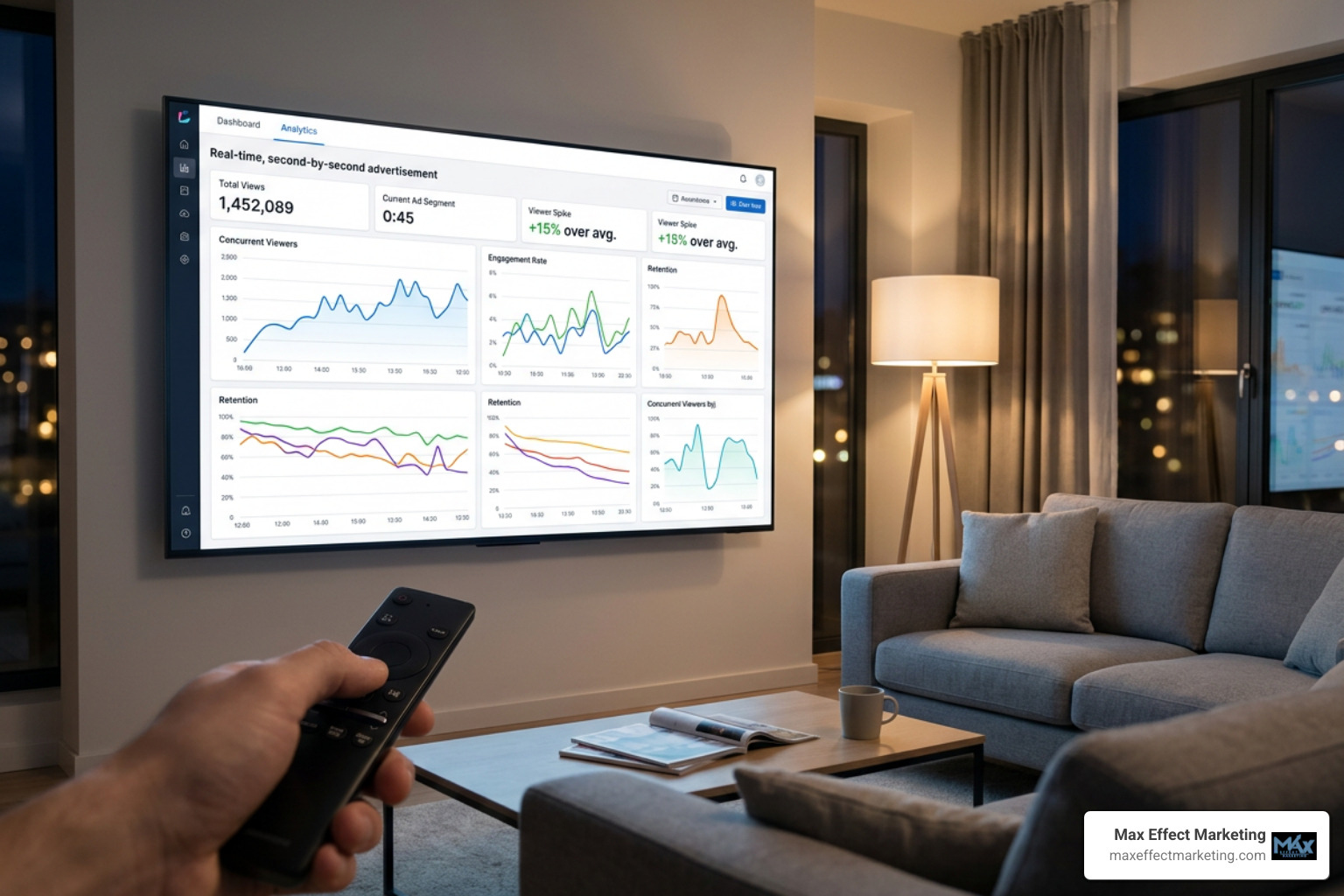
By combining second-by-second smart TV viewership datasets with actual digital transaction logs, modern advertisers can isolate true causal sales lift. For example, research analyzing fast-food delivery campaigns showed that TV ad responsiveness actually peaks within two days of a customer making an order, with maximum ad engagement occurring among customers who have previously ordered two to four times. Identifying these exact conversion windows prevents brands from overspending on low-converting slots.
To learn more about baseline commercial pricing and production structures, read our complete guide on Don’t Break the Bank: What It Really Costs to Run a Commercial on TV.
Technological Disruptions: DTRs, Streaming, and Addressable Targeting
Technological shifts have dramatically reshaped how households consume TV commercials:
- Digital Video Recorders (DTRs): Counter to early industry fears, when a household acquires a DTR, their overall TV viewing increases by 17%. Because overall viewing grows so significantly, viewers end up watching 2% more ads at normal speed than they did before installing the DTR, despite fast-forwarding capabilities.
- Addressable TV & Dynamic Ad Insertion: Addressable technology enables streaming platforms and digital cable providers to swap out commercials in real time. Two households watching the exact same broadcast show can receive completely different ad creatives based on their household income, lifestyle interests, or purchase history.
- Targeted Streaming Inventory: Platforms like YouTube TV, Pluto TV, and streaming networks offer granular demographic targeting with lower entry costs than traditional national broadcast buys.
To evaluate which options fit your campaign strategy, explore our comparisons in A Quick Start Guide to Comparing TV Ad Service Providers, dive into YouTube TV Ads: What You’ll Pay to Reach Cord-Cutters, or review budget streaming reach with Pluto TV Ads: Reach Cord-Cutters on a Budget.
Beyond the 30-Second Commercial: Sponsorships, Integrations, and Innovative Formats
The traditional 30-second commercial spot is no longer the only way to reach engaged audiences. As channel surfing and commercial skipping have evolved, leading networks and advertisers have developed deeper program integrations that hold viewer attention.
Research from the Science of Sponsorship Study proves that fully integrated television program sponsorships—combining break billboards, bespoke TV spots, and in-show content—dramatically outperform standard standalone commercials across every key memory metric:
- Top-of-Mind Ad Recall: Increases by 290% compared to a standard commercial spot alone.
- Unprompted Ad Recall: Lifts by 167%.
- Purchase Intent: Grows by 19% on average.
- Mental Market Share: Expands by 28% over unexposed control groups.
Adding billboards at both the beginning and end of commercial breaks yields a 61% boost in unprompted ad recall, compared to 37% when billboards appear only at the end of a break. Fully integrated sponsorships deliver an average of 76 seconds of total brand exposure per hour—3.4 times higher than the exposure offered by a single standalone commercial spot.
To see how premium streaming networks are implementing these high-impact placements, review our analysis of Prime Video Ads: Your Brand Alongside Premium Content.
Innovative Formats in Television Marketing Strategies
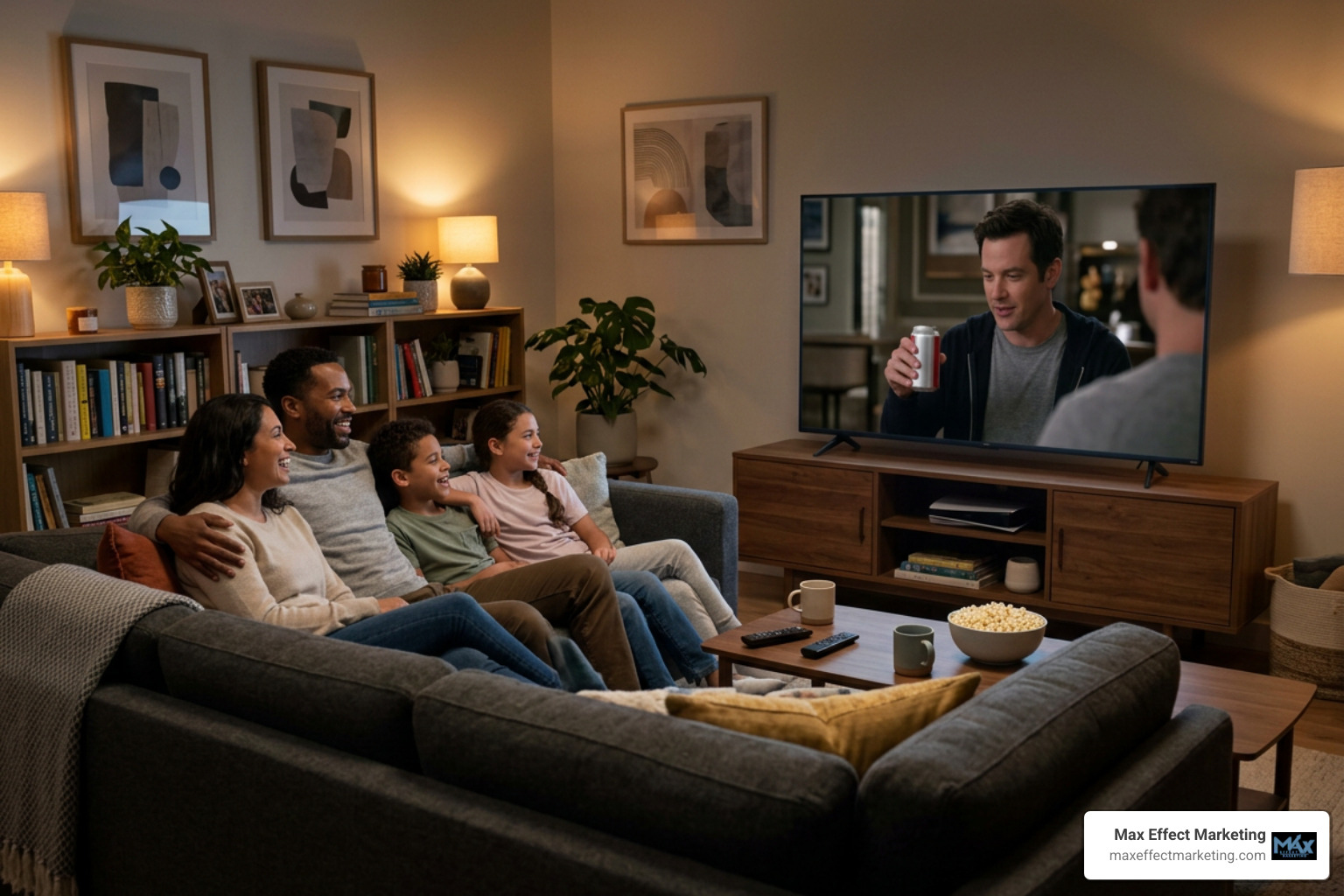
Networks are introducing creative commercial formats designed to reduce ad fatigue and boost active screen engagement.
Passive eye-tracking research reveals that viewer screen-attention is 5% higher during active program content than during standard commercial breaks. Furthermore, when a brand is mentioned inside integrated program content, viewer “eyes-on-screen” engagement is 17% higher than when the brand is mentioned in a regular ad spot.
Key innovative ad formats driving high engagement include:
- Organic Product Placement: Integrating physical products or brand storylines directly into show narratives, ensuring brand exposure even when viewers skip traditional ad breaks.
- Secondary Events & Banner Overlays (2E): Displaying non-intrusive lower-third graphics or logo bugs during live broadcasts. These overlays can occupy up to 25% of the screen without interrupting live programming.
- One-Minute Prime Pods: Shortened single-minute commercial breaks placed during high-stakes live sports or prime-time broadcasts to keep viewer retention at maximum levels.
- Bespoke Commercials: Custom-produced ad spots featuring show talent or storyline elements that seamlessly transition the viewer from the show into the advertisement.
To better understand inventory pricing across these emerging formats, explore The Complete Guide to OTT and CTV Ad Rates and check out The Ultimate Guide to the Cost of Hulu Ads.
Key Regulatory Challenges and Controversies in TV Advertising
While television marketing offers unmatched reach, it operates under strict regulatory scrutiny and legal compliance standards. Broadcasters must secure clearance before airing commercials, particularly across regulated categories such as pharmaceuticals, financial products, gaming, and dietary supplements.
Major compliance and ethical areas include:
- Children’s Advertising & Developmental Comprehension: Regulations govern how brands advertise to younger audiences based on cognitive development:
- Children under 2: Cannot distinguish commercials from regular show content.
- Ages 3 to 6: Can distinguish ads from programs but fail to recognize sales intent.
- Ages 7 to 11: Grasp sales intent but struggle to identify persuasive marketing tactics.
- Teenagers: Fully understand commercial intent but remain vulnerable to subtle product placements or influencer endorsements. These developmental nuances have led regulators and medical groups to challenge aggressive food and beverage marketing aimed at children, prompting major fast-food brands to retire iconic characters or adjust campaign tactics.
- Banned and Withdrawn Campaigns: Commercials that violate broadcast decency standards, feature unsafe behavior, or make unsubstantiated health claims face swift removal by broadcasting standards authorities.
- Hyper-Targeting and Privacy: As addressable TV relies more heavily on household IP tracking and third-party data matching, regulators are continually updating data privacy frameworks to ensure viewer information remains protected.
Brands must ensure their television campaigns follow regional broadcast standards to protect long-term brand reputation. For hyper-local implementations, see our guide on Convenience Store TV Commercials That Drive Foot Traffic.
Frequently Asked Questions About TV Advertising
Why do traditional metrics overestimate traditional TV ad effectiveness by 55%?
Traditional measurement methods rely on aggregate panel ratings that fail to isolate natural consumer purchasing behavior from commercial impact. They often attribute a sale to a TV commercial simply because a household was tuned into a channel, without verifying whether the viewer actually watched the spot or was already planning to purchase the product. Modern attribution uses second-by-second smart TV viewership combined with household transaction data to measure true causal sales lift.
How do fully integrated TV sponsorships outperform standard TV commercials?
Fully integrated sponsorships embed brands directly into program content using storylines, verbal mentions, and break billboards. Because viewer screen-attention is 5% higher during show content than during ad breaks, integrated mentions capture 17% higher eyes-on-screen engagement. This multi-layered exposure increases top-of-mind ad recall by 290% and expands mental market share by 28% compared to single commercial spots.
Is linear TV advertising still relevant compared to streaming video platforms in 2026?
Yes. Linear television commands $139 billion in ad spend in 2026 compared to $33 billion for streaming and CTV. Linear TV provides unmatched mass reach, higher consumer trust (70% for local news), and serves as a major driver of online search behavior, with 89% of viewers reporting that linear ads influence their web searches.
Maximize Your TV Campaign Performance with Max Effect Marketing
Navigating the evolving landscape of linear television, connected TV, and programmatic video buying requires an approach grounded in data. At Max Effect Marketing, we combine intelligent AI-driven tracking technology with experienced strategy experts to eliminate wasted ad spend and deliver transparent campaign performance.
Whether you are launching a national sponsorship integration or scaling hyper-targeted streaming video ads, our team helps you achieve a 5X ROI by aligning your top-of-funnel television reach directly with lower-funnel digital search and social conversion channels.
Ready to transform your broadcast and CTV performance? Maximize Your Growth with Integrated TV and Digital Strategies and partner with Max Effect Marketing today!