
What Does an Ad on TV Cost in 2026? (Quick Answer)
The ad on TV cost ranges from as little as $200 for a 30-second local spot in a small market to over $8 million for a Super Bowl placement. Most small businesses spend between $5,000 and $25,000 per month on a local TV campaign, while national advertisers budget $100,000 to $1 million or more per spot.
Here’s a fast breakdown to help you estimate your budget:
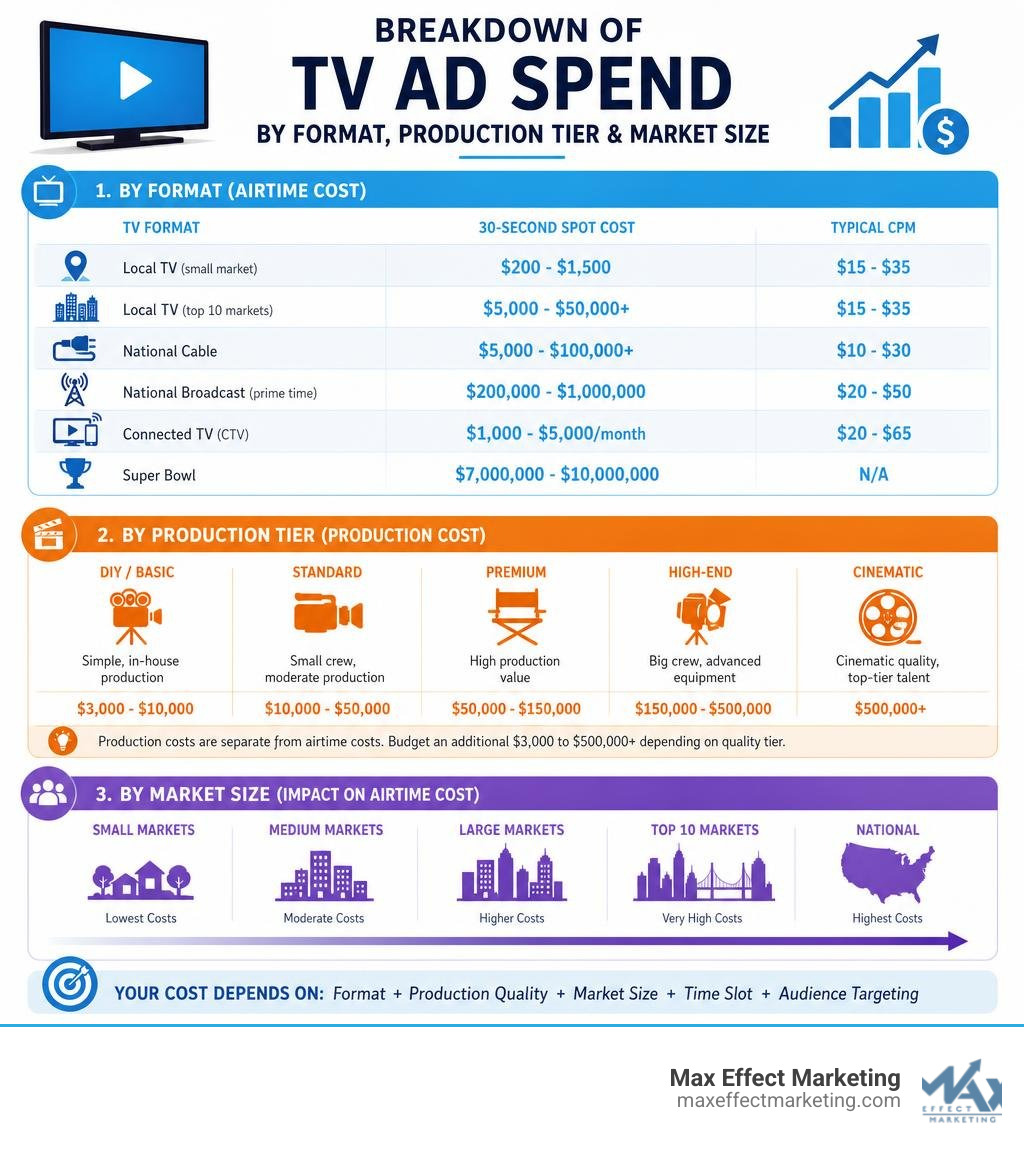
| TV Format | 30-Second Spot Cost | Typical CPM |
|---|---|---|
| Local TV (small market) | $200 – $1,500 | $15 – $35 |
| Local TV (top 10 markets) | $5,000 – $50,000+ | $15 – $35 |
| National Cable | $5,000 – $100,000+ | $10 – $30 |
| National Broadcast (prime time) | $200,000 – $1,000,000 | $20 – $50 |
| Connected TV (CTV) | $1,000 – $5,000/month | $20 – $65 |
| Super Bowl | $7,000,000 – $10,000,000 | N/A |
Note: Production costs are separate from airtime costs. Budget an additional $3,000 to $500,000+ depending on quality tier.
If you’re a business owner trying to figure out whether TV advertising makes sense for your budget, you’re not alone. TV advertising has a reputation for being expensive and confusing — and frankly, the wide price range doesn’t help.
But here’s the thing: television advertising is no longer just for big brands with massive budgets. The rise of Connected TV (CTV) and programmatic buying has opened the door to targeted campaigns starting as low as a few hundred dollars.
That said, the total cost of running a TV commercial involves two very different expenses:
- Production costs — what you pay to create the ad itself
- Airtime costs — what you pay to broadcast it to an audience
Both numbers vary enormously depending on your market, your goals, and the platform you choose. And if you only plan for one without the other, your budget will fall apart fast.
This guide breaks down every layer of TV ad costs clearly, so you can make a smart decision about where your marketing dollars actually go.
Demystifying the Ad on TV Cost: Production vs. Airtime

To truly understand your ad on TV cost, we must first separate the creative process from the media buy. Think of it like buying a car: production is building the vehicle, and airtime is the fuel required to make it go. You cannot have a successful journey without budgeting for both.
Many first-time advertisers make the critical mistake of pouring 95% of their funds into a premium airtime slot, only to run a low-budget, poorly produced commercial that actively damages their brand perception. Conversely, spending your entire budget on a Hollywood-grade commercial with no money left over to actually broadcast it is a recipe for a very expensive, unwatched masterpiece.
As a general rule of thumb, we recommend treating production as roughly 20% to 30% of your total first-year TV advertising budget. If you are planning a local campaign with a $50,000 media budget, allocating $10,000 to $15,000 for production ensures your creative matches the professional standard of the programming surrounding it. For a comprehensive look at how these dynamics operate in the modern ecosystem, you can explore the insights on TV Advertising Costs: What You Actually Pay and Why as well as supplementary industry data on TV Advertising Costs: What You Actually Pay and Why.
Pre-Production, Production, and Post-Production Breakdown
To understand where your production dollars actually go, it helps to break down the process into its three core phases. Each phase requires specialized talent and resources that directly impact your final ad on TV cost.
- Pre-Production (The Blueprint): This is where your commercial is born. It includes concept development, scriptwriting, storyboarding, location scouting, casting, and securing permits. Skimping on pre-production is a major mistake; a poorly planned shoot leads to chaotic, expensive delays on set.
- Production (The Shoot): This is the actual filming phase. Costs here are driven by the size of the camera crew, the quality of the gear (cameras, lighting, audio equipment), director fees, and talent fees. If you are hiring professional union actors, you will also need to budget for ongoing usage rights and residuals, which can increase talent costs by 20% to 100% if you transition your ad from local social media to national TV distribution.
- Post-Production (The Polish): Once the footage is captured, the editors, colorists, sound designers, and visual effects artists get to work. This phase also includes voiceover recording, sound mixing, and music licensing. Licensing a recognizable hit song can cost tens of thousands of dollars, whereas utilizing high-quality stock music or custom-composed tracks keeps costs manageable.
For a deeper dive into how these phases interact to shape your final creative bill, consult How Much Does a Television Ad Cost A Complete Guide and additional industry perspectives on How Much Does a Television Ad Cost A Complete Guide.
Production Quality Tiers and Their Price Tags
Depending on your business size and campaign goals, your production budget will generally fall into one of four quality tiers:
- DIY and AI-Assisted Tools ($0 to $5,000): Ideal for very small businesses or testing concepts on streaming platforms. While AI video generation and basic templates can help you spin up a video in an afternoon, professional production consistently outperforms pure AI-generated content in brand recall and viewer engagement during paid campaigns.
- Local and Small Business Production ($3,000 to $15,000): This tier typically involves a small, local production crew using professional equipment. It is perfect for local service providers, regional retail shops, and dental clinics. At this level, you can expect clean, high-definition visuals, professional voiceovers, and clear storytelling without Hollywood-style special effects.
- Regional Professional Production ($15,000 to $50,000): The sweet spot for mid-market brands and growing B2B companies. This budget allows for multi-day shoots, professional actors, custom locations, and polished motion graphics. It delivers a highly professional look that holds its own against national brands.
- National and Premium Production ($50,000 to $500,000+): This is the domain of enterprise brands, major consumer products, and campaigns featuring celebrity talent. These productions feature top-tier directors, elaborate set builds, advanced CGI, and licensed mainstream music.
How Much Does It Cost to Air a 30-Second vs. 60-Second Commercial?
Once your commercial is produced, you must secure the “real estate” to air it. The length of your commercial is one of the most direct pricing levers available to you.
| TV Format | Average 30-Second Airtime Cost | Average 60-Second Airtime Cost |
|---|---|---|
| Local Cable (Mid-Market) | $200 – $500 | $300 – $1,000 |
| Local Broadcast Affiliate | $1,500 – $15,000 | $2,250 – $30,000 |
| National Cable Network | $5,000 – $100,000 | $7,500 – $200,000 |
| National Broadcast Primetime | $100,000 – $400,000 | $150,000 – $800,000 |
As shown above, a 60-second commercial does not cost twice as much as a 30-second spot. Instead, 60-second commercials typically cost 1.5 to 2 times the 30-second rate.
This pricing structure exists because television networks sell inventory based on demand and available time blocks. While a 60-second ad allows you to tell a deeper, more emotional story, it also limits your frequency. For most direct-response and lead-generation campaigns, running two 30-second spots at different times of the day will yield a much higher return on investment than running a single 60-second spot. To see how these rates play out during peak television seasons, review TV commercial prices: primetime advertising costs for 2024-2025 – Ad Age.
How Local Market Size Affects Your Ad on TV Cost
If you are buying traditional local linear TV, your costs are heavily dictated by geography. The United States is divided into 210 Designated Market Areas (DMAs) ranked by population.
In a smaller DMA (such as Topeka, Kansas or Alpena, Michigan), a 30-second local spot during the local news might only cost $200 to $1,500. However, if you want to air that same 30-second spot in a Top 10 metro market like New York City, Los Angeles, or Chicago, the exact same slot can easily jump to $5,000, $15,000, or even $50,000+ per airing.
This dramatic price difference is why regional businesses with physical locations must be highly strategic. Spreading a thin budget across an entire major metro area is an expensive mistake. Instead, buying local cable insertions—which allow you to target specific zones or neighborhoods within a larger DMA—is a much more cost-effective way to get on the big screen without paying for millions of viewers who live too far away to buy from you. You can learn more about navigating these local buying strategies in Local TV Advertising Costs: What You Actually Pay and Local TV Advertising Costs: What You Actually Pay.
National Broadcast Networks and Prime-Time Rates
When you move from local TV to national broadcast networks (such as NBC, CBS, ABC, and Fox), you are paying for massive, simultaneous reach. National prime-time slots (typically 8:00 PM to 11:00 PM) are the most expensive because they command the highest concentration of live viewers.
During regular programming, a national prime-time 30-second spot generally costs between $100,000 and $400,000. However, premium sports programming drives these numbers significantly higher. For example, a 30-second spot on NFL Sunday Night Football averages around $882,000.
At the absolute peak of the pricing pyramid sits the Super Bowl. In 2025, 30-second spots commanded between $7 million and $8 million, with some premium 2026 placements reaching $8 million to $10 million. While these numbers sound astronomical, they represent a unique cultural moment where over 120 million viewers are actively tuned in specifically to watch the commercials, making it a highly coveted (albeit expensive) branding play for enterprise corporations.
Traditional TV vs. Connected TV (CTV) CPM Benchmarks
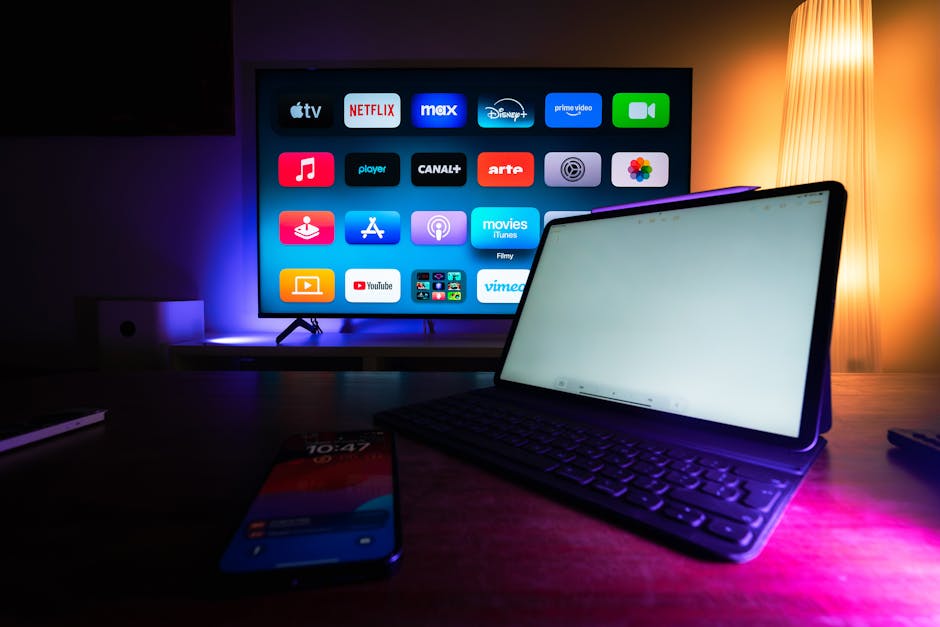
To compare the cost-efficiency of different television formats, marketers use CPM, which stands for Cost Per Mille (the cost to reach 1,000 viewers or impressions). CPM allows you to compare traditional linear TV, cable, and Connected TV (CTV) on an even playing field.
- Local Broadcast & Cable CPM: $5 to $15. Extremely cheap on a per-viewer basis, but offers very limited targeting.
- National Broadcast Primetime CPM: $20 to $50. Offers massive national scale and prestige, but requires high upfront commitments.
- Connected TV (CTV) and Streaming CPM: $20 to $65 (typically averaging $20 to $40). Premium programmatic networks like Netflix command $20 to $65 CPMs, while platforms like Hulu range from $10 to $30 CPMs.
- Addressable TV CPM: $40 to $80+. High-end targeting on traditional television networks delivered to specific households.
While traditional TV often boasts a lower raw CPM, it comes with a catch: you are paying to reach everyone watching that program, regardless of whether they fit your target audience. For a deeper analysis of these shifting dynamics, check out How Much Does Local TV Advertising Cost in 2026? and How Much Does Local TV Advertising Cost in 2026?.
Connected TV (CTV): A Modern Alternative to Traditional Ad on TV Cost
Connected TV (CTV) refers to any television content streamed over the internet via smart TVs, streaming sticks (like Roku or Apple TV), or gaming consoles. CTV has completely changed the economics of television advertising, especially for small to mid-market businesses.
With traditional linear TV, you buy a specific time slot on a specific channel. With CTV, you buy audiences.
Instead of paying to show your commercial to everyone watching a local football game, CTV allows you to show your ad only to homeowners in specific zip codes who have an active interest in home improvement, are in the market for a new car, or have a household income over $100,000.
Because of this precision targeting, CTV dramatically reduces wasted ad spend—often by up to 90%. Furthermore, CTV ads boast incredible engagement metrics, routinely achieving 95% completion rates compared to just 65% to 70% for traditional linear TV where viewers easily skip commercials or walk away during breaks.
TV Advertisement Rates: What You’re Actually Paying For
When you look at television rate cards, it is easy to get overwhelmed. But at their core, TV advertisement rates are determined by a simple economic principle: supply and demand. You can explore this further in TV Advertisement Rates: What You’re Actually Paying For and TV Advertisement Rates: What You’re Actually Paying For.
Specifically, rates are driven by:
- Audience Size and Ratings: Networks price their inventory using historical viewership data. More eyeballs equal higher prices.
- Inventory Availability: There are only so many commercial minutes per hour. When inventory is tight, prices rise.
- Upfront vs. Scatter Markets: Large brands buy the majority of their linear TV inventory during the “upfronts” in the spring, securing discounted rates for the upcoming season. Smaller advertisers buying closer to the air date must purchase in the “scatter market,” where rates can run 20% to 40% higher.
- Attention and Environment: Television offers a high-attention, big-screen environment that builds “mental availability” and trust in a way that small, skippable mobile banner ads simply cannot replicate.
Key Factors That Influence Your Total Television Campaign Budget
When mapping out your TV campaign budget, several external variables can cause your costs to fluctuate wildly. Understanding these factors will help you stretch your budget further:
- Seasonality (The Q4 Spike): The fourth quarter (October through December) is the most expensive time of year to run TV commercials. Retail and e-commerce brands flood the market ahead of the holidays, driving up traditional and digital TV ad costs by 30% to 50%. Conversely, January and February are historically the cheapest months to advertise, as consumer spending cools down and networks offer 20% to 30% discounts to fill open inventory.
- Political Cycles: During major election years, political campaigns pour billions of dollars into local TV stations, particularly in swing-state markets. This massive influx of capital completely crowds out local businesses, driving up rates and making inventory scarce.
- Dayparts (Timing Matters): The broadcast day is broken into segments called “dayparts.” Prime time (8:00 PM to 11:00 PM) is the most expensive. “Shoulder” time slots—such as early morning, daytime, and late night—are significantly cheaper (often costing 2.5x less than prime time) while still reaching highly engaged, specific demographic groups.
- Campaign Flight Length and GRPs: To see measurable results from a television campaign, you must achieve sufficient frequency. Marketers measure this using Gross Rating Points (GRPs). Running a single commercial once a week for a month is a waste of money; viewers will not remember it. A viable campaign typically requires a minimum flight length of 4 to 8 weeks with enough frequency (50 to 100 GRPs per week) to build brand familiarity.
Frequently Asked Questions About TV Commercial Costs
What is the absolute minimum budget needed to start TV advertising?
While a national broadcast campaign requires hundreds of thousands of dollars, you can start small. For local cable insertion, a monthly media budget of $5,000 to $10,000 is a realistic entry point to run a meaningful campaign in a mid-sized market.
If you choose Connected TV (CTV) or streaming platforms, the entry barrier is even lower. Many digital streaming platforms allow you to launch targeted local campaigns with monthly budgets starting around $1,000 to $5,000, making TV advertising highly accessible to local service businesses.
How do TV commercial costs compare to digital advertising?
Digital advertising (like paid search and social media) is fantastic for capturing existing demand—meaning reaching people who are already actively searching for your product or service. However, digital platforms can suffer from ad fatigue, ad blockers, and fragmented attention.
TV advertising works upstream. It builds broad brand awareness, establishes credibility, and creates demand before a consumer even starts searching. When you run a television commercial, you will typically see a direct, positive impact on your digital channels, leading to lower customer acquisition costs. To find out more about how digital channels can integrate with your broader strategy, read our guide on Google Ads for Small Businesses: A Smart Way to Generate More Leads.
How can businesses measure the ROI of a TV ad campaign?
Traditional TV measurement used to be a guessing game, but modern attribution models have solved this problem. Today, we measure TV campaign performance through:
- Branded Search Uplift: Tracking the increase in organic Google searches for your brand name during and immediately after your commercials air.
- Direct Traffic Spikes: Monitoring real-time traffic spikes on your website during the specific minutes your ads run on television.
- Matched Market Testing: Running ads in one geographic market while keeping a similar market dark, then comparing the difference in sales and leads.
- CTV Attribution Dashboards: Tracking actual website conversions, sign-ups, and online purchases directly back to the households that watched your streaming commercial.
To learn more about tracking conversions across multiple platforms, explore our approach to building high-performing Online Campaigns.
Conclusion
Navigating the ad on TV cost landscape doesn’t have to be overwhelming. Whether you are looking to launch your very first local cable campaign or scale a highly targeted Connected TV campaign across the country, success comes down to balancing high-quality, professional creative with a smart, data-driven media buy.
At Max Effect Marketing, we are an AI-powered digital marketing agency that specializes in helping businesses generate real revenue through highly optimized, data-driven campaigns. Our unique approach combines intelligent, cutting-edge technology with real human partnerships to help our clients achieve an average of 5X ROI on their marketing spend.
We don’t believe in wasted impressions or fuzzy metrics. We design integrated campaigns that ensure your television advertising works hand-in-hand with your digital presence to drive maximum conversions.
Ready to see how we can optimize your advertising spend? Take a look at our current Offer and partner with us to Maximize your TV and digital ad spend with Max Effect Marketing services today!