

TV Advertising Isn’t Dead — It Just Got a Lot Smarter
A strong television campaign strategy is still one of the most powerful ways to build a brand, reach voters, or drive real business results — but the playbook has changed dramatically.
Here’s a quick answer to what a modern TV campaign strategy actually involves:
- Set clear, measurable goals — brand awareness, foot traffic, voter persuasion, or direct response
- Choose the right mix of screens — broadcast TV for mass reach, cable for cost efficiency, and Connected TV (CTV) for precision targeting
- Match your audience to the platform — use demographic data for linear TV and voter-file or behavioral data for streaming
- Create story-driven ads — lead with a hook in the first 5 seconds, focus on one message per spot
- Measure what matters — track attribution, persuasion lift, cost per result, and cross-device behavior
- Integrate with digital — retarget TV-exposed households with digital ads to multiply impact
- Optimize continuously — adjust budgets, creative, and targeting based on real performance data
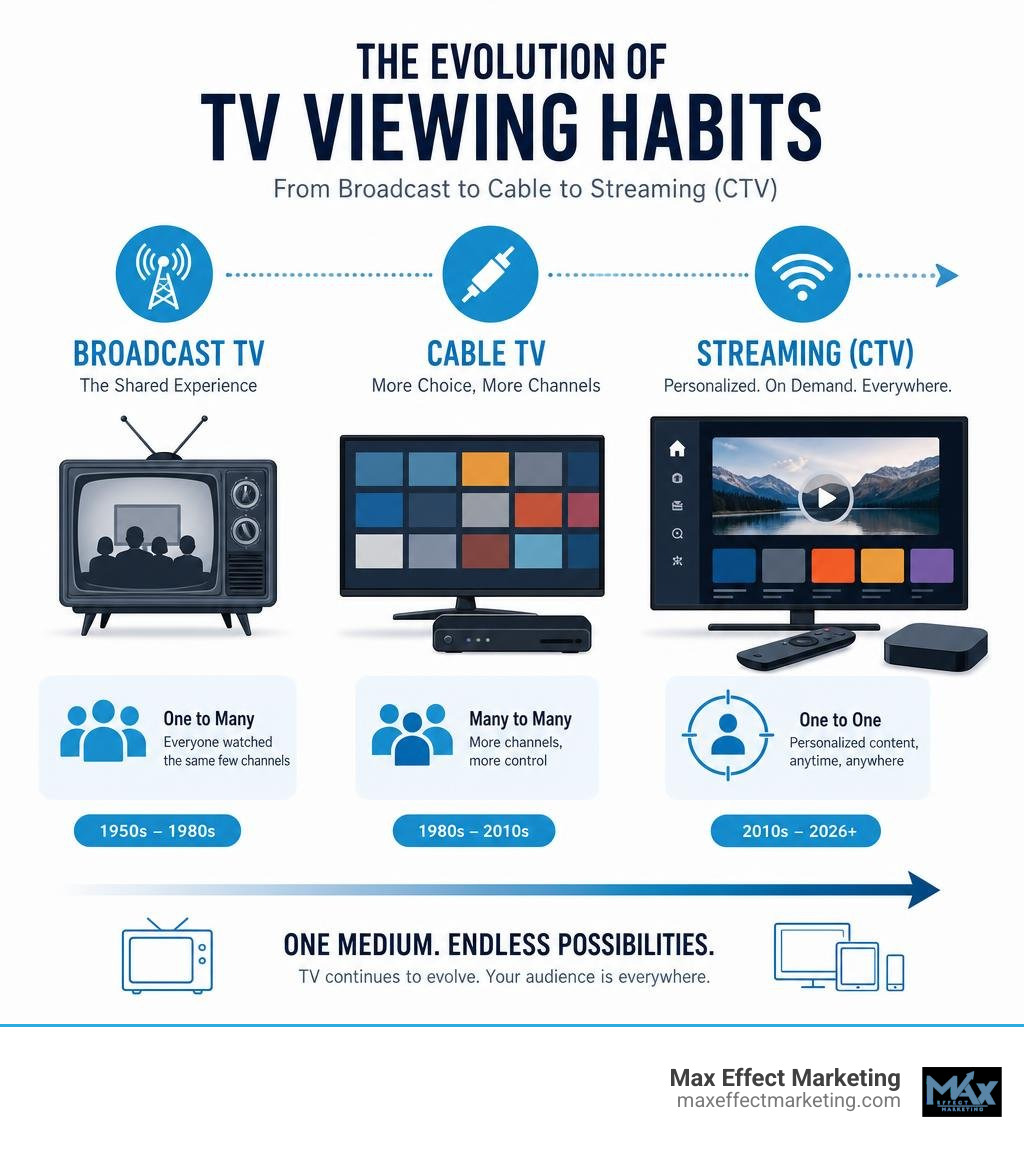
The old model was simple: buy a primetime spot, reach millions, repeat. It worked when 52 million American households all watched the same three channels. Today, streaming accounts for nearly 40% of all TV viewing — and according to Nielsen, it overtook cable and broadcast combined for the first time in 2024. Viewers bounce between Hulu, Max, Disney+, and a dozen other platforms. Reaching them now requires a completely different approach.
The good news? The new model is more effective, not less. You can target a specific household, measure actual outcomes, and spend your budget only on the people who matter to your campaign.
I’m David Bauer, VP at Max Effect Marketing, and I’ve spent 14+ years helping brands and campaigns build integrated advertising strategies — including television campaign strategies that connect broadcast reach with the precision of modern digital targeting. In this guide, I’ll walk you through exactly how to build one that works in 2026.
Why Your Television Campaign Strategy Must Evolve in 2026
If you are still using a television playbook written a decade ago, you are essentially trying to navigate a modern highway with a hand-drawn map from the 1950s.
Back in 1949, only 172,000 television sets had been sold in the United States. By 1953, that number had exploded to over 52 million. This rapid expansion birthed the golden era of linear broadcast TV—a time when a single, well-placed commercial could capture the attention of half the country overnight.
Fast forward to July 2026, and the landscape has completely fractured. While up to 90% of the US population still watches TV weekly in some form, how they watch is entirely different. Traditional broadcast and basic cable are no longer the default options. Streaming now accounts for nearly 40% of total TV viewing, driven by a massive influx of cord-cutters who have abandoned traditional cable packages entirely. In fact, roughly 60% of young adults in the US primarily watch TV via streaming services.
This shift does not mean television has lost its power. In many ways, modern TV is more potent than ever. To understand why, you can read A Practical Guide to Advantages of Advertising on Television, which outlines how television still commands unparalleled credibility and emotional resonance.
The core difference today is that a modern television campaign strategy must be multiscreen. It must bridge the gap between traditional linear broadcast and Connected TV (CTV) to capture viewers wherever they are watching. If you rely solely on traditional broadcast, you miss the millions of cord-cutters who live entirely on streaming apps. If you rely solely on streaming, you may miss the broad, trusted reach that local broadcast news and live sports still deliver to older, highly engaged demographics.
Traditional TV vs. Streaming TV: Choosing Your Battlefield
To build an effective media plan, you must understand the key differences between traditional broadcast TV and modern streaming/Connected TV (CTV). They are not competing mediums; rather, they are different tools in your marketing toolkit.
Traditional TV is built around broad, content-based reach. You buy ad space on a specific network, during a specific program, hoping that the viewers watching match your target audience. It is excellent for mass awareness but comes with significant geographic and demographic waste.
Streaming TV (CTV), on the other hand, operates like digital advertising. Instead of buying a show, you buy an audience. It does not matter if your target viewer is watching a prestige drama on Hulu, a live football game on Peacock, or a classic movie on Pluto TV—the ad follows the viewer.
| Feature | Traditional Broadcast & Cable | Streaming & Connected TV (CTV) |
|---|---|---|
| Primary Targeting | Broad demographics (e.g., Adults 25-54), show genres, and broad geographies (DMAs). | First-party data, voter files, household-level addressability, and specific ZIP codes. |
| Pricing Models | Fixed rates based on estimated ratings and programming. | Dynamic CPMs (Cost Per Thousand impressions) based on audience demand. |
| Ad Delivery | Linear programming; everyone watching the channel sees the identical commercial. | Addressable; different households watching the same show see different ads. |
| Measurement | Delayed third-party ratings (Nielsen), estimated reach, and post-campaign surveys. | Real-time digital metrics, website attribution, foot traffic lift, and persuasion studies. |
| Creative Turnaround | Typically 5 to 10 days for network approval and trafficking. | Rapid deployment; often 24 to 48 hours to update or swap creative variations. |
Navigating these differences is crucial for budget efficiency. To get a clear picture of what you can expect to spend on these platforms, check out The Complete Guide to OTT and CTV Ad Rates as well as our breakdown on Don’t Break the Bank: What It Really Costs to Run a Commercial on TV.
The real magic happens when you move away from the “spray-and-pray” demographic buckets of traditional TV and embrace laser-focused digital targeting. Instead of paying a premium to show your ad to an entire metropolitan area, CTV allows you to target only the households that match your exact customer profile or voter universe.
Setting Goals and Allocating Budgets Across Screens
Every successful campaign starts with a clear commercial or political objective. You cannot build a media mix until you know what you are trying to achieve.
Are you trying to drive immediate foot traffic to a local retail chain? Are you launching a new product nationwide? Or are you trying to persuade a narrow universe of undecided swing voters in a highly competitive congressional district?

One of the most common mistakes campaigns make is failing to account for geographic mismatches, particularly in political races. A traditional Designated Market Area (DMA) is massive. For example, if you buy a broadcast spot in the Chicago DMA to reach a single congressional district, up to 87% of your impressions are wasted on viewers who live outside that district.
To solve this, modern television campaign strategies must rely on precise geographic and audience allocation. This is why tools like the Congressional Campaign CTV Strategy (2026 Guide) and the Gubernatorial Campaign Advertising: Statewide TV (2026) have become industry standards for navigating complex, overlapping media markets.
Designing a Television Campaign Strategy for Commercial Brands
For commercial brands, the primary goals of a TV campaign are usually brand recall, digital search lift, and physical foot traffic.
When planned correctly, television has a powerful “halo effect” that legitimizes and boosts the performance of all your other digital channels. When a consumer sees your ad on the big screen in their living room, they are far more likely to click on your search or social ads later that day.
We have seen this play out in real-world campaigns:
- The Pizza Franchise Success: A regional pizza franchise wanted to drive mid-week sales. By running highly localized CTV ads on Monday through Wednesday targeting families within a 5-mile radius of their stores, they achieved a 31% increase in foot traffic—representing 12,195 additional physical store visits. For more on how to execute this, read our guide on Convenience Store TV Commercials That Drive Foot Traffic.
- The Premium Retail Growth: A luxury heritage retailer like Brooks Brothers used targeted OTT ads to reach over half a million millennial households. By focusing strictly on this high-value demographic rather than broad age brackets, they grew their revenue by 46% while the campaign was running.
- The Streaming Efficiency: Brands are increasingly utilizing platforms like Hulu to reach highly engaged audiences without paying traditional broadcast premiums. You can read The Ultimate Guide to the Cost of Hulu Ads to see how accessible these premium placements have become for mid-market brands.
Tailoring Your Television Campaign Strategy for Political Races
In political campaigns, the goal is not to sell a product, but to win a specific number of votes. With political ad spending projected to reach a staggering $10.8 billion in the 2026 midterm cycle, campaigns cannot afford to waste a single dollar on non-voters.
According to research on 2026 Midterm Campaigns | Comcast Advertising, voters trust television far more than social media. In fact, voters are 95% more likely to view TV ads as authentic and show nearly three times more confidence in the accuracy of information delivered via TV compared to social platforms.
To win in this environment, campaigns must transition from broadcast-only plans to data-driven, multiscreen campaigns. By matching voter-file data directly to household viewing data, political campaigns can target specific “persuasion universes”—undecided voters who actually hold the key to the election—while completely bypassing households that are already locked-in or ineligible to vote.
The financial efficiency of this shift is dramatic. In competitive House races, the cost per persuaded voter on CTV typically ranges from $15 to $45. On traditional broadcast TV, that same persuaded voter costs between $80 and $150 due to massive geographic waste.
Advanced Targeting and Digital Integration
A modern TV campaign should never exist in a vacuum. It must be integrated into a unified go-to-market system where television creates the demand, and digital channels capture it.
When a viewer sees your ad on their smart TV, they are likely holding a secondary device like a smartphone or tablet. By utilizing cross-device measurement and digital retargeting, you can serve a complementary digital ad to that same household’s mobile devices within minutes of them seeing your TV spot.
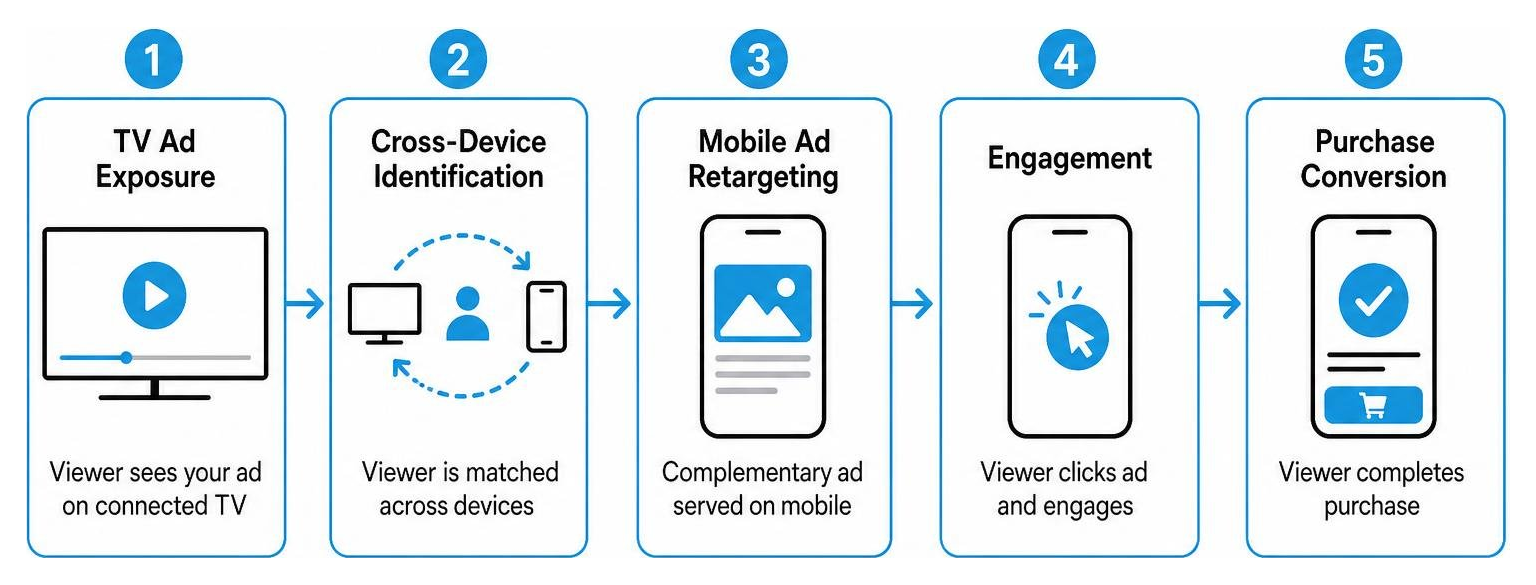
This multi-screen approach creates a powerful multiplier effect. To implement this cost-effectively, campaigns are increasingly turning to platforms like YouTube TV and Pluto TV to capture cord-cutters on a budget. You can learn more about these strategies in our guides on YouTube TV Ads: What You’ll Pay to Reach Cord Cutters and Pluto TV Ads: Reach Cord Cutters on a Budget.
However, many brands still struggle with this integration. If you want to avoid the most common pitfalls, read TV Advertising Strategy: What Most Brands Get Wrong, which explains why running TV without a downstream digital demand capture plan (like search engine optimization) essentially hands your generated leads directly to your competitors.
Measuring Impact and Attribution
How do you know if your TV campaign is actually working? Historically, TV measurement was a guessing game based on delayed ratings and estimated reach. Today, we can measure TV with the same precision as digital marketing.
By utilizing deterministic attribution models, we can track exactly what a viewer does after seeing an ad. We can measure:
- Digital Uplift: The spike in website traffic, search volume, or app downloads during and immediately after your ad airings.
- Foot Traffic Attribution: Tracking whether mobile devices exposed to your TV ad subsequently visited your physical store locations.
- Persuasion Lift: Running matched-market testing to measure the actual change in brand favorability or voter support between an exposed audience and a control group.
To find the right partners and tools to track these metrics, check out A Quick Start Guide to Comparing TV Ad Service Providers.
Creative Best Practices: Making Ads That Stick
You can have the most sophisticated targeting and the largest budget in the world, but if your creative is boring, confusing, or unmemorable, your campaign will fail.
In a world of fragmented attention, your creative must work harder than ever. For a structured look at how to plan your production process, you can read Planning a Successful Television Advertising Campaign — WriteUpCafe.
Storytelling and Ad Length
People do not like being sold to anymore. The most effective TV commercials do not feel like hard-sell pitches; they feel like stories.
Because streaming viewers have their fingers resting on skip buttons or are easily distracted by their phones, you must capture their attention immediately. You cannot afford a slow, cinematic build-up. You must place your hook—and your brand identity—in the first 5 seconds of the commercial.
Keep your message incredibly simple. Do not try to explain five different product features or three different political platforms in a single 30-second spot. Focus on one central emotional message, and make sure your call to action (CTA) is clear, simple, and easy to follow.
If you are running ads on premium streaming platforms, you can learn how to tailor your storytelling for high-end environments in our guide to Prime Video Ads: Your Brand Alongside Premium Content.
Production Quality vs. Authenticity
Many local businesses and down-ballot campaigns assume they cannot afford TV advertising because of high production costs. They believe they need a glossy, multi-million-dollar commercial to compete.
This is a myth. In 2026, authenticity often outperforms high production value. Viewers are highly sensitive to overly polished, corporate-style commercials. They crave real, relatable content.
Consider the case of a local HVAC company. Instead of running a standard, glossy commercial promoting a “10% off service calls” discount, they created a simple, authentic spot showing a local technician helping an elderly neighbor fix her air conditioning during a summer heatwave. The ad was warm, genuine, and focused on community care. It outperformed their previous discount-driven promotions by a massive 400%.
For local and regional brands, investing in a simple, heartfelt story told by real people will always deliver a higher return on investment than a flashy, expensive production that lacks soul.
Frequently Asked Questions about TV Advertising
How much does it cost to run a TV commercial?
The cost of running a TV commercial is split into two parts: production and airtime. Production costs can range from a few thousand dollars for a simple, authentic local spot to hundreds of thousands for a national brand campaign. Airtime rates vary wildly based on the platform. Traditional local broadcast and cable spots can be purchased for as little as a few hundred dollars per spot in smaller markets, while premium streaming CTV campaigns are typically priced on a CPM basis, usually ranging from $15 to $35 per thousand impressions.
How do you measure the ROI of a TV ad campaign?
We measure TV campaign ROI by connecting TV airings to digital and physical actions. By using digital tracking pixels, automated IP matching, and device graph data, we can attribute website visits, online purchases, search volume spikes, and physical foot traffic directly to the households that saw your TV commercial.
Is traditional broadcast TV still relevant in 2026?
Yes, traditional broadcast TV remains highly relevant, but its role has changed. Broadcast is no longer the sole anchor of a campaign; instead, it serves as a powerful tool for achieving rapid, broad reach among specific demographics, particularly older voters and live sports fans. A winning modern strategy combines this broad broadcast reach with the surgical targeting of streaming CTV.
Conclusion: Let’s Maximize Your Effect
Building a television campaign strategy that actually works in 2026 requires a careful balance of art and science. It requires creative storytelling that connects with real people, combined with the data-driven precision of modern multiscreen targeting.
At Max Effect Marketing, we are an AI-powered digital marketing agency designed to help businesses and campaigns generate real revenue and win races. We do not believe in vanity metrics or wasteful “spray-and-pray” media buys. Our unique approach combines intelligent, data-driven technology with genuine human partnerships to deliver an average of 5X ROI for our clients.
Whether you are looking to launch your first localized streaming campaign, integrate your TV ads with a cross-device digital retargeting flow, or build a winning statewide media plan, we are here to help you navigate the modern landscape.
Ready to build a television campaign that drives real, measurable results? Explore our additional services today, and let’s start crafting a strategy that maximizes your impact.