Why You Need to Market Your Event Before It’s Too Late
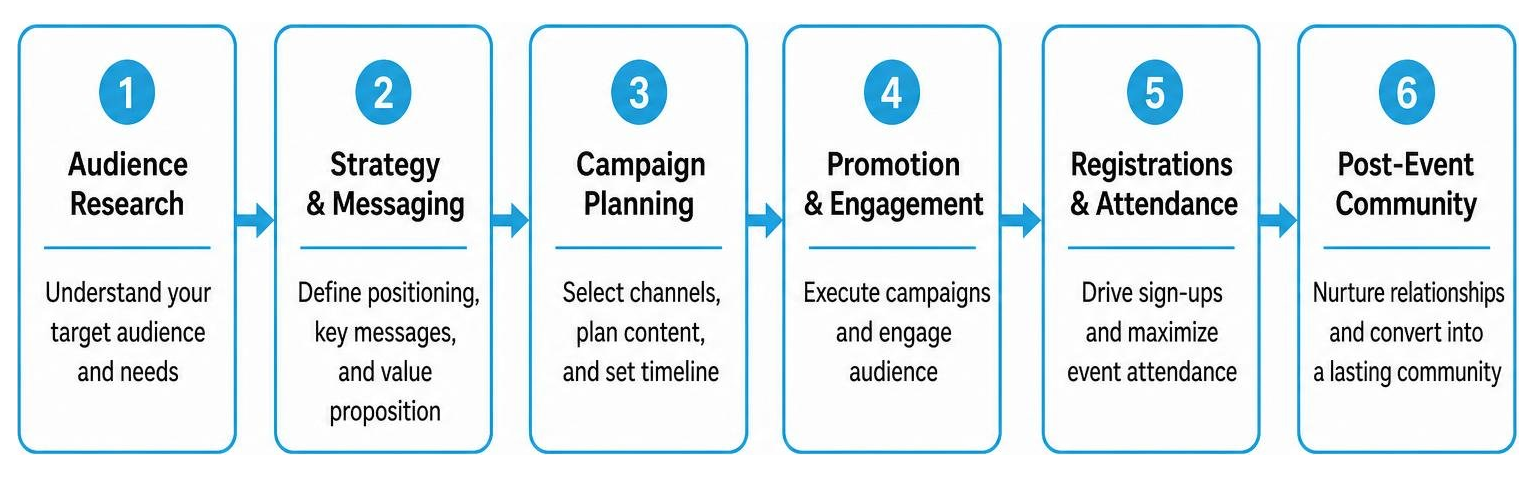
To market your event effectively, here are the core steps:
- Define your audience — know exactly who you’re trying to reach
- Build a value proposition — explain why your event is worth their time and money
- Set SMART goals — specific, measurable targets guide every decision
- Choose your channels — social media, email, SEO, paid ads, and partnerships
- Start early — begin promoting at least 12 weeks out
- Track and adjust — monitor registrations, open rates, and conversions in real time
You’ve locked in the venue. The lineup is set. Every detail is polished. But none of that matters if the room is empty.
That’s the harsh reality of event marketing in 2026. Your event isn’t just competing with other events — it’s competing with Netflix, TikTok, and every other claim on your audience’s attention. Even a brilliant event concept will quietly fail without a structured marketing system behind it.
The good news? Most events fail for predictable, fixable reasons. Starting too late. Relying on a single channel. Ignoring the checkout experience. These are all solvable problems.
This guide walks you through exactly what works — from building your foundation weeks out, to filling seats in the final days.
I’m David Bauer, VP at Max Effect Marketing, and I’ve spent 14+ years running high-performance advertising campaigns on Google and Meta that help businesses drive real conversions — including campaigns designed to market your event to the right audience at the right moment. Everything in this guide is built on what actually moves the needle.
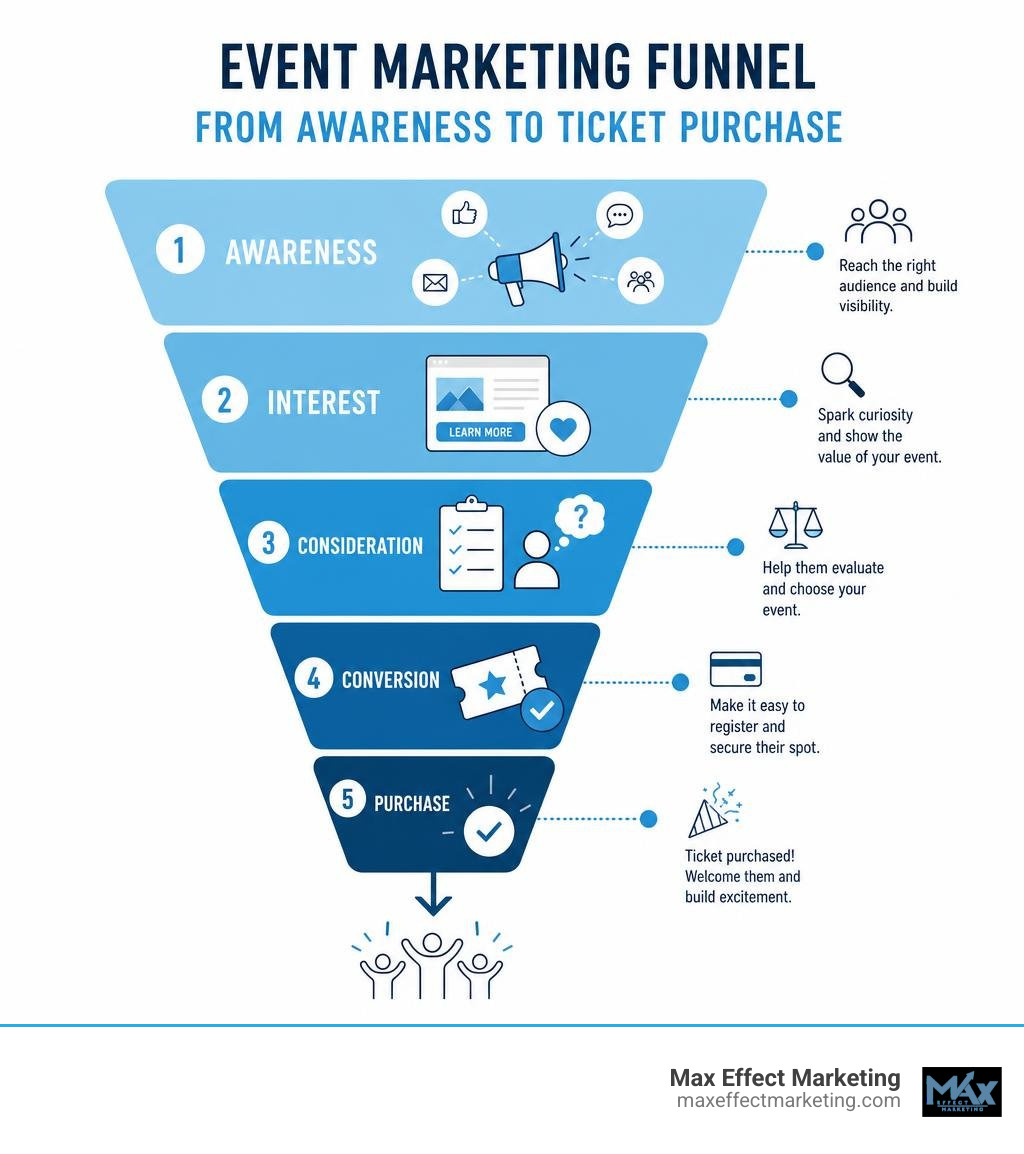
The Foundation: What to Do Before You Market Your Event
Before you run a single ad, write an email, or pitch a local influencer, you need to step back and build your foundation. Too many organizers jump straight into execution mode without understanding the psychology of their buyers.
Let’s face it: people do not buy tickets because your event exists. They buy because of what the event does for them. Does it offer them professional networking that could land them their next job? Does it give them a night of unbridled fun with their friends? Does it make them feel like they are part of an exclusive, forward-thinking community?
To tap into buyer psychology, you must first define your event’s identity. This means answering three core questions:
- Who is this event specifically for?
- What is the core purpose of this gathering?
- What exact feeling or outcome should people walk away with?
Once you have these answers, you can draft a crystal-clear value proposition. A simple, highly effective template to use is:
“For {target audience}, {event name} is the {type of event} that delivers {specific outcome or feeling} because {unique reasons}.”
For example: “For mid-career software engineers in Denver, DevSummit 2026 is the hands-on tech conference that delivers real, practical AI skills you can use on Monday because every session is led by working lead developers, not theorists.”
With your value proposition locked in, you can begin crafting your target audience personas.
Defining Your Target Audience and Compelling Message
A target audience persona is a semi-fictional representation of your ideal attendee. To build one, look past basic demographics like age and zip code. Dive deep into their pain points, motivations, and behaviors.
- Demographics: Where do they live? What is their job title? What is their disposable income?
- Pain Points: What are they struggling with? If it is a B2B conference, maybe they feel stuck in their career. If it is a local food festival, maybe they are tired of boring weekend routines.
- Motivations: What drives them? Is it status, connection, education, or pure entertainment?
Once you understand your persona, you can align your messaging through consistent verbal and visual branding.
Verbal branding is all about the specific vocabulary you use. For instance, calling your event a “gathering” or an “intimate summit” creates a welcoming, exclusive atmosphere, whereas calling it an “expo” or “trade show” signals scale and industry authority. Make sure your tone of voice matches your audience’s expectations.
Visual branding is equally vital. Your event logos, color schemes, and promotional graphics must look polished and professional. If your event page looks like it was thrown together in five minutes on a buggy website, potential attendees will immediately lose trust.
Setting SMART Goals and Budgeting Wisely
You cannot measure success if you do not define it. Before launching your campaign, establish clear targets using the SMART framework (Specific, Measurable, Attainable, Relevant, and Time-bound).
Instead of saying, “We want to sell out our event,” a SMART goal would be: “We want to secure 500 paid registrations from target industry professionals by September 15, 2026, using email campaigns and localized social media advertising.”
Your goals will dictate your budget. How much should you actually spend to market your event?
According to HubSpot data, you should allocate 10% to 15% of your total event budget for marketing a recurring event, and 15% to 20% for a brand-new event.
Events are a massive investment. In fact, 14% of marketing budgets are spent on event marketing, making events the second-largest expenditure behind online advertising. Furthermore, experiential marketing ranks as the most successful marketing tactic for industry professionals, and the majority of experiential budgets (24%) go directly to events.
To explore how these budgets fit into a broader, high-converting digital strategy, you can read more in The Complete Event Marketing Playbook: From Idea to Ticket Sales.
Building the Ultimate 12-Week Event Marketing Timeline
Successful event promotion is not a single sprint; it is a structured, multi-phase marathon. To keep your team on track and prevent last-minute panic, you need a comprehensive 12-week marketing calendar.
This timeline is designed to navigate the predictable “Ticketing Lifecycle.” Every event organizer experiences a similar pattern: an initial sales spike upon announcement, followed by a deep, quiet mid-campaign lull (often called “the doldrums,” where up to 40% of events sell less than half their tickets), followed by a massive last-minute buying spike in the final week.
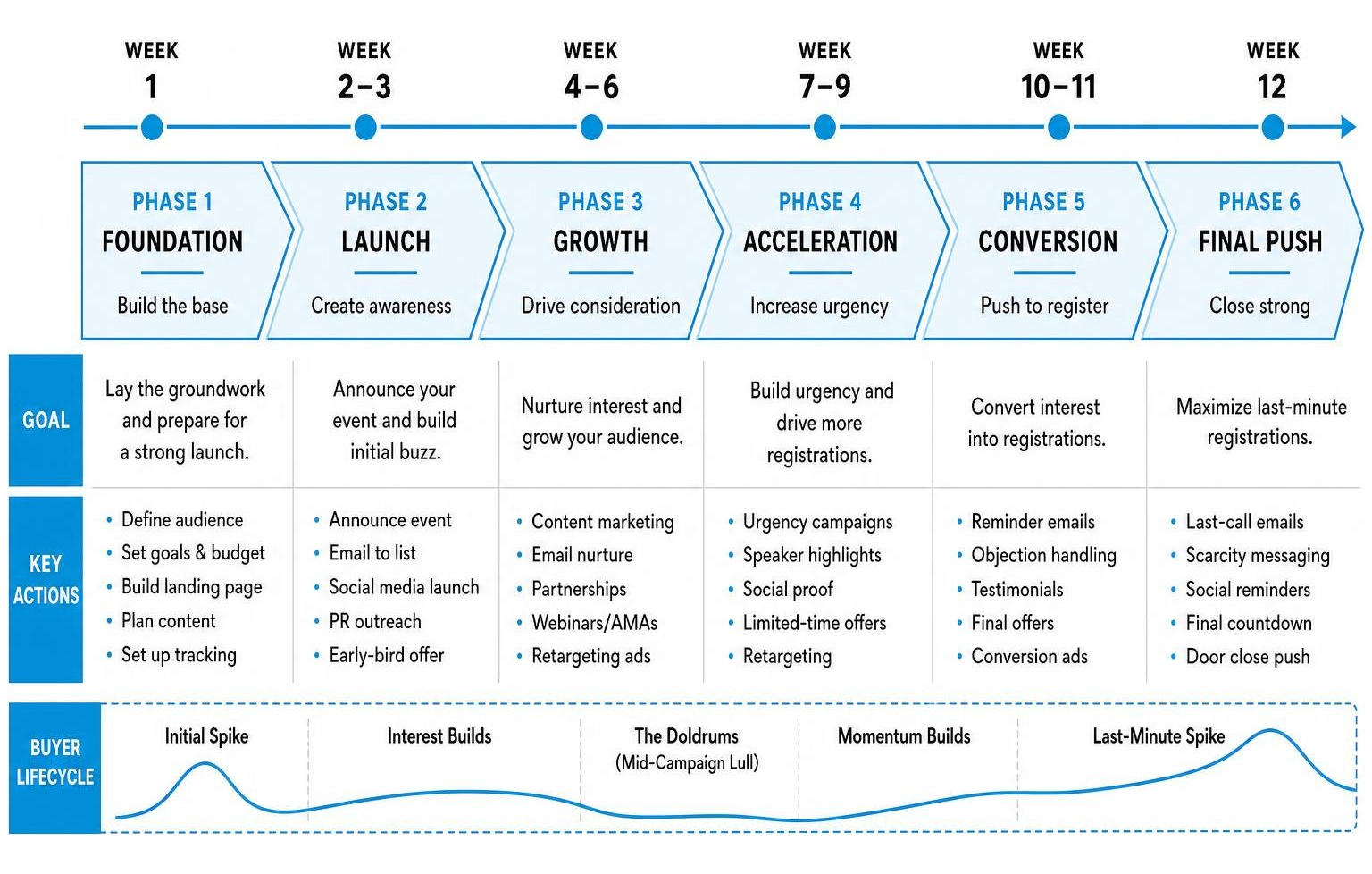
Understanding why people buy at different times allows you to tailor your messaging perfectly.
| Buyer Type | Core Motivations | Best Marketing Tactics |
|---|---|---|
| Early-Bird Buyers | Price sensitivity, planning-oriented, desire for exclusive bonuses, high trust in the brand. | Limited-time discounts, exclusive perks (e.g., free merch, early entry), countdown timers. |
| Mid-Campaign Buyers | Interest in specific speakers/lineups, social proof, alignment with personal schedules. | Staggered lineup announcements, behind-the-scenes content, attendee testimonials. |
| Last-Minute Buyers | Urgency, FOMO (Fear Of Missing Out), seeing friends post about attending, spontaneous weekend planning. | Scarcity messaging (“Only 15 tickets left!”), peer-to-peer referral incentives, direct SMS pushes. |
Weeks 12 to 8: Laying the Foundation and Launching Early Bird Tiers
The 90-to-60-day window is the single most critical phase for building the “engine” of your campaign. If you wait until two weeks before the event to start marketing, you have already lost valuable momentum.
First, build your dedicated ticketing page. This page must be a frictionless hub of information. Do not force users to leave your page to search for basic details like parking, schedules, or refund policies — doing so will kill your conversion rates. Research shows that 48% of ticket buyers abandon checkout due to unexpected fees added at the very end of the purchase process, and 34.8% abandon due to dynamic or demand-based pricing. Be transparent about costs upfront.
Next, launch your Early Bird ticket tiers. Offer a genuine discount (typically 15% to 25% off the general admission price) or a high-value bonus, such as exclusive merchandise or VIP lounge access.
Use urgency and scarcity tactics to drive immediate action. Communicate clear, non-negotiable deadlines (e.g., “Early Bird pricing ends Friday at midnight”). A ticking clock is your absolute best friend when it comes to driving impulse ticket buys.
For a deeper dive into laying this early groundwork, check out the Ultimate Event Marketing Guide Part 1 | Promoting Your Event 90–60 Days Out | Evvnt.
Weeks 8 to 1: Building Momentum and Driving Urgency
Once your early-bird window closes, you enter the momentum-building phase. This is where you fight the mid-campaign sales lull by executing a structured content calendar.
Instead of exhausting all your promotional ammunition at launch, stagger your announcements. Share a new speaker, highlight a specific food vendor, or reveal a support act every week. Each of these announcements creates a fresh “content moment” to share across your channels.
Use countdown photos and short-form videos on social media to build anticipation. Share behind-the-scenes clips of the venue setup, rehearsals, or interviews with your speakers.
As you enter the final month (Weeks 4 to 1), shift your messaging from consideration to urgency. Use honest scarcity warnings (e.g., “Tier 2 tickets are 90% sold out”). Run targeted email campaigns and SMS alerts to remind warm leads that time is running out.
High-Impact Channels to Drive Ticket Sales
To successfully market your event, you cannot rely on a single promotional channel. You need an integrated, multi-channel approach that captures your target audience wherever they spend their time online.
However, driving traffic to your event page is only half the battle. You must also focus on conversion rate optimization (CRO). Your conversion rate represents the percentage of website visitors who actually register or buy a ticket.
A major, often overlooked killer of event conversion rates is technical performance. Did you know that a mere 1-second delay in page load time can decrease conversions by 7% to 10%? On the flip side, speeding up your registration page by just 500 milliseconds can boost conversions by up to 3%.
Ensure your event page is lightweight, fast, and fully optimized for mobile responsiveness, as more than half of your potential attendees will browse and buy on their smartphones.
Leveraging Social Media and Email to Market Your Event
With the average person spending 2 hours and 23 minutes every day on social media, these platforms are essential for building buzz.
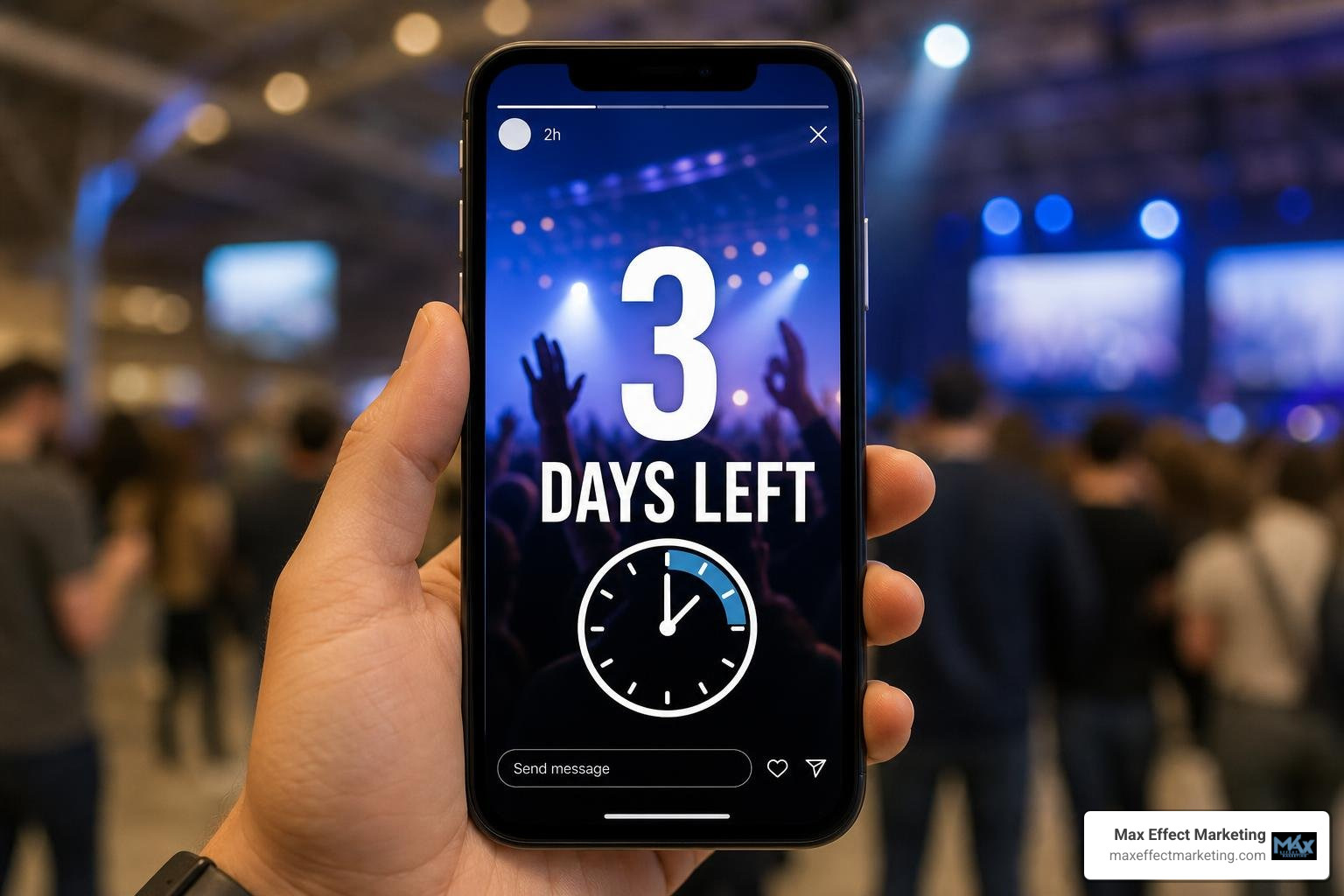
To maximize your organic reach, tailor your content to each platform’s unique strengths:
- Instagram Reels & TikTok: These are absolute necessities if you want to reach an audience under 35. TikTok’s algorithm rewards raw, authentic, and unpolished video content. A quick, genuine smartphone video of your event prep will often outperform a slick, highly produced promotional edit.
- Facebook Events: Create a dedicated Facebook Event page and add your co-hosts, sponsors, vendors, and performers. This allows your event to appear in their followers’ feeds organically. Facebook is a massive revenue driver, generating an average of $4.15 in future ticket sales per share.
- LinkedIn: If you are marketing a B2B conference or professional networking event, LinkedIn is your goldmine. Share thought-leadership articles, speaker highlights, and industry insights.
While social media is great for awareness, email marketing remains your highest-converting channel because it bypasses unpredictable algorithms and lands directly in your audience’s inbox.
Avoid sending generic, mass email blasts to your entire list. Instead, segment your subscribers based on their interests, job titles, or past attendance history.
Set up automated email sequences to nurture leads:
- The Announcement Email: Share the event vision and launch early-bird tickets (this email typically drives 30% to 50% of all email-driven sales).
- The Nurture Email: Share valuable content, speaker spotlights, or behind-the-scenes stories to build interest.
- The Final Push Email: Send this 5 to 7 days before the event, focusing heavily on urgency and ticket scarcity.
To understand how localized digital campaigns fit into your overall marketing ecosystem, explore our guide on Local SEO for Small Businesses: Why It Matters in 2026.
Search Engine Optimization (SEO) and Paid Digital Ads
Many attendees search for events organically. To capture this high-intent traffic, you need to optimize your event landing page for search engines.
Start by targeting localized keywords like “things to do in Denver this weekend” or “tech conferences Colorado 2026.” Incorporate these keywords naturally into your page titles, descriptions, and headers.
Additionally, implement Event structured data (schema markup) on your website. This technical SEO tactic helps Google understand your event details and feature your listing directly in local search results.
To amplify your organic efforts, run targeted paid digital ads:
- Meta Ads (Facebook & Instagram): Install the Meta Pixel on your event page. This allows you to run highly effective retargeting ads targeting people who visited your registration page but left without buying a ticket.
- Google Ads: Target users who are actively searching for keywords related to your event, ensuring your brand appears at the very top of search results.
At Max Effect Marketing, we specialize in building high-performing search engine campaigns that connect businesses with local customers. To see how we drive high-intent leads, check out our insights on Google Ads for Small Businesses: A Smart Way to Generate More Leads.
Leveraging Partnerships, Influencers, and Sponsors to Expand Reach
You do not have to build an audience from scratch. You can leverage the existing audiences of your partners, sponsors, and local influencers to expand your reach exponentially.

When partnering with influencers, look past follower counts. Micro-influencers (creators with 1,000 to 50,000 followers) deliver a far better return on investment for local events than national celebrities. Their audiences are highly engaged, niche-specific, and trust their recommendations deeply. Offer them complimentary VIP tickets, exclusive content, or affiliate commissions in exchange for authentic promotion.
Your sponsors and partners are also highly motivated to promote your event — after all, your success is their success. Make it as easy as possible for them to share your event by providing “sponsor promo kits.” These kits should include:
- Pre-made, professional Canva graphic templates in multiple sizes.
- Pre-written social media captions and email templates.
- A clear social media calendar with suggested posting dates.
Finally, turn your registered attendees into brand ambassadors. Implement a referral program that offers group discounts (e.g., “Buy 4 tickets, save 20%”) or rewards attendees with exclusive merchandise when they convince three friends to sign up. Word of mouth is a highly efficient engine for driving ticket sales.
Low-Cost and Free Promotional Strategies
If you are working with a tight budget, don’t worry. You do not need a multi-million dollar advertising budget to sell out your venue. There are plenty of highly effective, free platforms and creative organic tactics you can use to market your event successfully.
First, list your event on popular, free event discovery directories. These platforms already have millions of active users searching for things to do:
- Meetup: Perfect for community gatherings, professional networking, and hobbyist groups.
- Facebook Events: Crucial for local discovery and social sharing.
- Yelp & Craigslist: Highly effective for localized, community-focused events.
- Niche Platforms: Use specialized directories like Bandsintown for live music, or Resident Advisor for electronic music.
Additionally, partner with local businesses in your physical area. If you are hosting a local craft beer festival, ask neighborhood coffee shops, boutiques, and breweries to display physical flyers or posters. In exchange, offer them a handful of free general admission passes.
Creative and Free Ways to Market Your Event on a Budget
To stand out from the digital noise, try these highly creative, low-cost marketing hacks:
- Pinterest Visual Planning: Pinterest users are incredibly forward-thinking. In fact, 75% of event-related pins are saved 1 to 2 months before an event, and 25% are saved 2 to 4 months prior. Create visually stunning boards showcasing your venue, theme, and aesthetic to capture early planners.
- Spotify Playlists: If your event features live music, guest speakers, or a specific vibe, curate a custom Spotify playlist. Add your event details, dates, and a direct ticketing link to the playlist description. Spotify’s recommendation algorithm can help local music fans discover your playlist — and your event.
- Email Signatures: Update your professional email signature to include a small, eye-catching banner with your event date, time, and a direct link to register.
- Airbnb Host Partnerships: Reach out to local Airbnb hosts near your physical venue. Ask them to share your digital flyer or leave a physical poster in their guest welcome guide. This gets your event directly in front of out-of-town visitors looking for unique local experiences.
- QR Codes on Physical Flyers: Shorten the customer journey by placing a prominent QR code on all physical posters. This allows passersby to instantly scan the code and purchase tickets on their phones (the classic “See to Scan to Buy” journey).
To explore more creative organic marketing ideas, you can read the Event Marketing: Strategies to Promote Events Successfully.
Measuring Success and Post-Event Momentum
Once your event begins, your marketing doesn’t stop — it simply shifts phases. To maximize your long-term return on investment, you must continuously measure your success and leverage your current event to build momentum for the next one.
Track your key performance indicators (KPIs) in real time:
- Conversion Rates: What percentage of landing page visitors registered?
- Email Open and Click-Through Rates: Which subject lines and calls to action performed best?
- Ticket Sales Milestones: Did you hit your target sales numbers during your early-bird and mid-campaign phases?
Within 24 to 48 hours after your event ends, send out a post-event survey to all attendees. Ask them what they loved, what could be improved, and crucially: “How did you first hear about our event?” This feedback loop tells you exactly which marketing channels delivered the best results, allowing you to optimize your budget for future campaigns.
Finally, build your “marketing flywheel.” The morning after your event, while your attendees are still experiencing the post-event buzz, send a thank-you email featuring high-quality highlight photos or a quick recap video.
Use this moment of peak engagement to offer a “loyalty discount” or early-bird waitlist sign-up for your next event. By capturing their excitement immediately, you turn one-time attendees into lifelong advocates.
Frequently Asked Questions about Event Marketing
How much of my budget should I allocate to event marketing?
According to HubSpot budget data, you should allocate 10% to 15% of your total event budget to marketing if it is a recurring event. If you are launching a brand-new event, increase this allocation to 15% to 20% to build initial brand awareness and trust.
What is the highest-converting channel for event promotion?
Email marketing is consistently the highest-converting channel for event promotion. Because email lands directly in a subscriber’s inbox, it bypasses social media algorithms and allows you to nurture warm leads with personalized, segmented messaging.
How does page load speed affect ticket sales?
Page load speed has a massive impact on conversions. A mere 1-second delay in page load times can decrease ticket conversions by 7% to 10%. Ensuring your registration page is lightweight, fast, and optimized for mobile devices is critical to preventing cart abandonment.
Conclusion
At the end of the day, meticulous planning, creative channels, and frictionless checkouts are what turn a date on the calendar into a packed, vibrant venue.
At Max Effect Marketing, we are an AI-powered digital marketing agency dedicated to helping businesses generate real revenue through data-driven campaigns. We combine intelligent technology with real human partnerships to achieve an outstanding 5X ROI for our clients.
Whether you are looking to drive local search traffic, launch high-converting paid social ads, or build a comprehensive digital strategy, we are here to help you fill every seat.
Are you Ready to Grow Your Business? Let’s partner together to make your next event a massive success. Explore our Online Campaigns today to get started!