
What You Need to Know About TV Ads for Pharmaceutical Companies
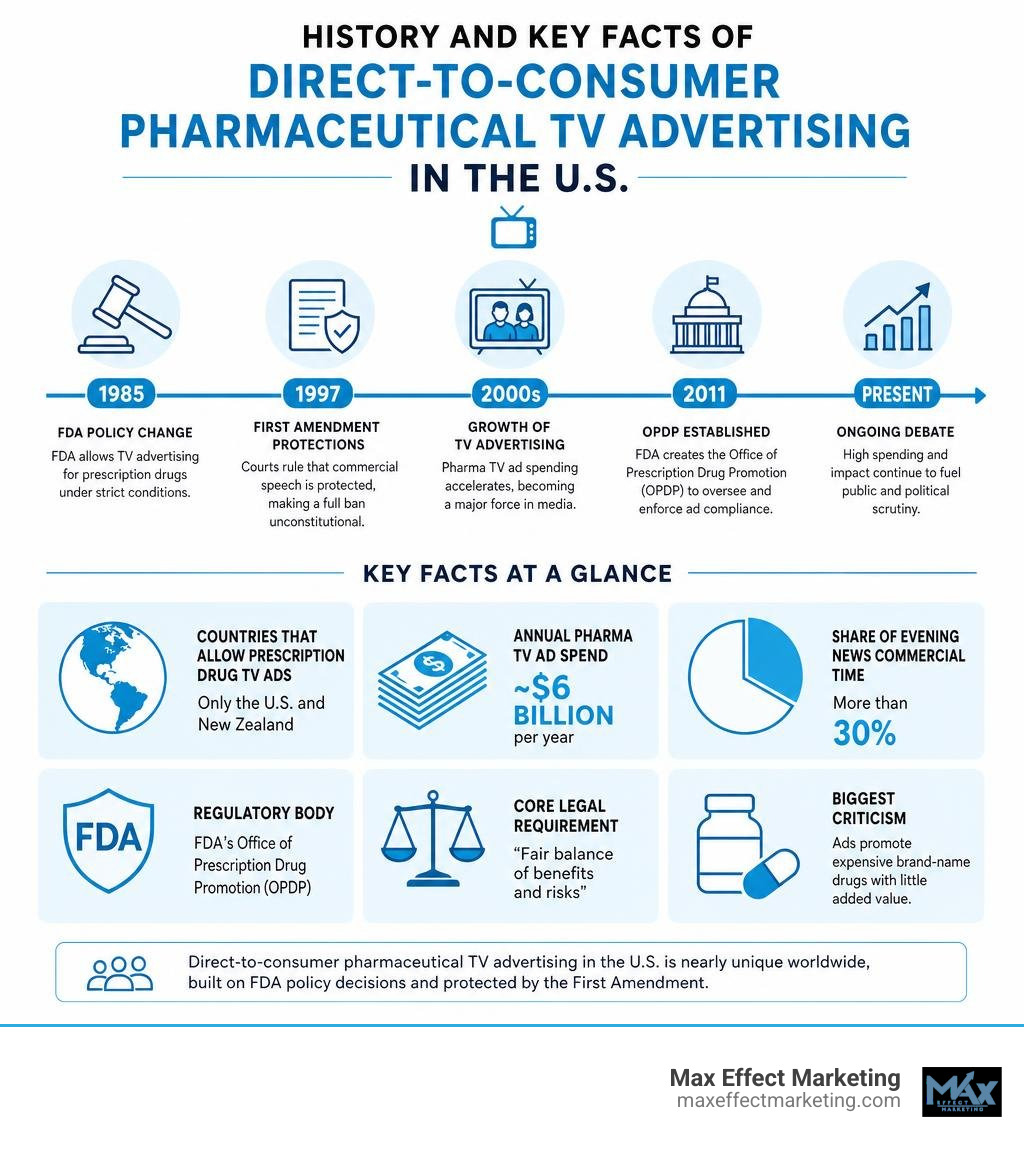
TV ads for pharmaceutical companies are one of the most regulated — and most debated — forms of advertising in the United States. Here is what you need to know at a glance:
| Key Fact | Detail |
|---|---|
| Countries that allow prescription drug TV ads | Only the U.S. and New Zealand |
| Annual pharma TV ad spend | ~$6 billion per year |
| Share of evening news commercial time | More than 30% |
| Regulatory body | FDA’s Office of Prescription Drug Promotion (OPDP) |
| Core legal requirement | “Fair balance” of benefits and risks |
| Biggest criticism | Ads promote expensive brand-name drugs with little added value |
The U.S. is almost alone in the world in allowing drug companies to advertise prescription medications directly to consumers on television. That is not an accident — it is the result of specific FDA policy decisions made in the 1980s and 1990s, backed by First Amendment legal protections that make a full ban extremely difficult.
Whether you are a marketer trying to understand compliance, or a business owner trying to make sense of how this industry spends billions on TV, this guide breaks it all down in plain language.
I’m David Bauer, VP at Max Effect Marketing, and I’ve spent 14+ years running advertising campaigns across television, digital, and integrated media — including for healthcare and regulated industries where TV ads for pharmaceutical companies intersect with complex compliance rules. I’ll walk you through exactly how these ads work, what the rules actually require, and what the ongoing political fight over them means for the industry.
Glossary for TV ads for pharmaceutical companies:
Why Are TV Ads for Pharmaceutical Companies Legal in the U.S.?

To understand why your favorite evening news broadcast is regularly interrupted by upbeat songs detailing terrifying lists of side effects, we have to look back at how the rules were written. For decades, direct-to-consumer (DTC) advertising of prescription drugs was practically impossible on television.
Historically, the 1938 Food, Drug, and Cosmetic Act gave the FDA authority over prescription drug labeling and advertising. Under early rules, if a drug manufacturer wanted to advertise a product, they were legally required to include a “brief summary” of every single side effect, contraindication, and warning associated with the medication. In print, this meant adding a page of tiny, unreadable text at the back of a magazine. On television, reading a multi-page document out loud would require a 10-minute commercial—which simply wasn’t financially feasible.
That all changed in 1997. The FDA issued a new ruling that allowed television and radio commercials to bypass the full “brief summary” requirement. Instead, manufacturers could present a “major statement” of the drug’s most important risks, provided they also made a “conspicuous disclosure” directing viewers to other sources for full prescribing information (such as a toll-free number, a website, or a print ad in a concurrently running magazine). This policy shift opened the floodgates, turning television into the primary battleground for pharmaceutical marketing.
Understanding these historical shifts helps clarify the broader advantages of advertising on television, where massive reach meets highly targeted messaging.
The Constitutional Shield of Commercial Speech
If you’ve ever wondered why Congress hasn’t simply banned these ads altogether like almost every other high-income nation, the answer lies in the First Amendment. In the United States, commercial speech—including advertising by corporations—is protected under the Constitution.
Over several decades, the Supreme Court has repeatedly ruled that truthful, non-misleading commercial speech cannot be easily banned by the government. If the FDA or Congress attempted a complete ban on TV ads for pharmaceutical companies, they would face immediate, highly organized, and likely successful legal challenges from the pharmaceutical industry.
To see how unusual this is, we only need to look across the globe. New Zealand is the only other developed, high-income country that permits direct-to-consumer prescription drug advertising on television. In every other major market—including the European Union, Canada, and Australia—the practice is strictly illegal. In those countries, medical information is expected to flow exclusively from healthcare professionals to patients, rather than through commercial broadcasts.
How the FDA Regulates TV Ads for Pharmaceutical Companies
While the FDA cannot easily ban these commercials, it does regulate them strictly through the Office of Prescription Drug Promotion (OPDP). The OPDP is responsible for ensuring that all promotional materials are truthful, balanced, and scientifically accurate.
One of the most important rules the FDA enforces is the “fair balance” doctrine. This regulation requires that a commercial present a balanced picture of both the drug’s benefits and its risks. The presentation of risk information must have comparable prominence, detail, and depth to the presentation of the benefits.

Surprisingly, the FDA does not actually pre-approve every drug commercial before it airs. Instead, manufacturers are required to submit their commercials to the FDA at the time of their initial broadcast. This retrospective review system means that a misleading or non-compliant commercial can run on national television for several months before the OPDP issues a warning or cease-and-desist letter.
A great example of how brands build landing pages to support these highly regulated TV spots can be found in the ENTYVIO TV Commercial for Crohn’s Disease & Ulcerative Colitis, which balances patient narratives with extensive, legally mandated safety disclosures.
The Multi-Billion Dollar Reality of Drug Commercials

Now that we know why these ads are legal, let’s look at the sheer scale of the money involved. The pharmaceutical industry is one of the largest buyers of television airtime in the world. Today, drug manufacturers pour roughly $6 billion a year into these ads.
This massive spending is highly concentrated. If you turn on a major network’s evening news program, you will quickly notice that prescription drug commercials account for more than 30% of all commercial time. This is because evening news programs draw an older demographic—the exact demographic most likely to require prescription medications.
For marketers looking to navigate this landscape, understanding how these budgets are allocated across traditional and digital formats is essential. You can learn more about how television and streaming budgets are structured in The Complete Guide to OTT and CTV Ad Rates.
The Top Spenders and Heavily Promoted Drugs
To give you an idea of how aggressive this spending can be, consider this: in the first three months of this year, Big Pharma spent more than $725 million advertising just 10 highly targeted drugs. In 2023, the top ten ad spenders alone accounted for $2.87 billion on TV ads.
These massive budgets are not spread evenly across all medications. Because generic drug manufacturers make very thin profit margins, they rarely advertise. Doing so would trigger a “free-rider” problem, where a generic company pays to advertise a molecule, only for consumers to buy a competitor’s cheaper generic version. Consequently, almost 100% of pharmaceutical TV ad spend is concentrated on expensive, newly patented, brand-name drugs.
A prominent example of this high-stakes marketing is the REXULTI® (brexpiprazole) | TV Commercial, which targets patients who are already taking an antidepressant but still experiencing ongoing symptoms, guiding them to a highly compliant digital destination.
Do TV Ads for Pharmaceutical Companies Drive Up Drug Costs?
A major criticism of DTC advertising is that it directly contributes to the skyrocketing cost of healthcare in the United States. While the ads themselves do not directly set the price of a drug—since U.S. drug prices are high primarily because the government does not negotiate them to the extent other countries do—they certainly drive up overall spending.
By heavily promoting brand-name drugs, these commercials encourage patients to ask their doctors for expensive, advertised medications instead of cheaper, equally effective generic alternatives. This shift in demand keeps profit margins incredibly high for brand-name manufacturers.
To put this in perspective, consider how U.S. drug prices compare to the rest of the world for heavily advertised medications:
| Medication Type | Monthly Cost in U.S. | Monthly Cost in Europe / UK |
|---|---|---|
| Popular Weight-Loss Drug A | ~$1,000 | ~$59 (Germany) |
| Popular Obesity Drug B | ~$1,349 | ~$92 (UK) |
While advertising budgets are massive, the sales they generate are even larger. For example, Merck spent $300 million marketing the painkiller Vioxx and made $2.5 billion in sales. In 2010, Eli Lilly spent $205 million on DTC ads for the antidepressant Cymbalta and generated $3.2 billion in sales. The return on investment for these campaigns is incredibly clear, which is why the spending continues to rise.
Deconstructing the Creative Strategies of Pharma Ads
Have you ever noticed how a pharmaceutical commercial seems to tell two completely different stories at the same time? While the voiceover actor calmly lists side effects like “sudden heart failure” or “internal bleeding,” the actors on screen are happily gardening, riding bicycles, or playing with puppies in a sun-drenched backyard.
This is not accidental. It is a highly calculated creative strategy rooted in cognitive psychology, specifically dual-coding theory and cognitive distraction.
When viewers are presented with highly positive visual imagery, their brains prioritize processing the visual information over the auditory warnings. The mismatch between the positive visuals and the negative side effects creates a cognitive buffer, making viewers up to 50% less likely to recall the side effects afterward. The visual-auditory mismatch allows companies to technically comply with the FDA’s “fair balance” requirements while minimizing the negative impact of those warnings on the viewer’s purchase intent.
To learn more about how premium video placements can help brands tell engaging stories, check out our guide on Prime Video Ads: Your Brand Alongside Premium Content.
The Art of the Side Effect Voiceover
The “major statement” segment of a commercial is a masterclass in risk mitigation. Advertisers use soothing, low-register music, warm color palettes, and relatable, active characters during the risk disclosure segment to keep the tone hopeful and reassuring.
A great example of this careful balancing act is the DAYBUE TV commercial | DAYBUE® (trofinetide), which must communicate complex pediatric treatment options and potential side effects while maintaining an encouraging, patient-centric narrative.
Unbranded Campaigns and Creative Metaphors
Not all pharmaceutical commercials promote a specific drug by name. In many cases, companies leverage “unbranded” disease awareness campaigns. These campaigns focus entirely on educating the public about a specific medical condition and directing them to a support website to find patient stories and tips.
Because these ads do not name a specific prescription drug, they are not subject to the same strict FDA risk-disclosure requirements. However, they successfully build top-of-funnel awareness and drive patients to speak with their doctors about potential treatments, which eventually leads them to the manufacturer’s branded product.
Other campaigns use creative visual metaphors to make uncomfortable or sensitive conditions easier to discuss. A highly successful example of this is the “Bent Carrot” campaign, analyzed in “Prime Time,” a Branded Peyronie’s Disease Commercial for XIAFLEX®, which uses simple visual metaphors and a couple’s journey to break down barriers to diagnosis and treatment.
The Battle Over Banning Prescription Drug Ads
The debate over TV ads for pharmaceutical companies has reached a boiling point in Congress. Recently, Senators Bernie Sanders (I-Vt.) and Angus King (I-Maine) introduced the End Prescription Drug Ads Now Act, a piece of legislation aimed at completely banning prescription drug advertising on television, radio, print, digital platforms, and social media.
Supporters of the ban argue that direct-to-consumer advertising drives up healthcare costs, leads to over-prescribing, and misleads patients. Opponents—primarily the pharmaceutical lobby and media networks—argue that the ads serve an educational purpose, empowering patients to seek help for underdiagnosed or stigmatized conditions.
Given the immense lobbying power of the pharmaceutical industry, which has one of the most well-funded operations in Washington, D.C., a complete ban faces an uphill battle. Even if it were to pass Congress, it would face immediate, severe constitutional challenges in the Supreme Court under the First Amendment.
The Impact on Patient Health and Prescribing Behavior
Do these ads actually make us healthier? The academic and clinical consensus is highly mixed.
On one hand, research shows that fewer than one-third of the most common drugs featured in direct-to-consumer television advertising were rated as having “high added value” for patients over existing, cheaper treatments. This suggests that the majority of ad spend is used to push expensive brand-name drugs that offer little therapeutic benefit over older, generic options.
On the other hand, these ads do play a role in patient empowerment. They can prompt patients to start conversations with their doctors about conditions they might otherwise be too embarrassed to discuss, such as depression, erectile dysfunction, or chronic gastrointestinal issues. However, because patients frequently request the specific brand-name drugs they saw on TV, doctors often face high pressure to prescribe medications that may not be the most cost-effective or medically necessary option.
Will the FDA’s New Enforcement Actions Actually Work?
In response to growing public concern, the FDA has announced plans to step up its enforcement of advertising guidelines, aiming to issue more cease-and-desist letters and warning letters to companies that use misleading visual tactics to downplay risks.
However, many industry experts believe these measures lack real teeth. The Office of Prescription Drug Promotion operates under tight budget constraints, making consistent oversight of the thousands of ads running across television, streaming, and social media platforms incredibly difficult to sustain. Without significant civil monetary penalties, warning letters are often viewed by large drug companies as simply the cost of doing business.
Frequently Asked Questions about Pharma TV Ads
Why do drug commercials always show happy people during side effect warnings?
This is a deliberate psychological technique known as visual-auditory mismatch. By showing positive visual imagery (like a family picnic or outdoor activities) while the voiceover reads the side effects, the advertiser distracts your brain. Because visual processing takes priority over auditory processing, you are far less likely to remember the risks of the medication.
Which countries besides the U.S. allow prescription drug TV commercials?
Only New Zealand legally permits direct-to-consumer television advertising for prescription medications. In every other developed country, including Canada, the UK, Australia, and the European Union, these commercials are strictly banned to ensure patients receive unbiased medical information directly from healthcare professionals.
Do these commercials actually help patients get diagnosed?
Yes, they can. For stigmatized or underdiagnosed conditions, TV commercials can raise awareness and empower patients to seek help. However, critics point out that they also drive over-prescribing of expensive brand-name drugs when cheaper, equally effective generic alternatives are readily available.
Conclusion
Navigating the rules of TV ads for pharmaceutical companies requires a delicate balance of creative storytelling, consumer psychology, and strict regulatory compliance. While the debate over their economic and public health impact continues, television remains one of the most powerful tools available for building broad brand awareness.
At Max Effect Marketing, we specialize in helping businesses cut through the noise and navigate complex advertising regulations. Our AI-powered digital marketing agency combines intelligent technology with real human partnerships to help you reach your target audience and generate measurable revenue, consistently achieving a 5X ROI on our campaigns.
Whether you are looking to launch a highly compliant video campaign or optimize your digital reach, we are here to help. To learn more about what it takes to build a successful campaign, check out our guide on Don’t Break the Bank: What It Really Costs to Run a Commercial on TV, or Contact Us today to start building your custom strategy!