
What Does OTT Advertising Actually Cost? (Quick Answer)
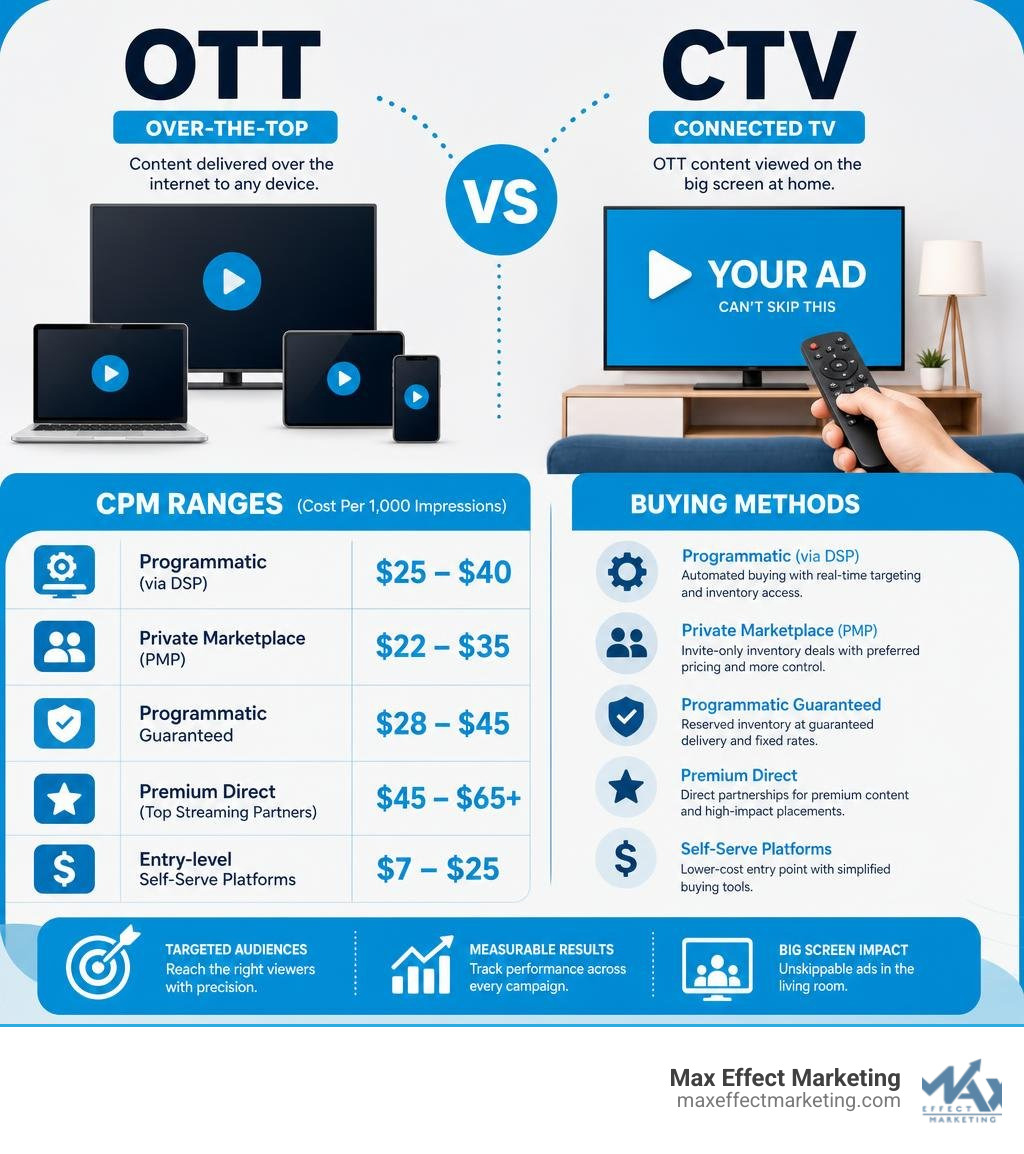
OTT advertising cost is measured in CPM – cost per 1,000 impressions. Here’s what you can expect to pay in 2026:
| Buying Method | Typical CPM Range |
|---|---|
| Programmatic (via DSP) | $25 – $40 |
| Private Marketplace (PMP) | $22 – $35 |
| Programmatic Guaranteed | $28 – $45 |
| Premium Direct (Hulu, Peacock, etc.) | $45 – $65+ |
| Entry-level self-serve platforms | $7 – $25 |
Minimum budgets to know:
- Meaningful test campaign: $15,000 – $25,000 over 4-6 weeks
- Local CTV awareness: $1,000 – $3,000/month
- Managed service platforms: $10,000 – $25,000/month minimum
If you’ve ever watched a show on Hulu, Roku, or Peacock and an ad played that you couldn’t skip, congratulations: you’ve seen OTT advertising in action. And if you’re a business owner, you’ve probably wondered what it costs to be on the other side of that screen.
Streaming now accounts for roughly 47% of all TV viewing in the United States. That’s not a trend anymore. That’s where your audience lives. Yet many business owners still assume OTT advertising is reserved for big brands with massive budgets, and that assumption is costing them.
The truth is more interesting. OTT pricing isn’t one number. It’s a range that shifts based on where you buy, who you target, when you run, and how you measure. Getting that equation wrong means burning budget. Getting it right means reaching viewers who can’t skip your ad, on their living room TV, at a CPM that can beat traditional television.
This guide breaks it all down in plain English: no jargon, no fluff, and no mysterious media-buying fog machine.
I’m David Bauer, Vice President at Max Effect Marketing, and over 14+ years of running advertising campaigns across television, digital, and streaming channels, I’ve helped businesses of all sizes navigate OTT advertising cost decisions without wasting money on impressions that go nowhere. I’ll walk you through everything you need to make a confident, informed decision.
For more context on related streaming and television ad costs, these guides can help you compare options before you build your budget:
Demystifying the OTT Advertising Cost: CPM Benchmarks and Pricing Models
When we talk about digital marketing, we are used to paying per click (CPC) or even per lead. But in Connected TV (CTV) and Over-The-Top (OTT) streaming, the king of currency is the CPM, or “Cost Per Mille” (which is just a fancy Latin-derived way of saying cost per 1,000 impressions).
When you purchase OTT inventory, you are paying for your video ad to be rendered on a viewer’s screen 1,000 times. But as you can see from our quick summary, not all thousands of impressions are created equal.
| Buying Channel | Average CPM (US) | Level of Targeting | Inventory Quality |
|---|---|---|---|
| Open Programmatic (DSP) | $25 – $40 | Extremely High (Behavioral, Demographic) | Mixed (FAST channels, long-tail apps) |
| Private Marketplace (PMP) | $22 – $35 | High (Curated packages) | Premium (Mid-tier publishers, niche networks) |
| Programmatic Guaranteed | $28 – $45 | High (Pre-negotiated audiences) | Very Premium (Reserved slots on major networks) |
| Direct Publisher Deals | $45 – $65+ | Moderate (Contextual, First-party) | Ultra-Premium (Hulu, Peacock, Max, Paramount+) |
Why is there such a massive gap between a $25 programmatic buy and a $65 direct deal? It comes down to control, context, and supply paths.
When you buy programmatically through a Demand-Side Platform (DSP), you are bidding in real-time on open inventory. It is highly efficient, but your ad might play on a lesser-known streaming app on a tablet. When you buy directly from a premium publisher, you are paying a premium to guarantee your ad runs during a hit show like Only Murders in the Building on a giant living room TV screen.
These pricing mechanics function dynamically under the hood, balancing real-time demand with the premium nature of the content being consumed.
Programmatic Buying vs. Direct Publisher Deals
To build a cost-effective campaign, we have to understand the three primary lanes of programmatic buying versus direct deals:
- Open Programmatic: This is the wild west of ad bidding. Your DSP evaluates millions of available ad slots in milliseconds, bidding on impressions that match your audience criteria across thousands of smaller apps and FAST (Free Ad-supported Streaming TV) networks. It offers the lowest entry barriers and the most flexible pricing, but you sacrifice some control over exactly which show your ad appears next to.
- Private Marketplace (PMP): Think of this as an invite-only VIP club. Premium publishers bundle their inventory and offer it to select advertisers via DSPs at a negotiated minimum price. You get better brand safety and premium environments without losing the programmatic targeting capabilities of your DSP.
- Programmatic Guaranteed: Here, you strike a deal with a publisher for a set number of impressions at a fixed price, but the transaction still executes programmatically. It secures high-demand inventory (like live sports or season finales) while allowing you to overlay your own audience data.
Integrating these various buying models into your broader Online Campaigns is where the magic happens. By blending highly targeted programmatic buys with selective premium placements, we can stretch your budget further while keeping your brand in top-tier environments.
How Platform Choice and Publisher Tiers Impact Your OTT Advertising Cost
Where your ad lives determines what you pay. Let’s look at the baseline CPMs for some of the biggest platforms in 2026:
- Hulu: As one of the pioneers of ad-supported streaming, Hulu commands some of the highest CPMs in the industry, typically ranging from $40 to $70. Why? Because they have highly engaged, non-skippable audiences watching premium, award-winning original programming. Learn more about budgeting for this giant in our guide on The Ultimate Guide to the Cost of Hulu Ads.
- Roku: Because Roku operates both as an operating system (on millions of smart TVs) and a publisher (The Roku Channel), their CPMs are incredibly competitive, sitting between $25 and $45. They offer fantastic first-party automatic content recognition (ACR) data, which helps target users based on what they watch on linear TV.
- Tubi & Pluto TV: These are FAST channels. Because they feature older, syndicated content rather than expensive original programming, their CPMs are highly budget-friendly, usually ranging from $20 to $40.
- Amazon Prime Video: With millions of subscribers transitioned to their ad-supported tier, Amazon has become an absolute powerhouse. They allow you to target viewers using real-world shopping data from Amazon.com. If you want your brand sitting alongside premium movies and Thursday Night Football, read up on Prime Video Ads: Your Brand Alongside Premium Content.
Linear TV vs. Connected TV: The Cost-Performance Showdown
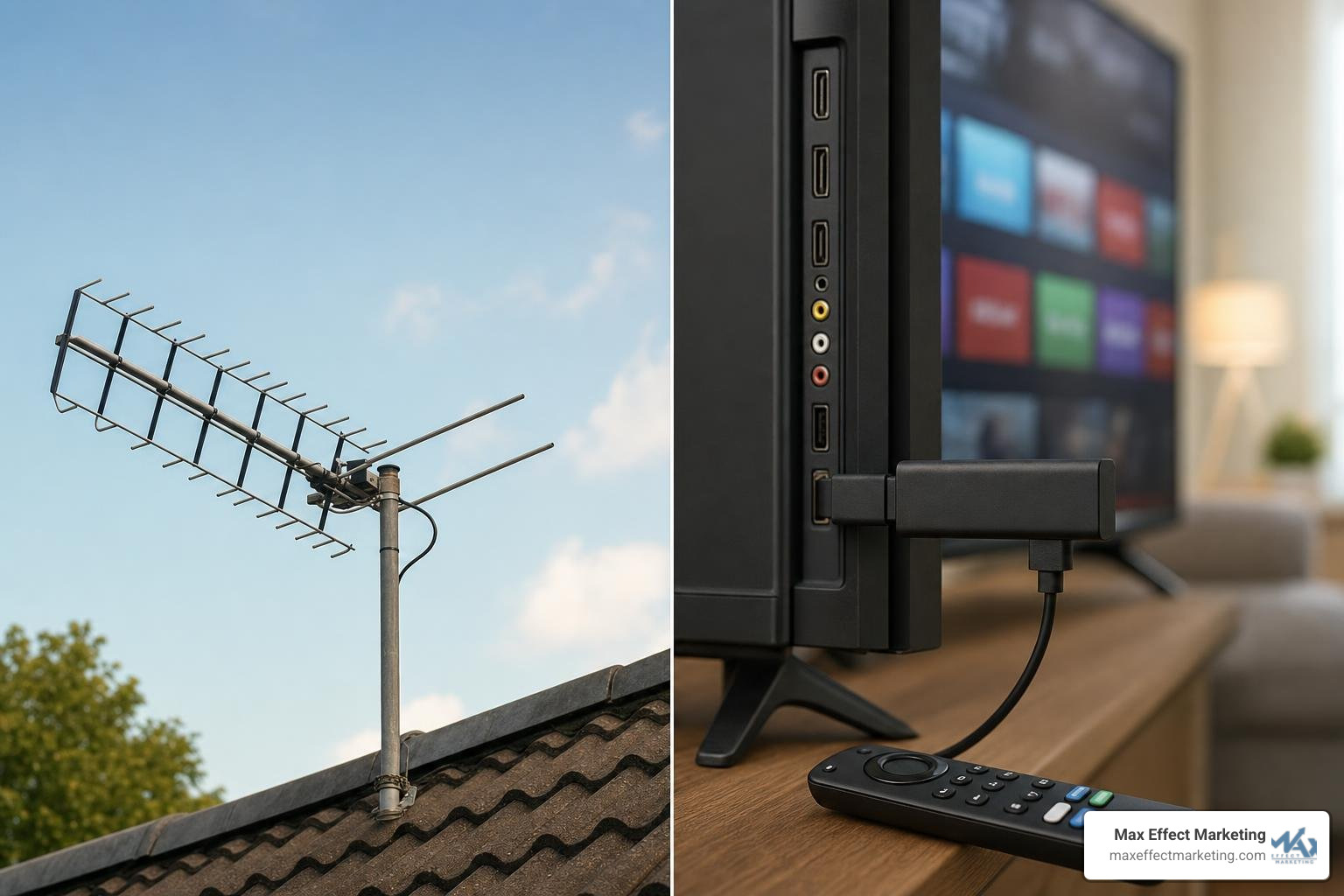
If you have ever bought traditional linear TV ads, you know the drill: you buy a package of spots on local cable or broadcast networks, usually based on ratings points (Nielsen data) and specific time slots. On paper, linear TV looks incredibly cheap. Cable TV CPMs can run as low as $19 to $36.
But there is a catch. A massive, budget-eating catch.
With linear TV, you are paying to show your ad to everyone watching that channel at that moment. If you own a high-end luxury kitchen remodeling business, and your ad runs during the local evening news, you are paying to reach renters, teenagers, and people who live outside your service area. That is what we call “ad waste.”
Connected TV (CTV) flips this model on its head. While the CPM is higher—typically $35 to $65—you only pay to show your ad to households that actually match your ideal customer profile.
Let’s look at how the performance metrics stack up:
- Completion Rates: On social media or YouTube, users can skip your ad after 5 seconds, or they scroll right past it. CTV ads are non-skippable, full-screen, and played in a “lean-back” environment. Because of this, CTV consistently delivers completion rates exceeding 90% (and often hitting 96% on premium platforms).
- Purchase Influence: Because streaming ads are highly targeted and delivered on the big screen, they drive massive action. Studies show that 23% of CTV viewers make a purchase after seeing an ad, compared to a mere 12% of linear TV viewers. Furthermore, 57% of those purchases are from customers who are completely new to the brand.
When you look at the math, paying a $45 CPM for highly targeted, non-skippable impressions that convert at a 23% rate is infinitely more cost-effective than paying a $20 CPM to blast your ad to an entire city of uninterested viewers. For a deeper dive into the cost comparison of traditional versus digital TV, check out our analysis: Don’t Break the Bank: What It Really Costs to Run a Commercial on TV.
Key Drivers and Budgeting Strategies for Streaming Campaigns
How do you build a realistic budget for an OTT campaign?
First, you need to understand the difference between self-serve and managed services. Many major platforms offer self-serve portals where you can set low minimum spends (sometimes as low as $1,000 per month). However, you are left to manage the targeting, creative optimization, and troubleshooting yourself.
Managed services—where an experienced agency or platform handles the heavy lifting for you—typically require minimum commitments ranging from $10,000 to $25,000 per month.
For businesses looking to test the waters, we recommend the following budgeting strategies:
- The Test Budget ($15,000 – $25,000 over 4-6 weeks): This is the sweet spot for a regional or mid-sized brand. It gives the programmatic bidding algorithms enough data to optimize, and generates enough impressions to measure lift in branded search and website visits.
- The Local CTV Budget ($1,000 – $3,000/month): If you are a local service business (like a law firm, dental clinic, or home services franchise), you don’t need to target the whole country. By narrowing your geographic targeting to specific ZIP codes or a 15-mile radius around your office, a modest monthly budget can dominate your local market.
Structuring your initial streaming budgets correctly ensures you gather enough actionable data without overextending your resources early on.
Hidden Variables: What Drives Your Real-World OTT Advertising Cost Up or Down?
Several factors can quietly inflate or deflate your CPMs. If you aren’t careful, these variables can eat through your budget faster than a teenager through a bag of chips.
- Audience Targeting Depth: Basic demographic targeting (age and gender) is relatively inexpensive. But when you start layering complex data—such as “households with an annual income over $150k who are actively shopping for an SUV and have a dog”—data providers charge a premium. This can add $2 to $10 to your base CPM.
- Geographic Granularity: Targeting the entire United States is highly efficient for DSPs, keeping CPMs low. If you restrict your targeting to a tiny, highly competitive neighborhood or a handful of wealthy ZIP codes, the lack of available inventory will drive your CPM up.
- Seasonality: Just like traditional TV, Q4 is the most expensive time to buy. Retailers flood the market for the holidays, driving up bidding competition. If you run campaigns in November and December, expect to pay 15% to 30% more than you would in July.
- Ad Length: While 15-second and 30-second spots are standard, some publishers charge a premium for longer formats, or price them dynamically based on demand.
To understand how publishers price their streaming inventory and what levers move those yields, take a look at the technical breakdown in the CTV CPM Benchmarks 2026: What Streaming Publishers Should Expect to Earn | OTT Engine Blog.
Avoiding Budget Waste: Frequency Capping and Attribution
The absolute easiest way to burn an OTT budget is frequency mismanagement.
We have all experienced this as viewers: you sit down to watch a 2-hour movie on a streaming app, and you see the exact same local car dealership ad eight times. By the fifth time, you aren’t thinking about buying a car—you are actively plotting how to avoid that dealership for the rest of your life.
This happens because the advertiser did not set a household-level frequency cap.
Without aggressive frequency capping, programmatic systems will repeatedly serve ads to the easiest-to-reach households because it is cheap and easy to fulfill the impression quota. We recommend capping your frequency at 3 to 5 impressions per household, per week. This keeps your brand top-of-mind without causing creative fatigue or breeding resentment.
Another common mistake is trying to measure OTT success using last-click attribution. OTT is fundamentally an upper-funnel, demand-generation channel. Viewers are sitting on their couches watching TV; they are not going to click on your ad with their remote control.
Instead, you must measure success using:
- Branded Search Lift: A healthy OTT campaign should drive a 10% to 30% increase in people searching for your business name on Google within 4 to 6 weeks.
- Server-Side Tracking: Matching IP addresses of exposed households to subsequent website visits or conversions.
By implementing smart frequency controls and focusing on the right attribution metrics, you can scale your streaming campaigns efficiently and eliminate unnecessary ad spend.
Frequently Asked Questions about OTT Ad Rates
What is a good CPM for OTT and CTV advertising?
A “good” CPM is entirely subjective and depends on your campaign goals. If you are running a broad national awareness campaign, clearing a programmatic CPM of $15 to $25 is excellent.
However, if you are targeting a highly specific, high-value audience (like corporate decision-makers or luxury home buyers) in a premium, brand-safe environment, a CPM of $45 to $60 is incredibly reasonable.
You should evaluate your CPM based on ROI and business growth, not just the lowest cost per impression. Cheap, low-quality impressions on sketchy, unviewed streaming apps are far more expensive in the long run than premium, high-converting placements.
Can small businesses afford to advertise on OTT platforms?
Yes, absolutely! The days of TV advertising being exclusive to Fortune 500 companies are long gone. Thanks to precise geographic targeting (ZIP code and radius-level) and low minimum spends on programmatic platforms, local businesses can easily run highly effective CTV campaigns.
In fact, pairing a localized CTV campaign with your existing search strategies is incredibly powerful. To see how these channels work together to drive local leads, read our guides on Google Ads for Small Businesses: A Smart Way to Generate More Leads and Local SEO for Small Businesses: Why It Matters in 2026.
How do you measure the ROI of an OTT campaign?
Because viewers cannot easily click on a TV ad, measuring OTT ROI requires a modern, multi-touch approach. We use three primary signals to measure success:
- Branded Search Volume: Tracking the increase in organic and paid search traffic for your brand name during and immediately after the campaign.
- Household-Level Visits: Matching the IP addresses of households that watched your ad to the IP addresses of devices that subsequently visited your website or physical store location.
- Geo-Holdout Tests: Running ads in one market while keeping a similar market dark, then comparing the baseline sales lift between the two.
By leveraging advanced analytics, we transform a historically “unmeasurable” channel into a highly predictable revenue driver. Explore how we handle these advanced analytics in our breakdown of Offer Types: Data.
Conclusion

Navigating ott advertising cost can feel overwhelming, but it doesn’t have to be. When executed with precision, streaming TV advertising is one of the most powerful tools available to grow your brand, capture household attention, and drive measurable revenue.
At Max Effect Marketing, we specialize in demystifying complex digital channels. As an AI-powered digital marketing agency, we combine cutting-edge programmatic technology with real human partnerships. We don’t just buy impressions; we build comprehensive, multi-channel funnels designed to achieve an outstanding 5X ROI for our clients.
Ready to see your brand on the big screen without breaking the bank? Let us build a customized, data-driven targeting plan tailored to your business goals. Explore our complete suite of solutions and get started today by visiting Offer Types: Services.