Why AI-Enhanced PPC Advertising Is Changing the Game in 2026
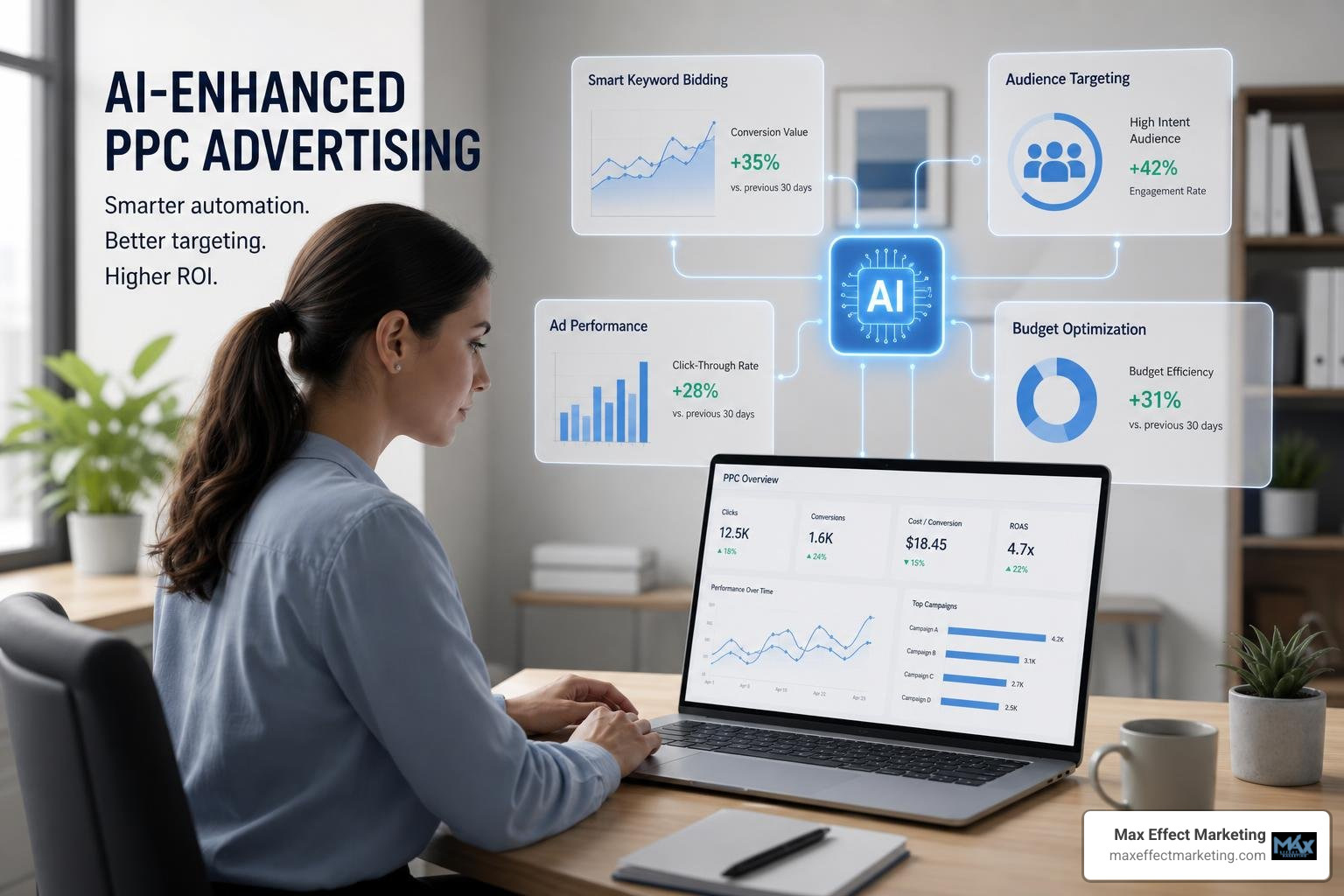
AI-enhanced PPC advertising is the use of machine learning and automation to optimize every part of a paid search campaign — from bidding and targeting to ad creative and budget allocation — in real time, using live data instead of manual guesswork.
If you’re trying to figure out whether AI-driven PPC is worth it, here’s the short answer:
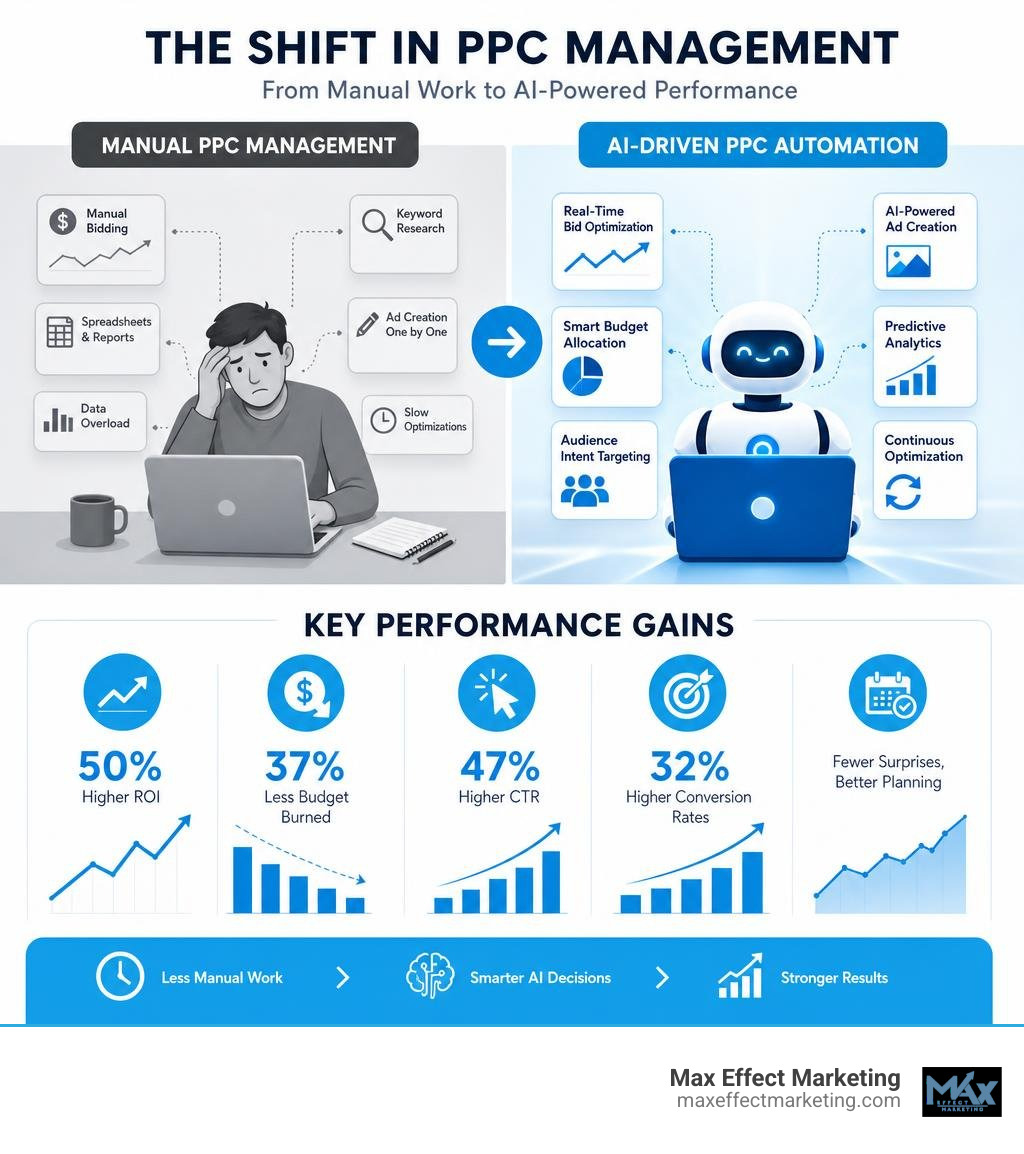
| What AI Does in PPC | The Result |
|---|---|
| Adjusts bids in real time across millions of signals | Up to 50% higher ROI |
| Reduces wasted ad spend automatically | 37% less budget burned |
| Generates and tests ad creatives at scale | 47% higher CTR, 29% lower CPA |
| Segments audiences by behavior and intent | 32% higher conversion rates |
| Forecasts performance before you spend | Fewer surprises, better planning |
In short: AI doesn’t just make PPC faster — it makes it fundamentally smarter.
If you’ve ever stared at a Google Ads dashboard wondering why your budget evaporated with nothing to show for it, you’re not alone. Manual PPC management was always a race against the clock — and the clock was winning. Today, 80% of Google Ads spend is already being optimized by AI automation, and the marketers still running fully manual campaigns are essentially bringing a spreadsheet to a machine-gun fight.
The good news? You don’t have to become a data scientist to benefit from this shift. You just need to understand what AI is actually doing inside your campaigns — and where a human still needs to be in the driver’s seat.
I’m David Bauer, Vice President at Max Effect Marketing, and I’ve been running AI-enhanced PPC advertising campaigns on Google and Meta since the early days of their ad platforms — over 14 years of watching this space evolve from manual keyword bids to fully automated, signal-driven systems. In this guide, I’ll walk you through exactly what’s working right now, what to watch out for, and how to get the most from AI without losing control of your campaigns.
What is AI-Enhanced PPC Advertising?
At its core, ai enhanced ppc advertising replaces static, rule-based campaign management with dynamic, real-time machine learning. Instead of a human media buyer logging in once a day (or once a week) to adjust bids by 10% based on last week’s performance, AI algorithms analyze millions of data points every second to make micro-adjustments instantly.
This technology doesn’t just automate repetitive tasks; it actively predicts user behavior. By evaluating historical patterns alongside real-time contextual signals — such as device type, location, time of day, and browser history — AI determines the exact value of every single ad impression.
| Feature | Traditional Manual PPC | AI-Enhanced PPC |
|---|---|---|
| Bidding Strategy | Static rules, manual adjustments | Real-time predictive bidding |
| Audience Discovery | Manual demographic targeting | Behavioral clustering & intent matching |
| Creative Testing | Static A/B tests (2-3 variants) | Multivariate generation & dynamic assembly |
| Budget Allocation | Fixed by channel, manual transfers | Automated cross-platform reallocation |
| Optimization Cycle | Weekly or bi-weekly manual reviews | Continuous, closed-loop machine learning |
Traditional PPC vs. AI-Enhanced PPC Advertising
Traditional PPC is reactive. You launch an ad, wait for data to accumulate, analyze a spreadsheet, and make a change. By the time you apply those adjustments, the market has already moved. You are driving by looking in the rearview mirror.
AI-enhanced advertising, on the other hand, is proactive and predictive. It operates on live signals rather than historical averages. For example, if a prospect visits your pricing page twice on mobile during weekday lunch hours, an AI-driven system recognizes this high-intent behavior and instantly boosts your bid for that specific user.
This level of precision is especially for local service providers and growing companies. As we outline in our guide on Google Ads for Small Businesses: A Smart Way to Generate More Leads, small budgets cannot afford the “learning tax” of manual trial and error. AI bypasses this waste by matching search intent with surgical precision from day one.
The Core Elements of AI-Enhanced PPC Advertising
To build a high-performing paid media campaign today, we focus on three core pillars of AI integration:
- Smart Bidding: Moving away from manual cost-per-click (CPC) bidding to algorithms that optimize for conversions or conversion value (Target CPA or Target ROAS).
- Audience Segmentation: Using AI clustering to group users based on real-time behavior rather than static, outdated demographics.
- Creative Scaling: Automatically generating, testing, and rotating hundreds of ad variations to prevent creative fatigue.
When these elements are combined into a structured AI Workflow, the results are transformative. Instead of human marketers spending 12 hours a week manually adjusting bids and writing headlines, they spend under two hours reviewing high-level strategy, leaving the machine to handle the heavy lifting.
Key Benefits and Campaign Elements Optimized by AI

Integrating artificial intelligence into your paid media campaigns delivers three undeniable benefits: massive cost savings, extreme operational efficiency, and a dramatic boost in ROI.
According to industry data, businesses implementing AI-driven PPC strategies reduce overall marketing costs by 20% to 30%, directly expanding their profit margins. Furthermore, 68% of marketing executives report achieving a measurable return on their AI investments. Let’s look at the specific elements of your campaigns that AI optimizes to achieve these results.
Smarter Bidding and Real-Time Optimization
Smart Bidding algorithms analyze over 70 million signals in real time to set the perfect bid for every single auction. Whether you are running campaigns on Google, Meta, or Amazon, AI-powered bidding strategies ensure you never overpay for a click that won’t convert, nor miss out on a high-value customer.
By setting clear bid floors and ceilings, you give the AI a safe playground to operate in. The system then utilizes predictive performance forecasting to shift budgets dynamically. If conversions spike on one platform while another stalls, the AI handles cross-platform orchestration, instantly moving dollars to the highest-performing channel without waiting for a human to approve the transfer.
Automated Ad Creative Generation and Testing
The days of writing three static headlines and letting them run for six months are over. In 2026, creative scaling is the ultimate competitive advantage. AI-generated ad creatives have been shown to boost click-through rates (CTR) on Google and Facebook by 47%, while dropping the cost per acquisition (CPA) by 29%.
Using multivariate testing, generative AI tools analyze your landing pages and existing high-performing “seed” assets to automatically spin up hundreds of highly relevant ad variations. This massive volume of active assets is crucial, but it also means ads wear out faster. AI-driven platforms solve this by tracking performance drops and triggering creative fatigue alerts, allowing you to swap out underperforming assets before your ROAS takes a hit. Think of it as having a tireless creative assistant who never needs coffee, never complains about headline testing, and still knows when an ad has overstayed its welcome.
Dynamic Landing Pages and URL Expansion
Getting the click is only half the battle; you still have to convert the visitor. AI bridges the gap between your ads and your website through Final URL expansion and text customization.
When a user searches for a specific product, Google’s AI Max can dynamically expand your campaign’s reach by matching the query to the most relevant landing page on your site, bypassing your generic homepage. To ensure a seamless user experience, the system automatically customizes the ad’s headlines to match the content of that dynamic landing page.
To prevent technical errors like 404 redirects, it is vital to configure your tracking parameters using standard LPURL tags. You can read more about how these mechanisms work in the official documentation on How AI Max for Search campaigns works – Google Ads Help and About text customization in Search campaigns – Google Ads Help.
Balancing Machine Precision with Human Strategy
As powerful as AI is, relying on it blindly is a recipe for disaster. AI is an incredibly powerful engine, but it still needs a human pilot to chart the course. Without strategic oversight, brand voice, and emotional resonance, automated campaigns quickly become cold, generic, and wildly inefficient.
The Risks of the AI “Black Box”
The greatest strength of AI is also its greatest weakness: it operates in a “black box.” Because machine learning models process millions of variables simultaneously, it can be incredibly difficult to diagnose why performance suddenly dropped or why a budget was spent on low-intent search terms.
Additionally, AI has no concept of real-world context. It doesn’t know if there is a global supply chain shortage, a sudden change in local weather, or a sensitive news event that makes your current ad copy look incredibly tasteless. Furthermore, strict privacy regulations like GDPR and CCPA limit the data these algorithms can collect. If your AI is fed low-quality or non-compliant data, its targeting will fail completely.
Designing a Hybrid AI-Human Workflow
To get the best of both worlds, we implement strict “quality gates” and human-in-the-loop validation.
Before we let any AI-driven campaign run wild, we establish clear ground rules:
- Respect the Learning Phase: We never modify budgets or targeting while a campaign is in its active learning phase (typically until it achieves at least 50 conversions).
- Enforce Brand Safety: Every AI-generated headline, image, and video script must be reviewed and approved by a human copywriter to protect our clients’ brand voice.
- Integrate Multi-Channel Marketing: We align our paid search campaigns with our organic SEO strategies and high-converting Web Design principles to ensure a seamless customer journey from click to close.
While some specialized agencies focus purely on automated media buying, we believe the magic happens at the intersection of technology and human connection. Technology is only as good as the strategy guiding it. To keep your budget safe, avoid agencies that rely purely on automated scripts without human supervision. If you want to stop burning cash, you need a partner who understands how to balance automated bidding with real-world business goals, ensuring your ad spend is always optimized for actual revenue, not just vanity metrics.
Frequently Asked Questions About AI PPC
Can AI fully automate my PPC campaigns?
No. While AI can automate tactical, repetitive tasks like bid adjustments, keyword grouping, and creative variations, it cannot define your business goals, understand your profit margins, or build a deep emotional connection with your audience. Human oversight is absolutely essential to provide strategic direction, maintain brand safety, and verify that your tracking infrastructure is capturing clean data.
How does AI improve Amazon PPC specifically?
AI has completely transformed e-commerce advertising. On Amazon, AI agents and shopping assistants analyze purchase history, search intent, and seasonal trends to place highly personalized sponsored content directly in front of active shoppers. By dynamically adjusting bids based on real-time inventory levels and competitor pricing, AI helps e-commerce brands maximize their organic and paid visibility simultaneously.
What is Google AI Max and how does it work?
Google AI Max is a comprehensive suite of targeting and creative features that leverages advanced machine learning to optimize your search campaigns in real time. It utilizes broad match and keywordless technology to expand your reach beyond traditional keyword lists, pulling context directly from your landing pages. Beginning in September 2026, Google is automatically upgrading all campaigns using text customization (formerly automatically created assets) to the unified AI Max framework.
Conclusion
The future of digital marketing isn’t artificial intelligence replacing humans. It’s humans who use AI replacing those who don’t.
At Max Effect Marketing, we don’t believe in handing your entire marketing budget over to a machine and hoping for the best. Our unique approach combines cutting-edge, machine-learning precision with real, dedicated human partnerships. This hybrid approach is how we consistently deliver a 5X ROI for our clients, turning complex data points into predictable, scalable revenue.
If you are ready to stop guessing, stop wasting ad spend, and start scaling your business with a future-proof paid media strategy, we are ready to help.
Transform your PPC campaigns today with Max Effect Marketing and let’s build something incredible together.