Is a Programmatic Ad Agency Right for Your Business?
A programmatic ad agency manages the automated buying and placement of digital ads on your behalf — using data, algorithms, and real-time bidding to reach the right audience at the right moment.
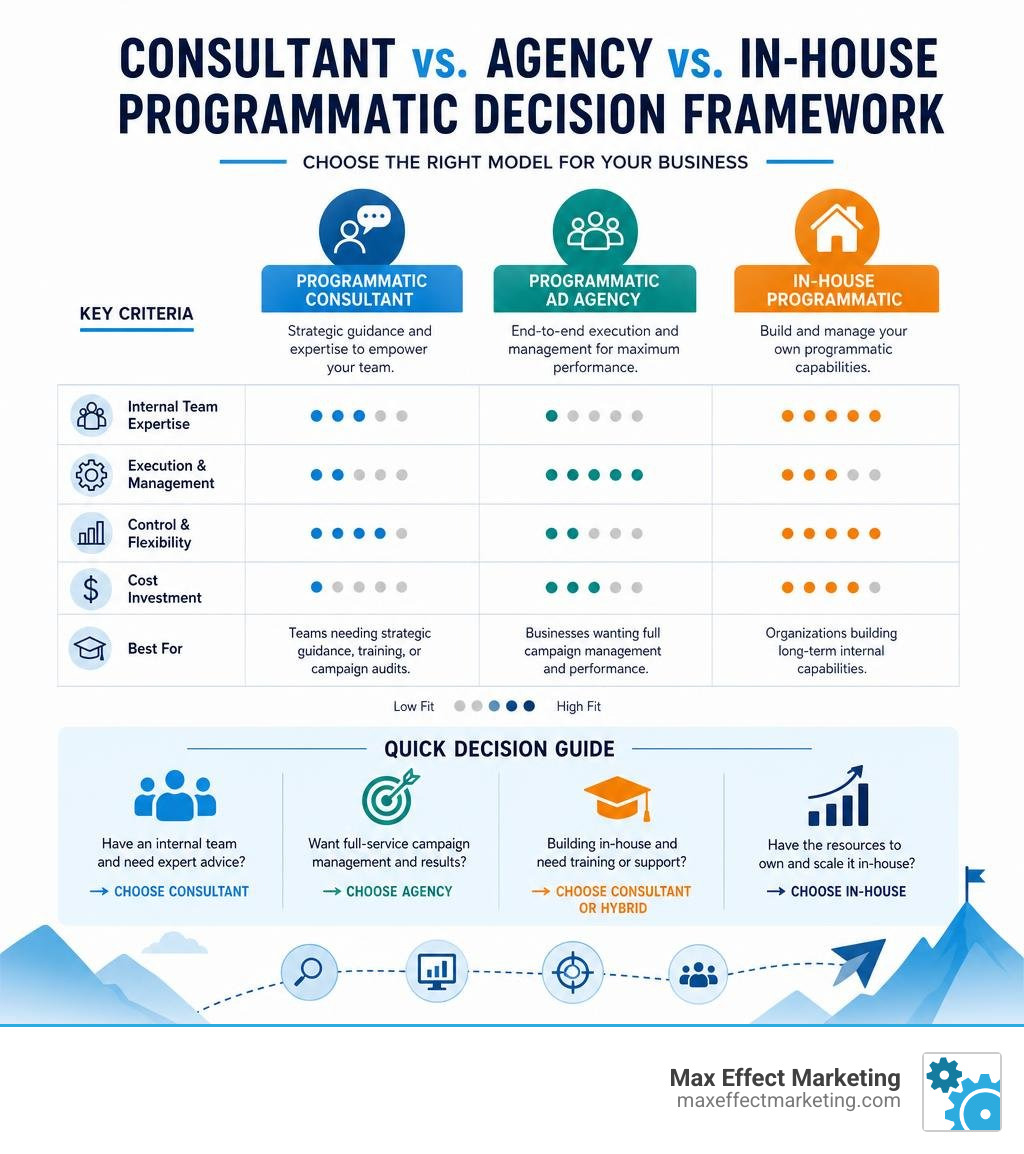
Quick answer: Consultant vs. Full Agency
| Your Situation | Best Fit |
|---|---|
| You have an internal team and need strategic guidance | Programmatic Consultant |
| You want full campaign management from start to finish | Programmatic Ad Agency |
| You’re building an in-house program and need training | Consultant or Hybrid Model |
| You have no internal ad ops resources | Full-Service Agency |
Right now, 85% of all digital ads are bought programmatically. That means if your campaigns aren’t running on programmatic infrastructure, you’re likely leaving efficiency — and revenue — on the table.
But here’s the problem most business owners run into: not all programmatic partners are built the same. Some are full agencies that handle everything. Others are consultants who advise your team. Choosing the wrong model can burn budget without results.
This guide helps you figure out which approach fits your business — and what to look for before you sign anything.
Understanding Programmatic Advertising vs. Traditional Media Buying
To understand why working with a programmatic ad agency is such a game-changer, we first need to look at how digital advertising has evolved.
Traditionally, buying ad space was a manual, slow, and often frustrating process. If you wanted to place a banner ad on a popular news website, you had to contact their sales team, negotiate pricing (usually based on a flat cost per thousand impressions, or CPM), sign insertion orders, and manually send over your creative files. This process took days, if not weeks. It lacked flexibility, and worst of all, you paid the same price for every visitor, whether they were your ideal customer or someone who clicked by accident.
Programmatic advertising completely flips this model on its head through automation and real-time bidding (RTB). Instead of buying ad space in bulk directly from specific publishers, programmatic systems use software and data to purchase individual ad impressions in real time.
When a user loads a webpage, an auction happens behind the scenes in milliseconds. Algorithms analyze the user’s demographic data, browsing behavior, and geographical location, and then decide how much to bid on that specific impression. The highest bidder wins, and their ad is instantly displayed.
This level of automation means we can stop buying “ad placements” and start buying “audiences.” It allows brands to scale their Online Campaigns with unparalleled efficiency, ensuring that media spend is only used on impressions that actually matter.
| Feature | Traditional Media Buying | Programmatic Advertising |
|---|---|---|
| Buying Process | Manual negotiation, RFPs, and insertion orders | Automated real-time bidding (RTB) via software |
| Targeting | Broad demographics based on publisher audience | Granular, data-driven targeting (behavioral, contextual, location) |
| Optimization | Done post-campaign or manually mid-campaign | Continuous, real-time optimization using machine learning |
| Pricing | Fixed CPMs negotiated in advance | Dynamic CPMs based on real-time market demand |
| Speed | Weeks or days to plan and execute | Milliseconds to bid, win, and display an ad |
| Scale | Limited to specific contracted publishers | Access to millions of websites, apps, and platforms globally |
How the Programmatic Ecosystem Works
To successfully navigate programmatic media, it helps to understand the main players in this digital supply chain. The ecosystem relies on three core technologies working together in perfect harmony, adhering to global IAB standards:
- Demand-Side Platform (DSP): This is the software that advertisers and agencies use to buy mobile, video, and search ads. The DSP allows us to set up campaigns, upload creatives, define targeting criteria, and manage bidding strategies.
- Supply-Side Platform (SSP): This is the publisher’s equivalent of a DSP. Websites, mobile apps, and streaming platforms use SSPs to list their available ad inventory and manage their monetization.
- Ad Exchanges: Think of the ad exchange as the virtual auction house. It connects DSPs and SSPs, facilitating the rapid-fire bidding process that occurs in the milliseconds it takes for a webpage to load.
When these three elements connect, they create a seamless, transparent marketplace where billions of ad impressions are bought and sold every single day.
Key Benefits of Automating Your Media Buying
Why are so many brands moving away from manual buying? The statistics speak for themselves: programmatic display advertising is the fastest-growing segment of all digital marketing, and more than 80% of display ads running digitally are executed on programmatic platforms.
Here are the primary advantages of programmatic media buying:
- Unmatched Efficiency: Because the buying process is automated, your team doesn’t have to spend hours negotiating contracts or manually tracking campaign delivery. In fact, programmatic tools can increase operational efficiency for agencies by nearly 30%.
- Real-Time Optimization: Unlike traditional campaigns where you have to wait for a weekly report to make changes, programmatic campaigns can be optimized on the fly. If a certain creative isn’t performing well, or if a specific geographic region is driving higher conversions, adjustments can be made instantly.
- Massive Scale: Programmatic allows you to reach audiences across a vast landscape of channels — including connected TV (CTV), digital audio, native ads, and digital billboards — all from a single dashboard.
- Improved ROI: By combining machine learning with precise audience targeting, programmatic minimizes wasted spend, directly boosting your return on investment.
To stay updated on how these efficiency gains are reshaping the marketing landscape, check out our latest insights on our Blogs.
Choosing the Right Programmatic Ad Agency for Your Business
Because the programmatic landscape is highly complex and relies on sophisticated technology, many businesses choose to partner with an external specialist. However, finding the right programmatic ad agency requires careful evaluation.
The market is filled with different types of service providers, ranging from massive holding-company agencies to nimble, specialized boutiques. Your goal is to find a partner that not only understands the technology but also values transparency, especially when it comes to budget management and media markups.
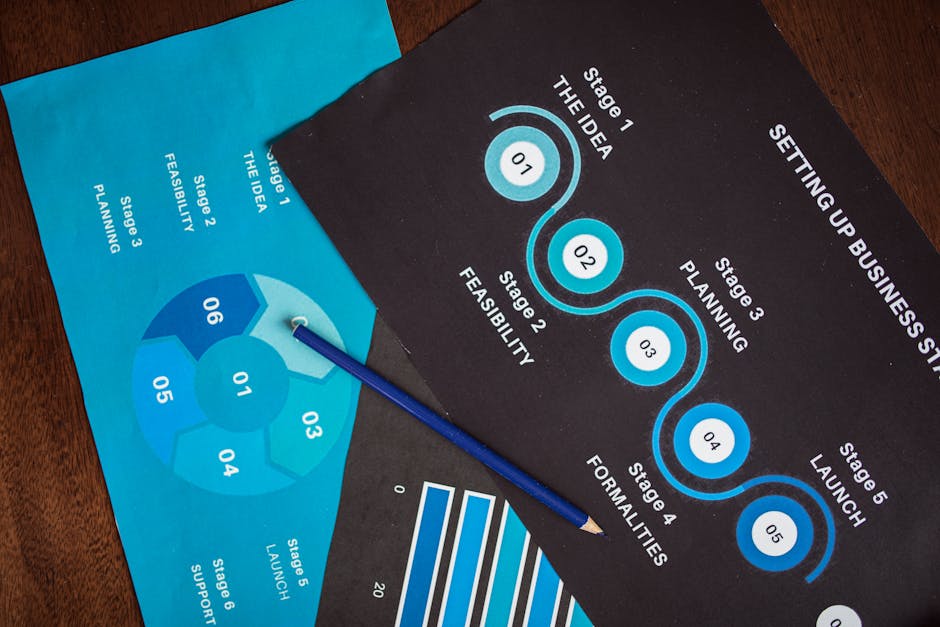
What to Look For in a Programmatic Ad Agency
When vetting potential agencies, you should look beyond shiny pitch decks and focus on their actual operational capabilities. Here are the key criteria to evaluate:
- Platform Independence: A great agency should be tech-agnostic. This means they are not locked into a single DSP or proprietary network. Instead, they should have the flexibility to choose the best technology platforms based on your specific campaign goals.
- Direct Trader Access: Many large agencies place a layer of account managers and client-relationship executives between you and the person actually pulling the levers in the DSP. This can create communication lag. Look for partners that offer direct access to media traders for faster, more accurate optimizations.
- Transparent Reporting Dashboards: Avoid agencies that only provide high-level PDF summaries at the end of the month. You deserve real-time reporting dashboards that show exactly where your media dollars are going, what placements you are winning, and what your actual CPMs are.
- Full Campaign Management: The agency should handle everything from initial audience research and media planning to creative formatting, campaign setup, continuous optimization, and post-campaign analysis.
To see what this level of execution looks like in practice, explore our real-world Case Study library to see how we drive measurable growth for our clients.
When to Hire a Consultant vs. a Programmatic Ad Agency
If you are trying to decide whether to hire an independent consultant or a full-service programmatic ad agency, ask yourself these questions about your internal resources:
- Do you have an in-house marketing team? If you already have skilled digital marketers who want to learn how to operate a DSP themselves, a consultant is a great choice. They can provide the training, strategic roadmaps, and ad tech integration advice you need to build an in-house programmatic division.
- Do you need hands-on execution? If you do not have the internal bandwidth or technical expertise to manage daily bidding, creative rotation, and campaign troubleshooting, you need a full-service agency. An agency acts as an extension of your marketing department, handling the heavy lifting so you can focus on high-level business growth.
- What is your budget scale? Consultants typically work on project-based fees or hourly rates, making them highly cost-effective for strategic planning. Agencies usually charge a percentage of media spend or a monthly retainer, which is ideal for businesses looking to scale their ongoing media investments.
If you are looking to expand your overall marketing capabilities beyond programmatic, we invite you to explore our wide range of Additional Services to see how we can support your business.
Advanced Targeting Strategies and Omnichannel Activation
One of the biggest reasons programmatic advertising is so powerful is its ability to target users with surgical precision. Rather than relying on broad guesses, programmatic uses a wealth of data sources to ensure your message lands in front of the right person, on the right device, at the exact moment they are most receptive.
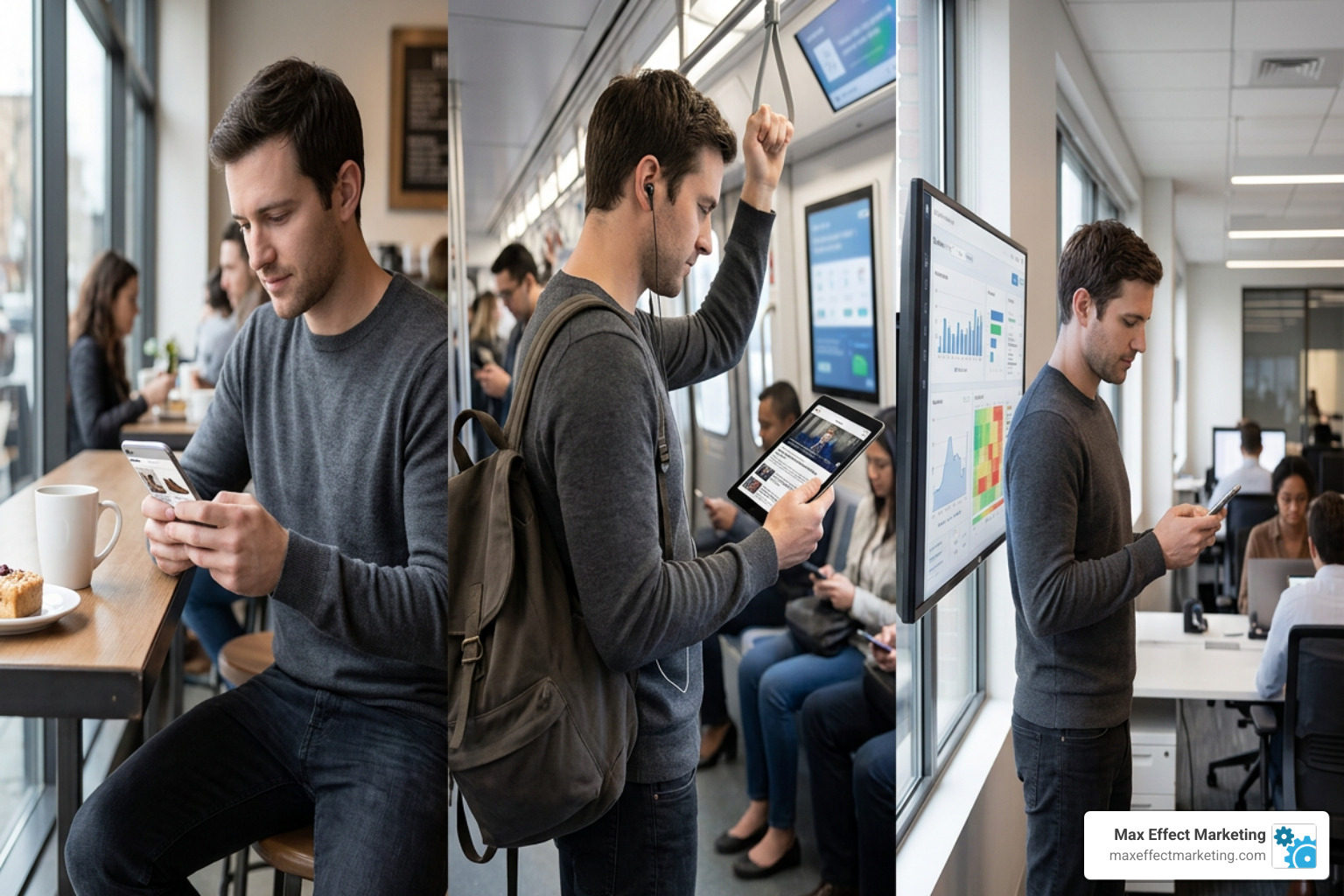
Programmatic Channels and Formats
Modern programmatic campaigns are truly omnichannel. You can coordinate your messaging across a wide array of formats, creating a synchronized brand experience across multiple touchpoints:
- Connected TV (CTV) & OTT: Serve high-impact, non-skippable video ads to audiences streaming content on platforms like Netflix, Prime Video, and YouTube TV.
- Streaming Audio: Reach highly engaged listeners on Spotify, Pandora, or popular podcast networks with personalized audio ads.
- Digital Out-of-Home (DOOH): Programmatically purchase digital billboard space in airports, shopping malls, or roadside locations, adjusting your creative dynamically based on the time of day or local weather conditions.
- Display & Native Ads: Deliver visually engaging banner ads and native content placements across millions of premium websites and mobile apps.
- Retail Media: Tap into first-party purchase data on major retail networks like Amazon, Walmart, and Target to display your products directly to shoppers actively looking to buy.
Integrating Programmatic with Full-Funnel Marketing
Programmatic advertising should never exist in a silo. Instead, it works best when integrated with your broader marketing mix, including paid search, organic SEO, and conversion-focused Web Design.
For example, you can use high-impact programmatic CTV and digital audio ads at the top of the funnel to build broad brand awareness. As those users begin to search for your products, your search engine marketing and SEO strategies capture that high-intent traffic.
Simultaneously, you can use programmatic retargeting to serve display or native ads to users who visited your website but didn’t convert, gently guiding them back down the funnel. By using multi-touch attribution modeling, you can see exactly how each channel contributes to your final conversions, allowing you to allocate your budget more intelligently.
Brand Safety, Transparency, and Future Trends in 2026
As we move through 2026, the programmatic landscape continues to shift rapidly, driven by two major forces: privacy regulations and the deprecation of third-party cookies.
To thrive in this cookieless environment, agencies are moving away from legacy tracking methods and embracing advanced identity solutions, first-party data onboarding, and contextual targeting. Contextual targeting uses machine learning to analyze the actual content of a webpage, placing your ads alongside highly relevant editorial content without needing to track individual user history.
Furthermore, brand safety and ad fraud prevention remain top priorities. High-quality agencies integrate third-party verification tools like DoubleVerify to keep non-human traffic (NHT) below 1%, ensuring your ads are only viewed by real people in brand-safe, premium environments. For more academic insights on how the industry is combating these challenges, you can read the latest Research on programmatic ad fraud.
Frequently Asked Questions About Programmatic Advertising
What is the difference between a programmatic consultant and an agency?
A programmatic consultant focuses on strategy, training, and helping you select and set up your technology stack. They are ideal if you want to build an in-house programmatic team. A programmatic ad agency handles the end-to-end execution of your campaigns, including media buying, daily optimization, creative management, and hands-on reporting.
How do programmatic agencies ensure brand safety and prevent ad fraud?
Reputable agencies use a multi-layered approach to protect your budget. This includes using pre-bid filters, maintaining strict exclusion lists (blocklists), purchasing media through Private Marketplace (PMP) deals with trusted publishers, and integrating industry-leading verification tools like DoubleVerify to block invalid or non-human traffic.
Can programmatic advertising be used for both B2B and B2C campaigns?
Absolutely. For B2C brands, programmatic is highly effective for behavioral targeting, geofencing, and driving immediate online or in-store sales. For B2B brands, programmatic can be used for account-based marketing (ABM), allowing you to serve tailored ads specifically to decision-makers at target companies as they browse the open web.
Conclusion
Navigating the programmatic advertising landscape can feel overwhelming, but you don’t have to do it alone. Whether you need a strategic partner to guide your internal team or a full-service agency to manage your campaigns from top to bottom, the key is choosing a partner that prioritizes transparency, technology, and real business results.
At Max Effect Marketing, we are an AI-powered digital marketing agency built on a unique promise: combining intelligent technology with real human partnerships to achieve an average of 5X ROI for our clients. We eliminate the “black box” of digital media buying, giving you complete visibility into your campaigns and ensuring every dollar of your budget works toward your bottom line.
Ready to take control of your media investments and scale your revenue? Contact our team of experts today, or explore our custom programmatic marketing Offer to see how we can transform your digital strategy.