Why Every Business Owner Should Understand the Benefit of SEO
What is the benefit of SEO? Here’s the short answer:
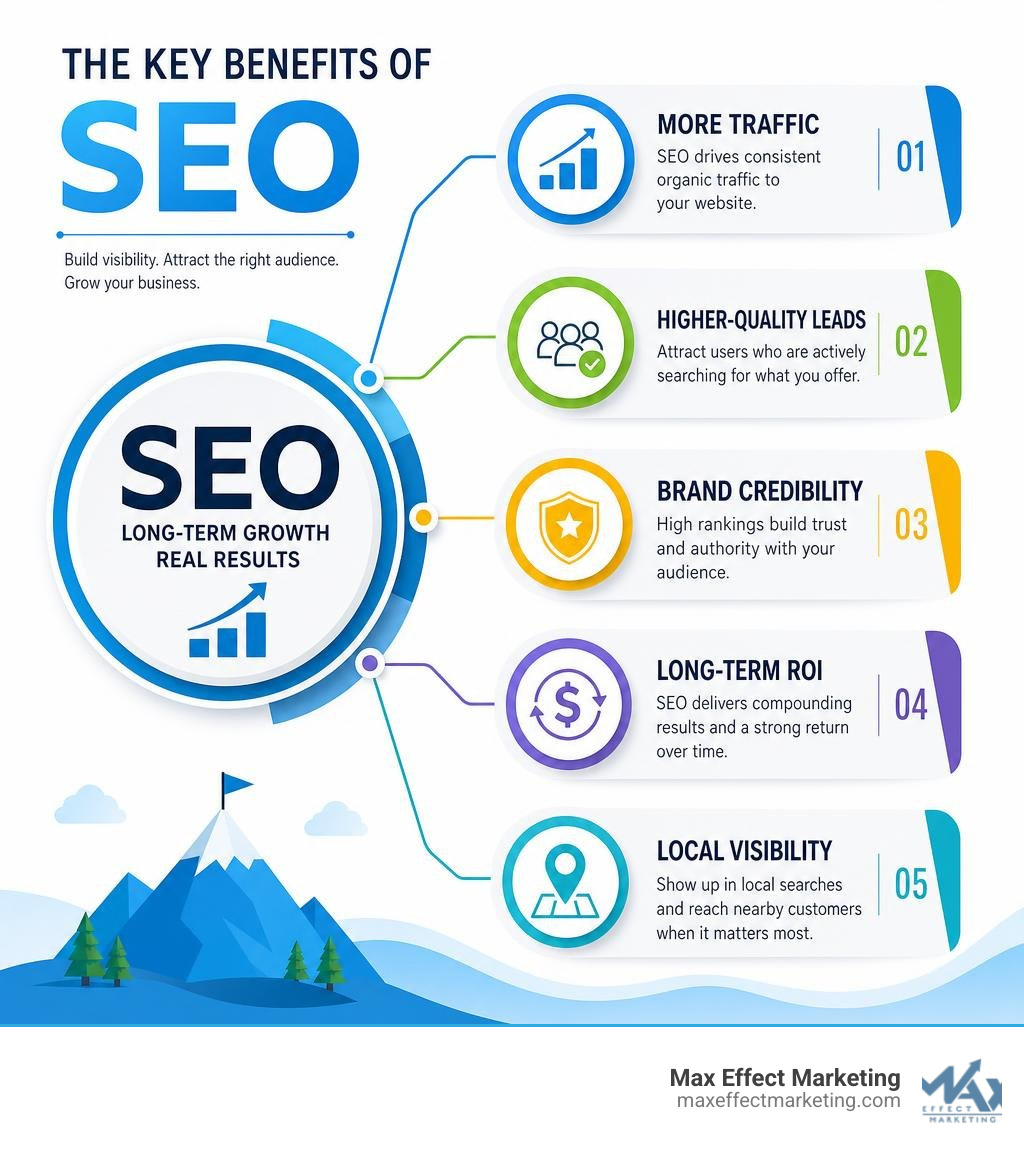
- More organic traffic — 53.3% of all web traffic comes from organic search
- Higher-quality leads — 60% of marketers say their best leads come from SEO
- Brand credibility — high rankings signal trust and authority to users
- Long-term ROI — SEO campaigns have yielded 317% to 1,389% ROI across industries
- Local customer reach — 76% of nearby searches lead to a store visit within a day
- AI search visibility — strong SEO now gets your content cited by ChatGPT and Google AI Overviews
- Better user experience — faster, cleaner sites rank higher and convert better
If your marketing budget keeps disappearing without much to show for it, you’re not alone. Many business owners pour money into ads, watch the spend climb, and still struggle to generate consistent, quality leads. The problem isn’t always the ad — sometimes it’s the foundation underneath it.
That’s where SEO comes in.
Search engine optimization isn’t just about rankings. It’s about showing up when your customers are actively looking for exactly what you offer — without paying for every single click.
The numbers back this up. Only 0.63% of Google users ever click past the first page of results. If your business isn’t on page one, you’re essentially invisible to most of your potential customers.
I’m David Bauer, Vice President at Max Effect Marketing, and with over 14 years of experience running digital campaigns across Google, Meta, and beyond, I’ve seen what is the benefit of SEO for businesses of all sizes — from small local shops to growing companies competing in crowded markets. In this guide, I’ll break down exactly how SEO works and why it may be the most valuable long-term investment in your marketing mix.
What is the Benefit of SEO for Modern Businesses?
In the digital world of 2026, the question is no longer whether your business needs an online presence, but how visible that presence actually is. Every second, Google processes more than 60,000 searches. When users type in a query, they are expressing immediate search intent. They aren’t just browsing; they are actively looking for answers, products, or services.
Unlike interruptive marketing channels like social media ads or television commercials, SEO places your brand directly in front of users at the exact moment they are looking for a solution. This alignment with user behavior is what makes organic search traffic so incredibly valuable. Rather than shouting into the void hoping someone hears you, you are answering the door when they knock.
Furthermore, SEO is one of the few marketing channels that offers compounding returns. When you pause a paid advertising campaign, your traffic stops instantly. With SEO, the high-quality content and technical optimizations you build today will continue to attract visitors, capture leads, and drive sales for years to come.
Demystifying Search Engine Optimization
At its core, search engine optimization is the process of aligning your digital footprint with the algorithms that search engines use to organize information. To understand how to leverage this, we must look at how search engines work. Google uses automated programs called crawlers (or spiders) to constantly scan the web.
This process involves three distinct steps:
- Crawling: Spiders discover new and updated pages by following links from pages they already know.
- Indexing: Google analyzes the content, images, and video files on the page and stores this information in a massive database called the Google Index.
- Ranking: When a user types a search query, Google’s complex algorithms evaluate hundreds of ranking factors to serve the most relevant, high-quality, and user-friendly pages.
Understanding these fundamentals is crucial. As outlined in the official SEO Starter Guide: The Basics | Google Search Central | Documentation | Google for Developers , search engines prioritize websites that organize their content logically, use descriptive URLs, resolve duplicate content issues, and focus on providing real, human-centric value.
Why Traditional Ads Can’t Match the Organic Advantage
Paid advertising certainly has its place in a balanced marketing mix. However, relying solely on paid channels is like renting your traffic. The moment you stop paying the landlord, you get evicted.
SEO, on the other hand, is about buying and building digital real estate. It allows you to create permanent marketing assets that reduce your overall dependence on paid channels. Consider the financial math: with pay-per-click (PPC) ads, every click costs you money. With organic search, the cost-per-click is effectively zero. Once your content ranks, you can receive thousands of visitors a month without writing another check to Google or Meta.
To build a truly resilient digital presence, smart businesses use organic strategies to establish a permanent foundation while supplementing their growth with targeted Online Campaigns to capture immediate demand.
The Top 5 Business Benefits of SEO
To fully appreciate what is the benefit of SEO, we have to look past simple rankings and focus on bottom-line business outcomes. While ranking number one is a great ego boost, the real magic happens when that ranking translates into measurable growth.
When executed correctly, SEO delivers a powerful combination of brand awareness, lead generation, and improved conversion rates. By helping you outrank larger competitors, it levels the playing field and gives small to mid-sized businesses a sustainable competitive edge.
Let’s dive deep into the five most impactful business benefits of search engine optimization.
1. Driving High-Quality Traffic and Leads
The most immediate and obvious benefit of optimizing your website is an increase in organic traffic. But not all traffic is created equal. You don’t just want eyes on your site; you want the right eyes.
SEO excels at attracting active searchers who have commercial or transactional intent. Because these users are already looking for your services, they are highly qualified. In fact, search engines offer an average close rate of nearly 15% for new organic leads, compared to a meager close rate of less than 2% for outbound, traditional marketing methods like cold calling or direct mail.
By building targeted content around the specific keywords your buyers use, you can capture leads at every stage of the buying funnel. Whether you are looking to increase overall brand awareness or drive direct sales, a robust SEO strategy ensures your business is the one they find when they are ready to make a decision.
2. Building Brand Credibility and Trust
In 2026, trust is the ultimate digital currency. With the rise of AI-generated content, consumers are more skeptical than ever. Fortunately, ranking high on Google acts as an implicit stamp of approval.
According to recent data, 68% of respondents trust search engine results for general news and information. Users instinctively associate high organic rankings with industry leadership and authority. If Google trusts you enough to place you on the first page, users will too.
To earn these top spots, search engines evaluate your site using a framework known as E-E-A-T (Experience, Expertise, Authoritativeness, and Trustworthiness). By consistently publishing well-researched, expert-attributed content and securing backlinks from other respected websites, you build your domain authority. This process is detailed further in the comprehensive guide on SEO Benefits: Why Search Engine Optimization Matters in 2026 , which highlights how establishing trust directly translates into long-term customer loyalty.
3. Enhancing User Experience and Site Performance
Many business owners don’t realize that SEO and user experience (UX) are two sides of the same coin. Google wants to keep its users happy, which means its algorithm rewards websites that are fast, intuitive, and easy to navigate.
When you optimize your site for search engines, you are also optimizing it for human beings. This includes focusing on:
- Core Web Vitals: Ensuring your pages load quickly and don’t experience unexpected layout shifts.
- Mobile Optimization: Since over 50% of global web traffic comes from mobile devices, a responsive, fast-loading mobile experience is mandatory.
- Clear Navigation: Grouping topically similar pages in clean directory structures so users can find what they need in just a few clicks.
When your site is a pleasure to use, visitors stay longer, view more pages, and are far more likely to convert into paying customers.
4. Securing Visibility in AI Search and LLMs

The search landscape is undergoing its biggest evolution in decades. Today, users aren’t just searching on Google; they are asking questions to AI engines like ChatGPT, Claude, and Perplexity.
If you think this makes traditional SEO obsolete, think again. AI search engines don’t pull their answers out of thin air — they crawl and index the web just like Google does. In fact, brands with a higher volume of organic keyword rankings show the strongest correlation with Large Language Model (LLM) mentions.
Interestingly, a recent Semrush study revealed that 90% of the time, ChatGPT search cited URLs ranking in position 21 or lower in Google’s organic results. This means that even if you aren’t dominating the very top of Google for a highly competitive head term, optimizing your content with clear, structured Q&A formats and targeting long-tail keywords can earn you valuable LLM citations.
Adapting your content for these generative engines is a modern necessity, as discussed in 12 Benefits of SEO for Your Business: From Traffic to AI Visibility .
5. Dominating Local Search to Attract Nearby Customers
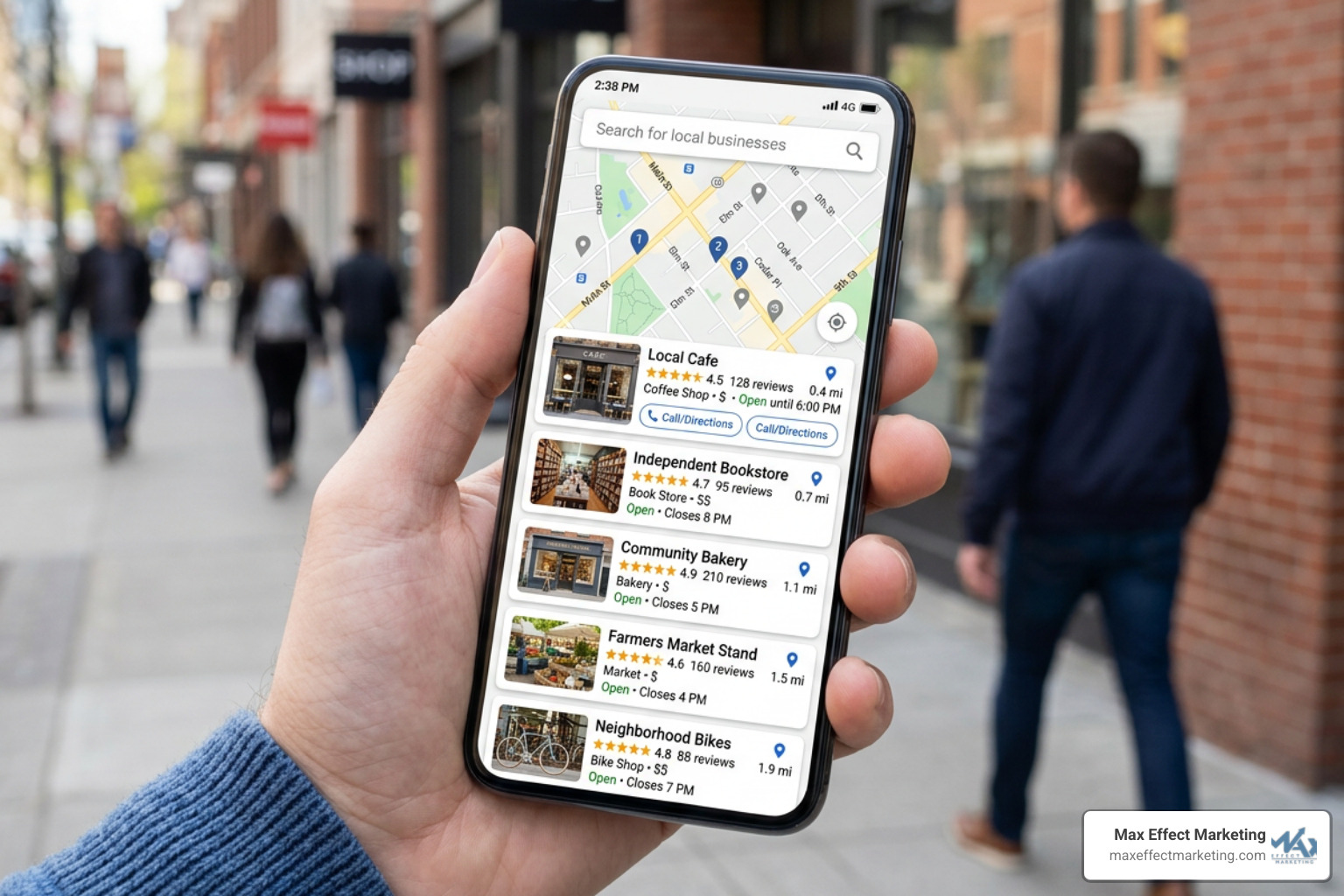
For brick-and-mortar stores and service-based businesses, local SEO is nothing short of a game-changer. Over 1 billion people use Google Maps every single month to find businesses near them.
When someone searches for a local service on their smartphone, their intent to buy is incredibly high. Statistically, 76% of those who conduct a local smartphone search visit a related business within 24 hours, and 28% of those searches result in an immediate purchase.
By optimizing your Google Business Profile, ensuring consistent Name, Address, and Phone Number (NAP) details across local directories, and gathering positive customer reviews, you can earn a spot in Google’s coveted “Local 3-Pack.” This puts your business directly in front of nearby, high-intent buyers exactly when they need you. To learn more about capturing this local demand, check out our guide on Local SEO for Small Businesses: Why It Matters in 2026.
SEO vs. PPC: Finding the Perfect Marketing Synergy
A common question we hear from business owners is: “Should I invest my marketing budget in SEO or PPC?”
The truth is, this shouldn’t be an “either/or” decision. While both strategies fall under the umbrella of search engine marketing, they serve different purposes. PPC is fantastic for driving immediate traffic, testing new landing pages, and running seasonal promotions. SEO, on the other hand, is a long-term play that builds equity and delivers a significantly higher lifetime ROI.
Comparing the ROI of Organic Search and Paid Ads
To help you visualize how these two channels compare over time, let’s look at their core differences:
| Feature | Organic SEO | Paid PPC Ads |
|---|---|---|
| Time to Results | 3 to 6 months (compounds over time) | Immediate (starts as soon as ads launch) |
| Cost Per Click | $0 (free organic traffic) | Variable (you pay for every single click) |
| Longevity | Permanent (traffic continues if paused) | Temporary (traffic stops when budget runs out) |
| Trust & Credibility | High (users trust organic results) | Medium (users recognize ads) |
| AI Search Eligibility | High (eligible for AI citations & Overviews) | None (ads do not appear in AI citations) |
While PPC offers speed, SEO offers sustainability. For many businesses, starting with a targeted ad campaign is a smart way to generate immediate cash flow while building out their organic search foundation. You can read more about maximizing your paid ad budget in our resource on Google Ads for Small Businesses: A Smart Way to Generate More Leads.
How SEO and PPC Work Together for Maximum Visibility
When you combine SEO and PPC, the results aren’t just additive — they are multiplicative. This strategy is known as search engine dominance.
By targeting the same high-performing keywords with both organic content and paid ads, you occupy more digital real estate on the search engine results page (SERP). This dual visibility reinforces your brand’s authority and dramatically increases your overall click-through rate.
Additionally, you can use your PPC keyword data to inform your SEO strategy. If a specific keyword in your Google Ads campaign is converting at a high rate, you know it is worth investing the resources to rank for that term organically. To see this synergy in action, take a look at our real-world Case Study showing how integrated search marketing drives massive growth.
Frequently Asked Questions About SEO Benefits
What is the benefit of seo for small businesses with limited budgets?
For small businesses, SEO is the ultimate equalizer. It allows you to compete with massive corporations that have virtually unlimited advertising budgets. Since you don’t have to pay for organic search placement, a highly optimized, hyper-targeted local website can easily outrank a major national brand for local search queries. It is a highly cost-effective strategy that turns your time and expertise into a permanent digital asset.
How long does it take to see what is the benefit of seo?
While paid ads can drive traffic in minutes, SEO is a long-term investment. Most websites begin to see measurable improvements in traffic and rankings within three to six months of consistent optimization. The exact timeframe depends on your website’s current domain authority, the competitiveness of your industry, and the quality of your strategy. However, once the momentum builds, the compounding returns make the wait entirely worthwhile.
Can SEO help my business get cited by AI search engines like ChatGPT?
Yes, absolutely. AI search engines and LLMs rely on indexed web content to answer user queries. By structuring your content with clear headings, using schema markup (structured data), answering conversational long-tail questions directly, and demonstrating strong E-E-A-T signals, you make it incredibly easy for AI engines to find, trust, and cite your website as a primary source.
Conclusion
Understanding what is the benefit of SEO is the first step toward transforming your business’s digital future. From driving high-quality, high-converting organic traffic to building bulletproof brand authority and securing your place in the emerging world of AI search, search engine optimization is the backbone of sustainable digital growth.
At Max Effect Marketing, we specialize in helping businesses cut through the noise. As an AI-powered digital marketing agency, we combine intelligent, cutting-edge technology with real human partnerships to deliver data-driven campaigns that consistently achieve a 5X ROI.
Ready to stop renting your traffic and start building a digital asset that drives revenue 24/7? Let’s build something great together. Get in touch with us today to schedule your consultation at Max Effect Marketing SEO Services.