
Why PPC Management Is the Smartest Way to Grow Your Ad ROI
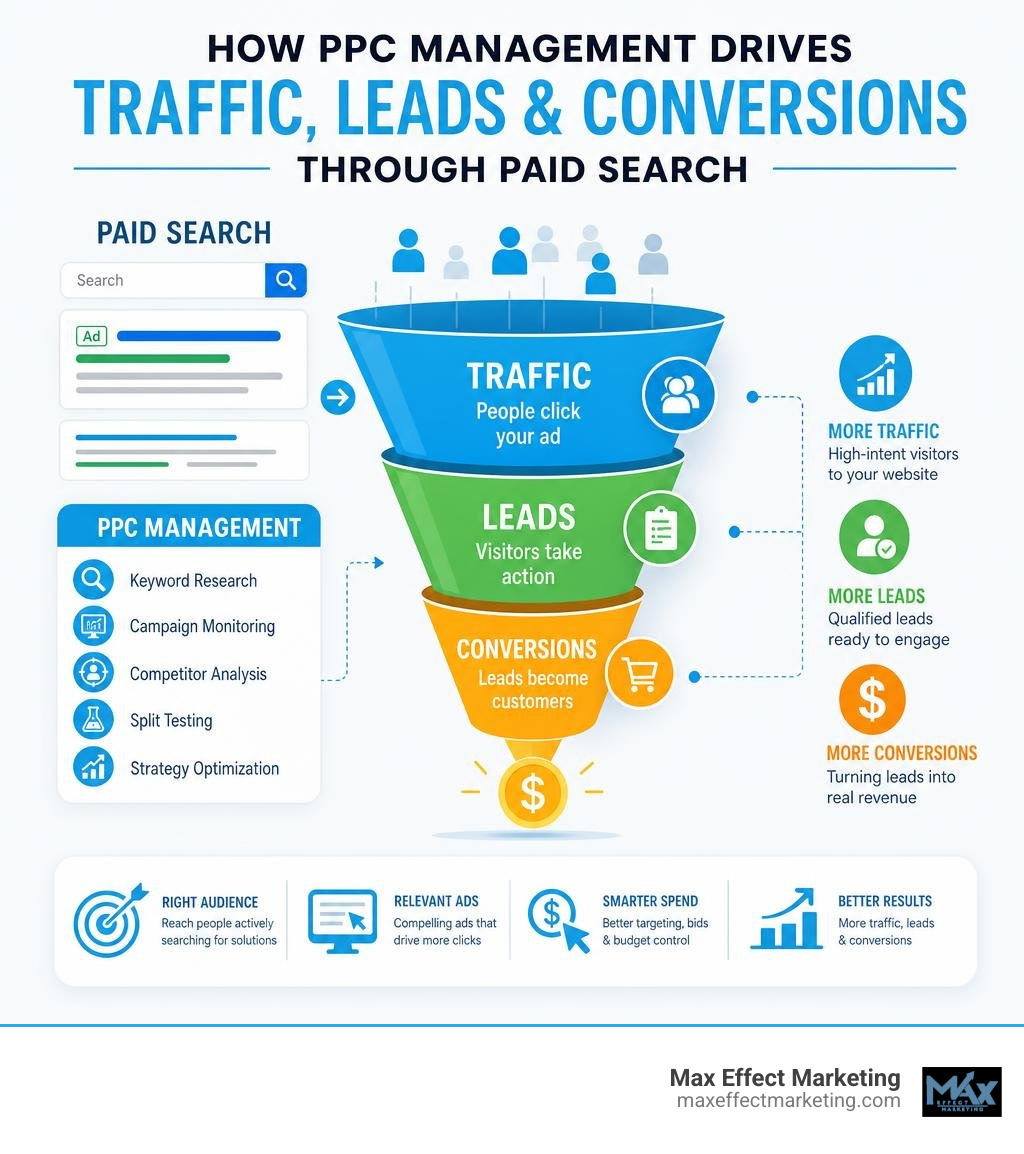
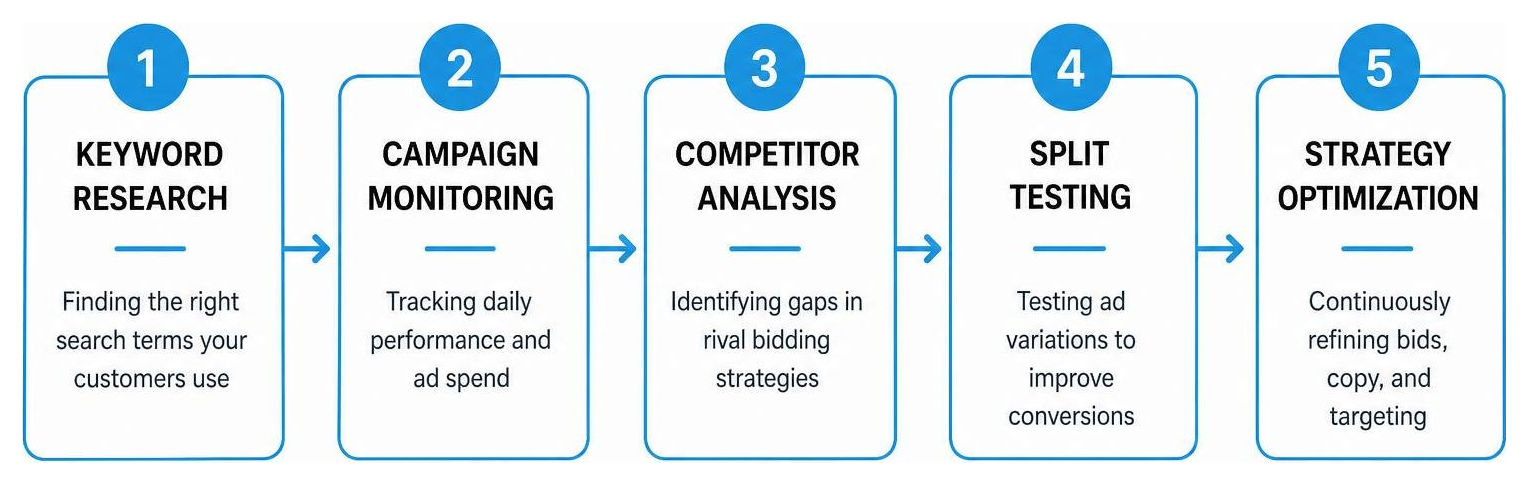
PPC management is the ongoing process of overseeing and optimizing your pay-per-click ad campaigns to get the most return from every dollar you spend. Here’s a quick snapshot of what it covers:
| PPC Management Element | What It Means |
|---|---|
| Keyword Research | Finding the right search terms your customers use |
| Campaign Monitoring | Tracking daily performance and ad spend |
| Competitor Analysis | Identifying gaps in rival bidding strategies |
| Split Testing | Testing ad variations to improve conversions |
| Strategy Optimization | Continuously refining bids, copy, and targeting |
If your ads are burning budget without driving real results, you’re not alone — and that’s exactly the problem good PPC management solves.
The numbers make a strong case. Businesses earn an average of $2 for every $1 spent on Google Ads. And 65% of all high-intent searches end in a click on a paid ad. That’s not a coincidence — it’s the result of well-managed campaigns working the way they should.
Without active management, even a generous ad budget can quietly drain away on the wrong keywords, the wrong audiences, and ads that nobody clicks.
I’m David Bauer, Vice President at Max Effect Marketing, and I’ve been running PPC management campaigns on Google and Meta since both platforms launched their advertising products — over 14 years of helping businesses turn ad spend into measurable growth. In the sections below, I’ll walk you through everything you need to know to make paid search work for your business.
What Is PPC Management and How Does It Drive Growth?

At its root, PPC management is the strategic oversight of an organization’s pay-per-click advertising spend. Pay-per-click is an online advertising model where you only pay when a user actually clicks on your ad. While that sounds simple enough on paper, launching a campaign and letting it run on autopilot is like buying a high-performance sports car and never changing the oil. Pretty soon, things start smoking, performance plunges, and you end up wasting serious cash.
The primary purpose of comprehensive PPC management is to help your business establish cost-effective advertising budgets, maximize financial returns, and secure top placement across major search engine results pages (SERPs) and social platforms. When executed effectively, managed paid search transforms ad spend into a highly predictable, repeatable engine for customer acquisition.
Instead of guessing which search terms might work or crossing your fingers that your ad budget lasts through the end of the month, professional management gives you total control over ad placement, bidding schedules, geographic reach, and cost allocation.
Essential Core Processes in Strategic PPC Management
Professional PPC management isn’t a one-and-done setup task. It is a continuous, multi-step lifecycle designed to keep your ads performing at their absolute peak:
- Keyword Research: Identifying high-value search terms that potential customers use when they are ready to purchase, while eliminating terms that drain your budget without delivering leads.
- Campaign Structuring: Organizing your ad accounts into tight, highly thematic campaign and ad groups so that your messaging matches user intent seamlessly.
- Ad Copy Writing & Creative Development: Crafting compelling headline options, descriptive body copy, and eye-catching ad extensions that motivate high-intent searchers to click.
- Bid Strategy & Budget Management: Adjusting monetary bids dynamically across device types, schedules, and geographic locations to maximize impression share without overspending.
- Ongoing Strategy Optimization: Analyzing performance data daily to prune unproductive terms, refine targeting parameters, and improve overall account health.
Strategic Channel Selection and Audience Targeting
Not all digital channels serve the same business objectives, which is why channel selection is vital to any PPC management strategy. Google Ads excels at capturing immediate demand because users are actively searching for solutions. Meta Ads (Facebook and Instagram), on the other hand, shine when building interest, targeting detailed demographic profiles, and remarketing to visitors who previously engaged with your brand.
For regional or brick-and-mortar enterprises, geographic targeting serves as a critical growth lever. By establishing precise location parameters, a local service provider or restaurant can concentrate its ad budget on users within a 5-mile radius, ensuring not a single dollar is wasted advertising to people who live three states away. If you’re looking to scale local lead generation, take a look at our guide on Google Ads for Small Businesses: A Smart Way to Generate More Leads.
Key Benefits of Implementing a Data-Driven Paid Search Strategy
When you transition from unmanaged, unmonitored ad campaigns to a data-driven PPC management approach, the operational difference is night and day. Unmanaged campaigns often suffer from runaway budgets, irrelevant traffic, and plummeting conversion rates. Data-driven management, by contrast, relies on clear quantitative benchmarks to scale performance predictably.
| Performance Metric | Unmanaged PPC Campaigns | Data-Driven PPC Management |
|---|---|---|
| Ad Spend Control | Unpredictable month-end budget spikes | Strict daily caps and targeted bid pacing |
| Search Intent Match | High percentage of irrelevant broad clicks | Negative keyword filtering and high-intent focus |
| Brand Awareness Impact | Moderate, sporadic visibility | Up to 80% increase in brand awareness |
| Click-Through Rates (CTR) | Frequently below industry standards | Consistently targets or exceeds the 3.17% search benchmark |
| Conversion Conversion Rates | Low ROI due to generic landing pages | Optimized messaging resulting in up to 49% higher conversions |
Beyond immediate lead generation, paid digital advertising provides an extraordinary boost to brand visibility. Studies show that running consistent PPC advertising can increase overall brand awareness by 80%. Furthermore, across all major industries, search ads maintain an average click-through rate (CTR) of 3.17%—providing a stable, scalable baseline for user acquisition.
Synergies Between SEO and PPC Management
One of the most powerful—yet frequently overlooked—advantages of systematic PPC management is how closely it works alongside Search Engine Optimization (SEO). Rather than viewing paid search and organic search as competing tactics, top-performing marketing teams combine them into a unified revenue strategy.
- Keyword Overlap Analysis: PPC data reveals immediate conversion trends. Keywords that show exceptional conversion rates in paid search can be immediately prioritized for long-term organic SEO content strategies.
- SERP Real Estate Dominance: When your brand occupies both the top paid ad position and a top organic ranking on Google, you effectively dominate the search engine results page (SERP), driving higher total click volume and projecting industry authority.
- Search Intent Alignment: Search engines constantly update how they display results. Combining SEO and paid search ensures you catch users regardless of whether they prefer clicking paid or organic links.
To learn more about evaluating your broader digital presence and organic search readiness, explore The Complete Guide to Evaluating SEO Marketing Services.
Core Pillars: Keyword Research, Competitor Analysis, and Split Testing

Achieving top-tier returns on ad spend isn’t about luck; it relies on three foundational technical pillars: deep keyword research, detailed competitor analysis, and rigorous split testing.
Advanced Keyword Research and Negative Keyword Filtering
Effective keyword research goes far deeper than simply compiling a list of obvious industry terms. It involves evaluating search volume, cost-per-click (CPC) dynamics, and user intent. High-intent searches represent moments when a user is actively looking to make a purchase or hire a service provider—and 65% of all high-intent searches result in a click on a paid ad.
However, capturing winning keywords is only half the battle. Preventing budget waste requires aggressive negative keyword management. Negative keywords act as strict exclusion rules for search engines.
For instance, if you offer premium paid software consulting, adding terms like “free,” “cheap,” “jobs,” or “tutorial” as negative keywords ensures your ads never show up when someone is looking for a zero-cost DIY guide or a new career. Regularly pruning unproductive search terms preserves your ad spend so it can be reallocated to terms that actually generate revenue.
Competitor Analysis and Ad Copy Optimization
Your prospects are constantly comparing options, which makes competitor analysis a non-negotiable step in PPC management. By analyzing competitor ad messaging, promotional offers, call-to-action phrases, and bidding behavior, you can easily spot untapped market gaps.
- Uncovering Keyword Gaps: Competitor intelligence tools highlight valuable search queries your rivals are bidding on that you might have missed.
- Ad Copy Benchmarking: Reviewing your competitors’ value propositions helps you draft creative copy that directly highlights your unique competitive advantages (such as superior guarantees, speed of service, or exclusive pricing).
- Strategic Bid Positioning: Knowing when a competitor is aggressively pushing bids allows you to adjust your ad schedules or target long-tail search phrases where you can win at a significantly lower cost-per-click.
How to Use Paid Advertising Services Effectively for Maximum ROI
To squeeze the absolute highest performance out of your advertising budget, strategic oversight must extend beyond the ad interface itself. You need a complete, end-to-end framework connecting ad creative directly to user conversion on your website.
Landing Page Optimization and Goal Setting
Sending paid ad traffic to your home page is one of the fastest ways to burn through an advertising budget. When a user clicks an ad featuring a specific product, discount, or service offer, they expect to land on a page that directly addresses that promise.
Companies that consistently conduct A/B split testing on their PPC landing pages experience an average conversion rate increase of 49%. Successful landing page alignment includes:
- Cohesive Messaging: Matching the exact headline and offer presented in the ad copy on the landing page layout.
- Dedicated Layouts: Removing unnecessary top-navigation menus to keep users focused strictly on the conversion goal.
- Clear Quantitative Goals: Establishing hard numerical baseline metrics—such as target Cost Per Lead (CPL) or target Return on Ad Spend (ROAS)—prior to launching campaigns.
- Frictionless Conversion Pathways: Designing straightforward sign-up forms, fast-loading pages, and prominent call-to-action buttons.
Daily Ad Spend Tracking and Long-Term Campaign Planning
A successful campaign requires close, regular oversight. Monitoring daily ad expenditure through specialized tracking tools prevents unexpected budget overruns and highlights subtle performance dips before they turn into costly problems.
Long-term campaign success relies on establishing an ongoing testing rhythm. As consumer behavior shifts and search trends evolve, continuous split testing of graphics, body text, bidding strategies, and audience targeting keeps your campaigns fresh, resilient, and profitable over time.
For an in-depth look at how modern automated tools and smart machine learning can transform your digital advertising performance, check out The Smart Marketer’s Guide to AI-Powered PPC Services.
Frequently Asked Questions About Paid Search Strategy
What is the main purpose of PPC management for a business?
The main purpose of PPC management is to ensure that a business achieves maximum return on investment (ROI) from its paid advertising spend. It provides full control over ad placement, budget allocation, and target audience reach, driving high-intent search traffic directly to dedicated conversion pages while eliminating unnecessary ad spend.
How often should PPC ad spend and keywords be monitored?
PPC ad spend and keyword performance should ideally be monitored on a daily basis. Daily tracking allows account managers to catch sudden cost spikes, pause underperforming or irrelevant search terms, adjust bids based on live performance data, and ensure campaigns stay comfortably within monthly budget parameters.
What is the average return on investment for Google Ads campaigns?
On average, businesses generate $2 in revenue for every $1 spent on Google Ads, representing an average 200% ROI. However, with professional campaign structuring, landing page split testing, and negative keyword pruning, businesses can achieve significantly higher returns.
Harness Data-Driven PPC Management for Scalable Business Growth
Navigating pay-per-click advertising doesn’t have to feel like a continuous gamble with your marketing budget. When backed by systematic keyword research, routine negative keyword pruning, compelling ad creative, and dedicated landing page optimization, PPC management becomes one of the most reliable growth drivers for your business.
At Max Effect Marketing, we operate as an AI-powered digital agency designed to help businesses generate consistent revenue through data-driven ad strategies. Our unique strength lies in pairing intelligent, cutting-edge optimization technology with genuine human partnerships—focused squarely on driving up to a 5X ROI for our clients.
Ready to stop wasting money on unproductive ad spend and start scaling your paid search return? Explore our comprehensive Online Campaigns solutions today, or get in touch with our team to unlock the full potential of your paid digital strategy!