
Why SEO and Marketing Services Are the Growth Engine Your Business Can’t Ignore
SEO and marketing services are how businesses get found online — by real people who are already searching for what you sell.
Here’s the quick version of what that means:
| What It Is | What It Does | Why It Matters |
|---|---|---|
| SEO (Search Engine Optimization) | Gets your website ranking higher on Google | Drives free, ongoing organic traffic |
| Content Marketing | Creates pages and posts that match what people search for | Builds trust and authority over time |
| Technical SEO | Fixes site speed, mobile experience, and crawlability | Helps Google actually find and rank your pages |
| Off-Page SEO | Earns backlinks and citations from other websites | Signals credibility to search engines |
| AI SEO (GEO/AEO) | Optimizes your brand for ChatGPT, Gemini, and Perplexity | Gets you recommended inside AI-generated answers |
Google processes over 8.5 billion searches every day. The first five organic results capture 69% of all clicks. If your business isn’t showing up, someone else is getting that traffic — and those customers.
The frustrating part? Most business owners know they need SEO. They’ve just been burned by agencies that promised page-one rankings and delivered monthly PDF reports full of numbers that didn’t connect to actual revenue.
That’s exactly what this guide is here to fix.
I’m David Bauer, Vice President at Max Effect Marketing, and I’ve spent 14+ years running data-driven SEO and marketing services campaigns across Google, Meta, and beyond — helping businesses across dozens of industries turn their websites into real growth engines. Everything in this guide comes from what I’ve seen actually work (and fail) in the real world.
What is SEO Marketing and Why Does It Matter?
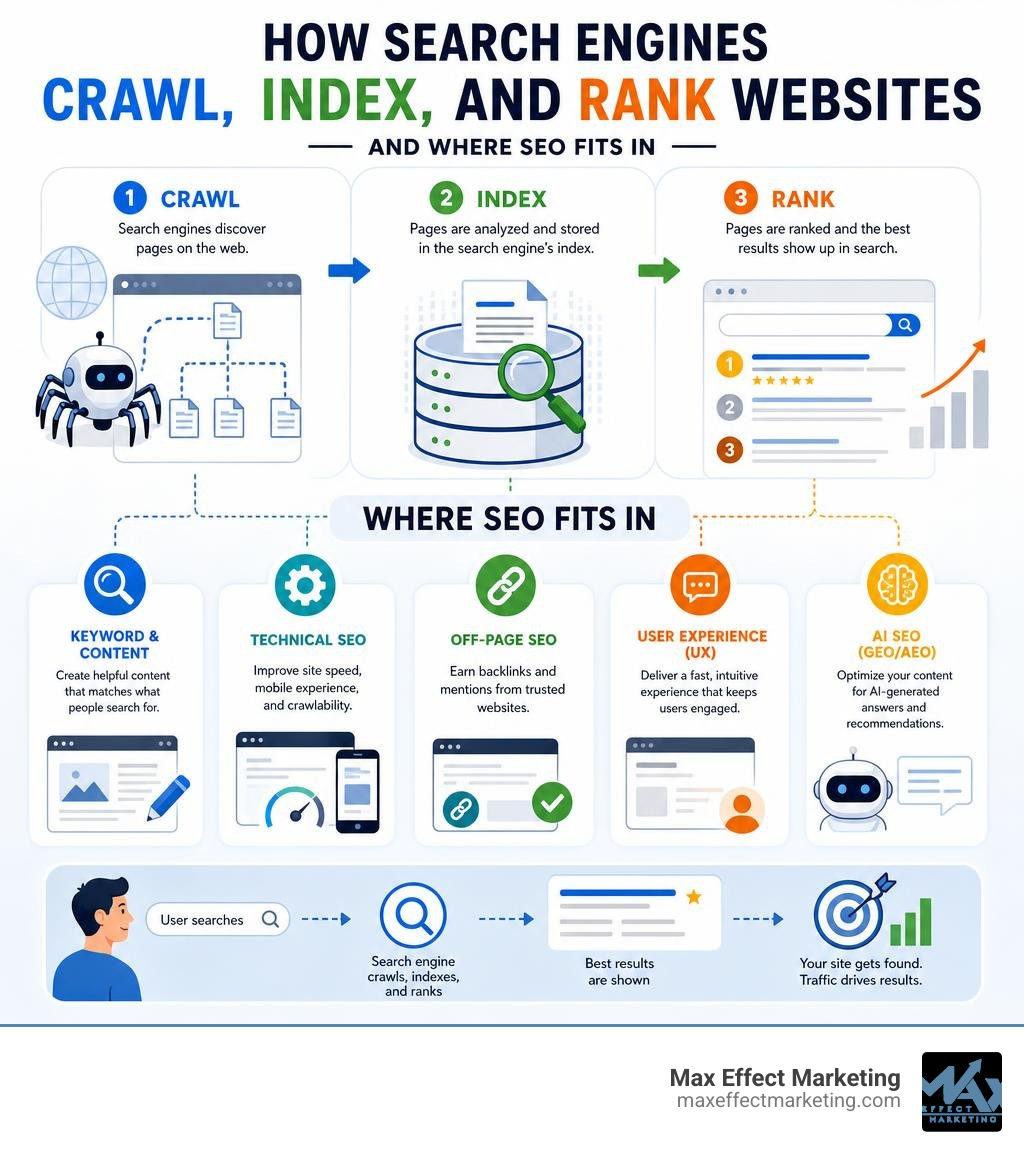
At its core, search engine optimization is the art and science of aligning your digital presence with what search engines—and more importantly, your prospective customers—are looking for. When we talk about seo and marketing services, we aren’t just talking about stuffing a few keywords into a paragraph and hoping for the best. We are talking about a comprehensive strategy that connects search intent to real business outcomes.
Every time someone types a query into Google, they have a specific goal. They might want to learn how to fix a leaky pipe (informational intent), compare the best coffee makers (commercial intent), or buy a pair of running shoes (transactional intent). In fact, search intent is highly skewed toward informational queries, which make up roughly 52.65% of Google searches, compared to only 0.69% for transactional queries.
By understanding this behavior, we can design Online Campaigns that capture users at the very top of the funnel and guide them down to a conversion. When your website consistently answers these queries, search engines reward you with visibility. That visibility translates into organic clicks—which are incredibly valuable because they carry zero ad-spend cost. Because these users are actively seeking your solutions, organic traffic boasts highly competitive conversion rates compared to cold social media ads.
To help you understand the landscape, let’s look at how organic SEO stacks up against Paid Ads (PPC):
| Feature | Organic SEO | Paid Ads (PPC) |
|---|---|---|
| Upfront Cost | Moderate to High (Time/Agency fees) | Low (Pay per click instantly) |
| Ongoing Cost | Low (Mainly maintenance and content) | High (Stops the moment budget runs out) |
| Speed of Results | Slow (Typically takes 4 to 6 months) | Instant (Traffic starts within hours) |
| Long-Term ROI | Exceptional (Average of $22 earned per $1 spent) | Moderate (Tied directly to ad spend margins) |
| Credibility | High (Users trust organic results over ads) | Moderate (Some users actively skip sponsored links) |
While paid ads are fantastic for short-term lead generation, relying solely on them means you are renting your traffic. Organic SEO is like buying real estate; once you own the top spots, they continue to generate leads and revenue with minimal ongoing costs.
The Timeline and Cost of Organic Growth
One of the most common questions we hear is: “If I hire an agency for SEO and marketing services today, when will I see a return on my investment?”
The honest answer is that sustainable SEO takes time. Most campaigns require 4 to 6 months to begin showing meaningful, revenue-generating results. Why? Because search engines need time to crawl your new content, recognize your updated site architecture, and index your growing backlink profile. It is a compounding process—like compound interest in a savings account.
During the first 30 to 60 days, the focus is on fixing technical errors, optimizing existing pages, and executing deep keyword research. By months 3 and 4, search engines start recognizing these optimizations, and you will see your keyword rankings climb. By months 5 and 6, those ranking improvements translate into a steady climb in organic traffic and conversions.
In terms of cost, professional SEO services typically operate on a monthly retainer model, ranging anywhere from $1,000 to $5,000+ per month depending on your industry’s competitiveness. While that might seem like a commitment, the long-term ROI makes it highly cost-effective. For businesses that need leads immediately while their organic foundation is being built, we often recommend integrating paid strategies. You can learn more about this dual approach in our guide on Google Ads for Small Businesses: A Smart Way to Generate More Leads.
The Core Pillars of SEO and Marketing Services
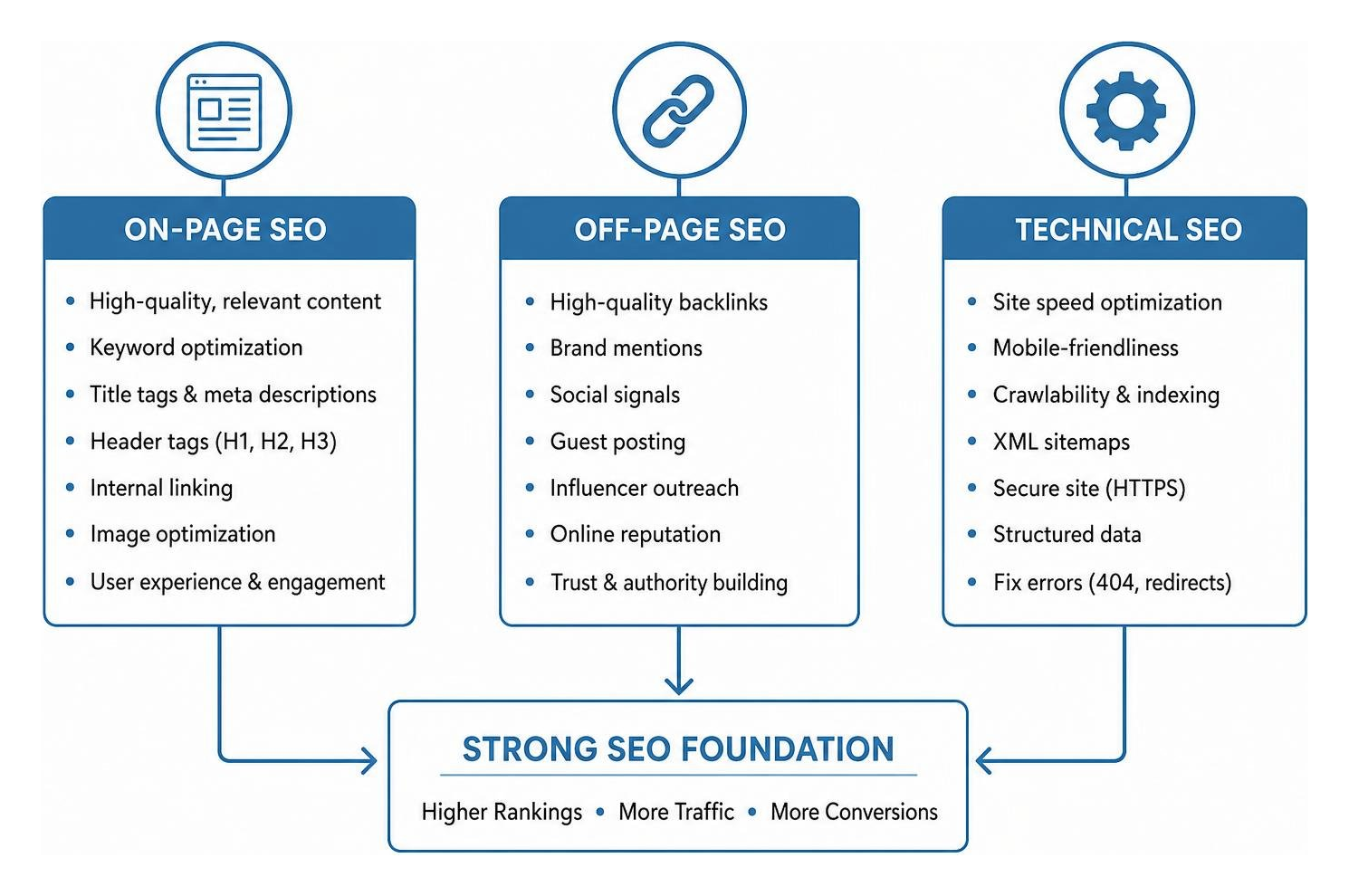
Search engine ranking algorithms are incredibly complex, evaluating hundreds of signals to determine which page deserves the top spot. However, we don’t need to get lost in the weeds. To make search engine optimization work for you, we focus on three core pillars: On-Page SEO, Off-Page SEO, and Technical SEO.
Think of your website like a high-performance sports car. Technical SEO is the engine under the hood; On-Page SEO is the sleek, aerodynamic body and comfortable interior; and Off-Page SEO is the reputation and track record that makes people want to drive it. If your cousin’s friend built you a beautiful website that looks great but lacks a solid technical structure, search engines won’t be able to crawl or index it. It’s like having a sports car with no engine—it looks nice in the driveway, but it isn’t going anywhere.
Demystifying On-Page SEO and Marketing Services
On-page SEO is all about optimizing the elements on your website so search engines can easily understand what your pages are about. This begins with comprehensive keyword research to identify the phrases your target audience actually types into search bars.
Once we have our target keywords, we optimize several key areas:
- Content Optimization: Writing high-quality, comprehensive text that thoroughly answers the user’s search intent. This means keeping paragraphs short (2 to 3 sentences), using clear headings, and avoiding “keyword stuffing.”
- HTML & Metadata: Crafting compelling title tags (under 60 characters) and meta descriptions (under 160 characters) that encourage users to click through from the search results page.
- Website Architecture: Structuring your site logically so that both users and search crawlers can navigate it effortlessly.
- Internal Linking: Linking relevant pages together using descriptive anchor text, which helps distribute “ranking power” across your site.
A highly effective way to build topical authority and target long-tail keywords is through high-quality Blogs. When you regularly publish articles that address real industry challenges and answer customer questions, search engines view your site as a trusted resource.
Off-Page Authority and Local SEO Strategies
If On-Page SEO is what you say about yourself, Off-Page SEO is what the rest of the web says about you. The most critical element of off-page optimization is backlink building—acquiring links from other authoritative, reputable websites. Think of each high-quality backlink as a vote of confidence. Google’s algorithm views these votes as proof that your content is trustworthy and valuable.
For businesses that serve a specific geographic area, local SEO is the ultimate game-changer. Local search engine optimization ensures that when someone searches for your services “near me,” your business appears in the coveted Google Local Map Pack.
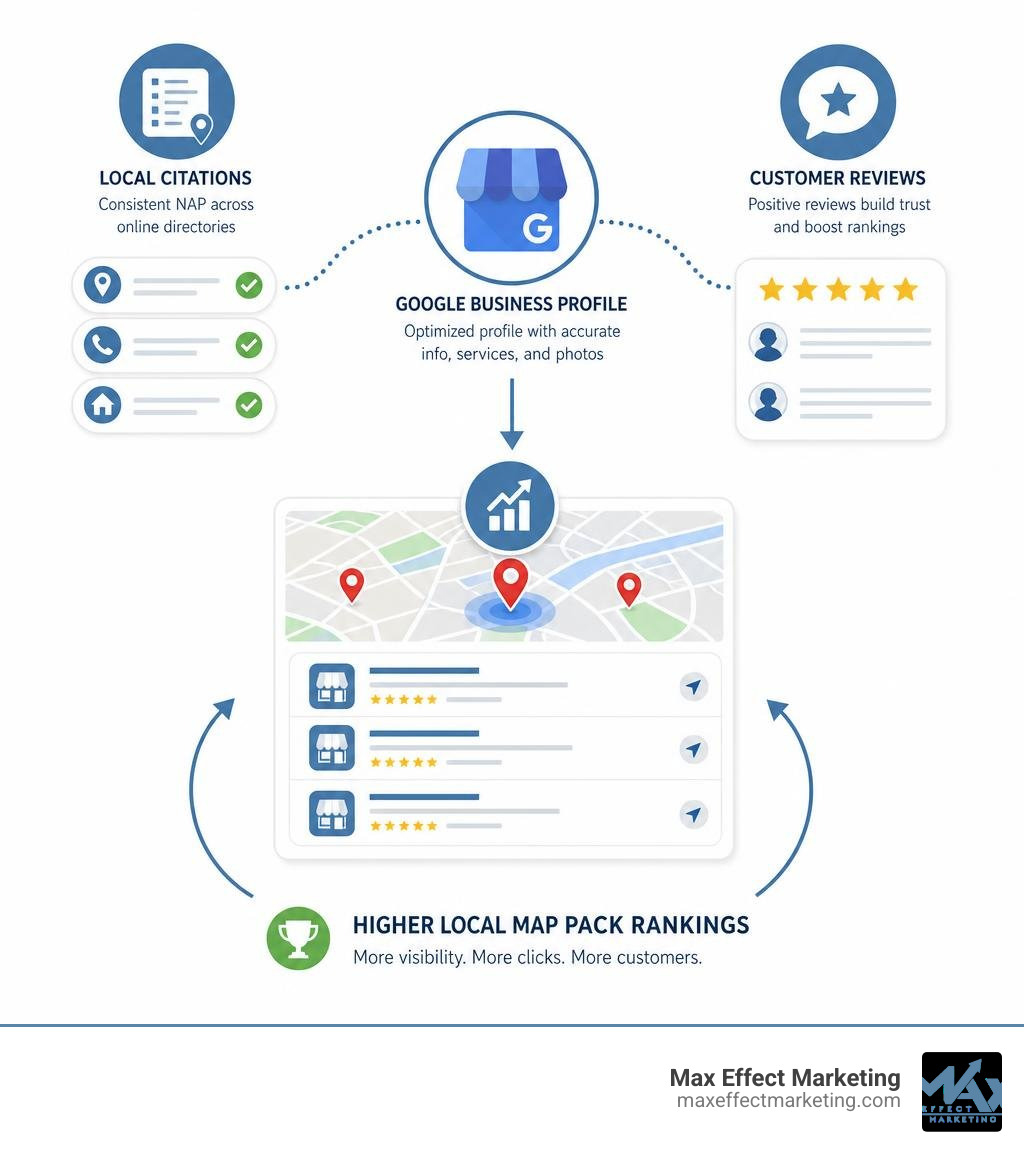
To win at local SEO, we focus on:
- Google Business Profile: Claiming, verifying, and meticulously optimizing your profile with accurate hours, services, and photos.
- Local Citations: Ensuring your Name, Address, and Phone number (NAP) are 100% consistent across all online directories (like Yelp, YellowPages, and local chambers of commerce).
- Customer Reviews: Actively encouraging happy customers to leave positive reviews, which directly influences local rankings.
If you want to dive deeper into why local search is so critical, check out our resource on Local SEO for Small Businesses: Why It Matters in 2026. To learn how to combine organic local maps with targeted local advertising, read our guide on Stop Being Invisible: How Local Search Advertising Puts Your Business on the Map.
Technical SEO: Building a Flawless Foundation
Technical SEO focuses on the backend of your website, ensuring that search engine spiders can crawl, render, and index your pages without running into roadblocks. If your technical foundation is broken, even the best content in the world won’t rank.
Key areas of technical optimization include:
- Website Speed & Core Web Vitals: Google rewards fast-loading websites because they offer a better user experience. Slow load times lead to high bounce rates, which hurt your rankings.
- Mobile-First Indexing: Over 58% of global online searches come from mobile devices. Google ranks websites based on how well they perform on mobile, making responsive Web Design absolutely non-negotiable.
- Website Security (HTTPS): Securing your site with an SSL certificate is a standard security requirement and a direct ranking signal.
- XML Sitemaps & Robots.txt: Providing search engines with a clear map of your site while instructing them on which pages to ignore (like duplicate print-friendly pages) to maximize your crawl budget.
Traditional SEO vs. AI SEO: Navigating the New Era of Search
The search landscape is undergoing its most significant evolution in decades. With the rise of large language models (LLMs) like ChatGPT, Claude, Perplexity, and Gemini, the way people find information is shifting.
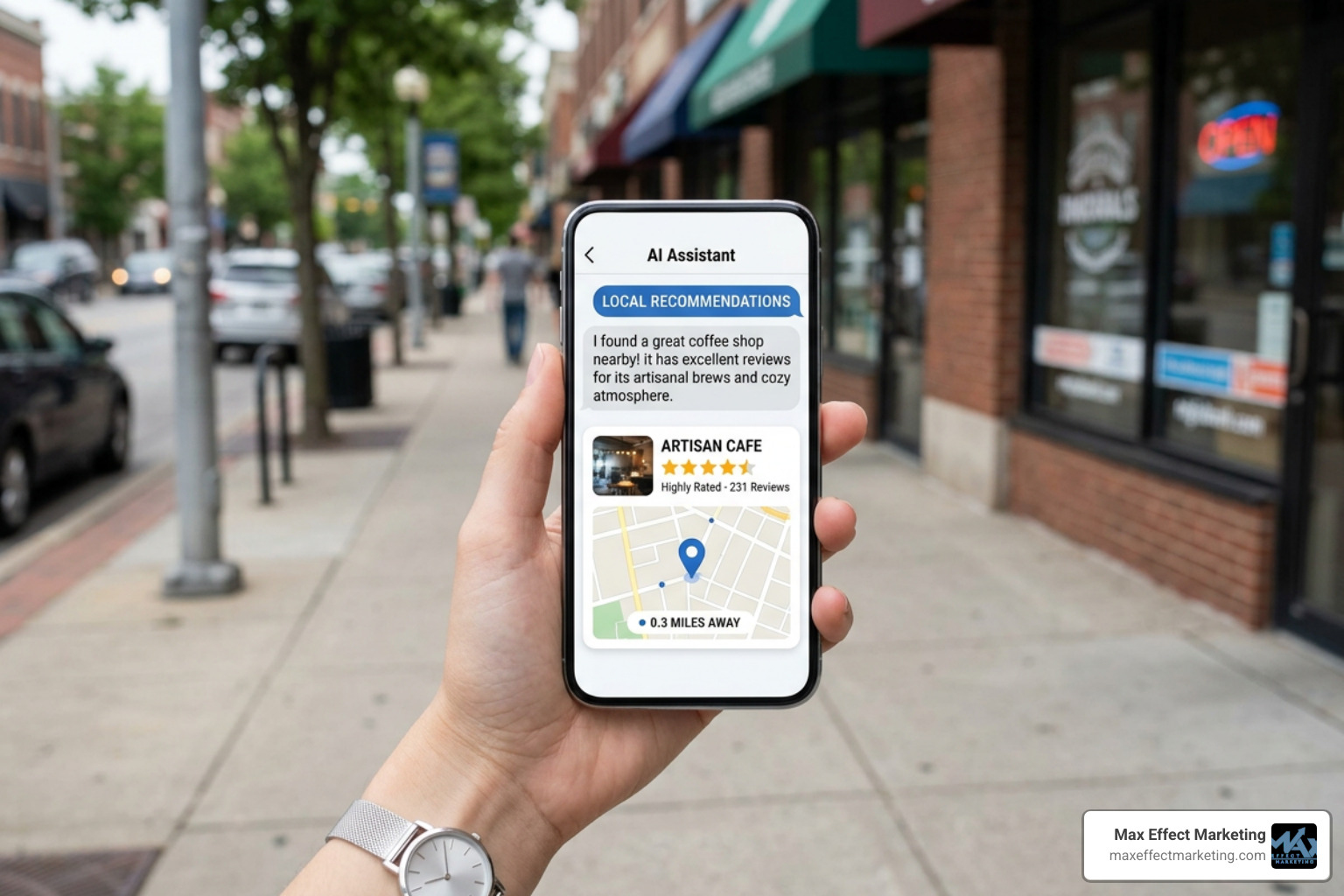
We are moving from a world of “ten blue links” to a world of conversational answers. This has birthed two new disciplines: Generative Engine Optimization (GEO) and Answer Engine Optimization (AEO).
Traditional SEO focuses on ranking a page in search engine results. AI SEO focuses on getting your brand cited and recommended inside the answers generated by AI assistants. Because AI models synthesize information from across the web, being cited by an LLM is the new page-one ranking.
To optimize for AI search, we structure content with self-contained, highly factual answers, implement robust schema markup, and build strong off-page digital footprints (including PR and podcast transcriptions) that AI models use during their training and real-time searches.
How to Choose the Right SEO and Marketing Services for Your Business
Choosing an agency partner is a major decision. Unfortunately, the market is flooded with providers offering cookie-cutter, templated packages that do little to drive actual revenue. To make sure you partner with an agency that acts as a true extension of your team, you need to know what to look for.
A great agency will always start with a custom strategy tailored to your industry, goals, and current digital footprint. They will also offer transparent, performance-driven contract terms—such as month-to-month agreements—rather than locking you into rigid 12- or 24-month commitments.
If you are evaluating local providers, we highly recommend reading The Ultimate Guide to the Best SEO Company Denver Options and Don’t Get Burned by the Best SEO Denver Agencies to protect your investment.
To help you navigate the hiring process, watch out for these major agency red flags:
- Guaranteed Rankings: No one can guarantee a #1 spot on Google because search algorithms change daily. Anyone promising this is likely using risky “black hat” techniques that can get your site penalized.
- Lack of Transparency: If an agency refuses to explain their process, show you where they are building links, or give you direct access to your analytics, walk away.
- No Written Work-Hour Guarantees: Reputable agencies should clearly state how many hours of dedicated work are being put into your campaign each month to avoid automated, template-only delivery.
- Extremely Low Pricing: Quality SEO requires skilled copywriters, developers, and strategists. If a package costs $150/month, you are likely getting automated spam that will hurt your brand long-term.
Frequently Asked Questions
How do you measure and track SEO success?
We measure success using hard data that connects directly to your bottom line. While tracking keyword rankings and organic traffic growth is important, the ultimate metrics are goal completions, lead quality, and transaction revenue. By integrating your website analytics with a robust CRM, we can track exactly how a user found your site, what content they engaged with, and how much revenue they generated for your business.
What are the most common SEO myths and pitfalls to avoid?
The biggest pitfall is chasing search volume instead of search intent. Ranking #1 for a high-volume keyword that has nothing to do with your services won’t generate sales. Other common myths include believing that keyword stuffing still works (it doesn’t and will get you penalized), that duplicate content is fine, or that buying cheap, spammy backlinks is a shortcut to authority. To see how a clean, strategic approach drives real results, take a look at our Case Study page.
Does AI SEO replace traditional SEO services?
No, AI SEO does not replace traditional SEO—it builds directly on top of it. Large language models and AI search engines still rely on crawled web data, fast-loading pages, high-quality backlinks, and structured data to find and trust information. A great digital marketing strategy combines traditional search engine optimization with forward-looking AI optimization. To see how we integrate these cutting-edge techniques with our other marketing channels, explore our Additional Services.
Conclusion: Ready to Scale Your Revenue?
At the end of the day, seo and marketing services shouldn’t be a line-item expense that leaves you guessing. They should be a predictable, high-performing growth engine.
At Max Effect Marketing, we do things differently. We are an AI-powered digital marketing agency that believes in combining advanced, intelligent technology with real human partnerships. We don’t focus on vanity metrics or confusing jargon; we focus on delivering a 5X ROI for our clients.
Whether you want to dominate local search, optimize your brand for the next generation of AI engines, or build a beautiful, fast-loading website that converts visitors into customers, we have the expertise to make it happen.
To learn more about who we are and our values, visit our About Us page. If you are ready to stop being invisible and start scaling your business, Contact us today.
Let’s build something great together. Claim Your Free Growth Offer and get a custom competitor strategy review for your business.