
Why the Benefits of TV Ads Still Matter in 2026
The benefits of TV ads are more relevant today than most marketers realize — even as social media budgets balloon and digital-first strategies dominate the conversation.
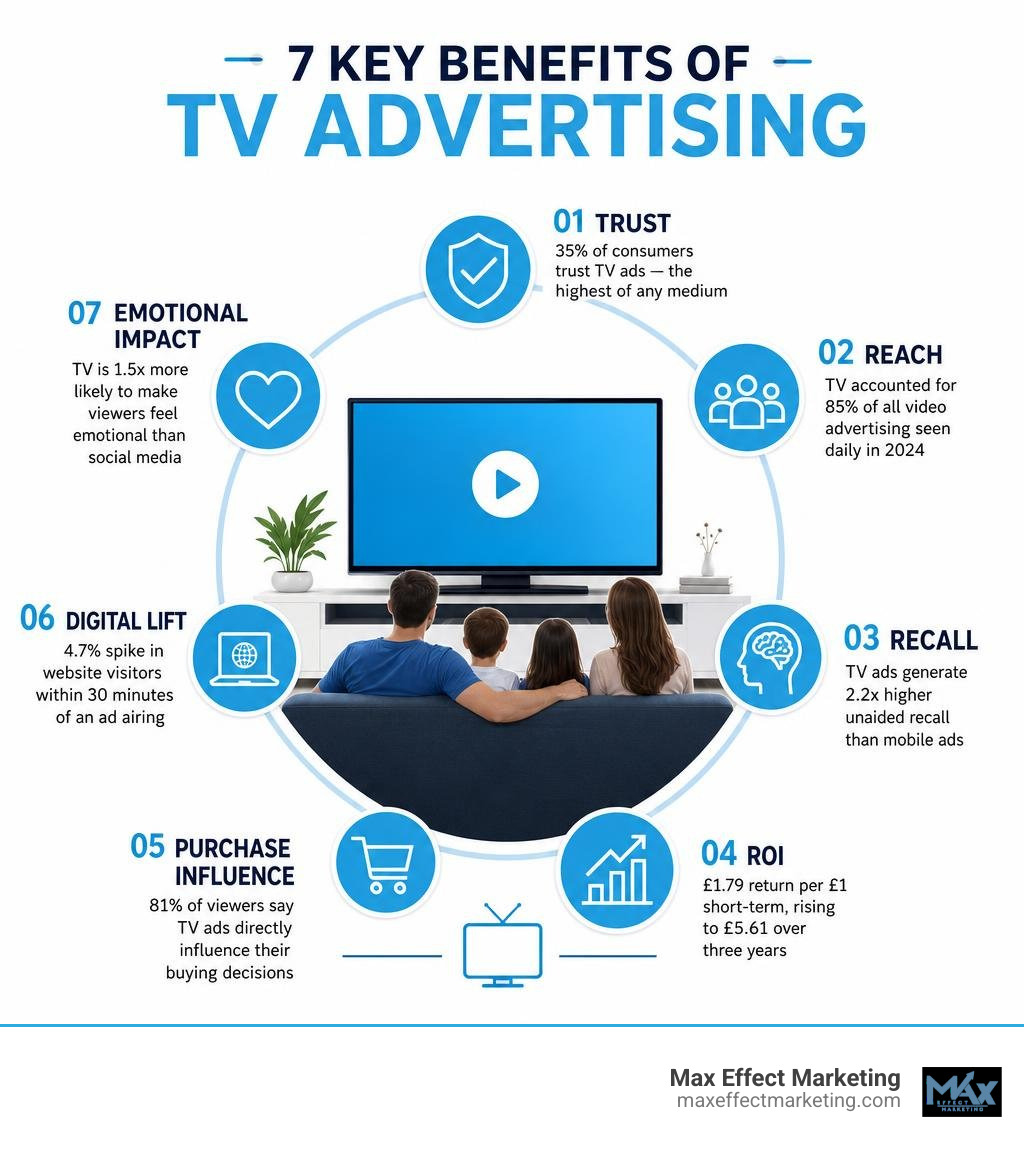
Here’s a quick snapshot of why TV advertising still delivers:
| Benefit | What the Data Shows |
|---|---|
| Trust | 35% of consumers trust TV ads — the highest of any medium |
| Reach | TV accounted for 85% of all video advertising seen daily in 2024 |
| Recall | TV ads generate 2.2x higher unaided recall than mobile ads |
| ROI | £1.79 return per £1 short-term, rising to £5.61 over three years |
| Purchase influence | 81% of viewers say TV ads directly influence their buying decisions |
| Digital lift | 4.7% spike in website visitors within 30 minutes of an ad airing |
| Emotional impact | TV is 1.5x more likely to make viewers feel emotional than social media |
Think TV is a legacy channel running on nostalgia? Think again.
Global TV and video ad spend topped $103 billion in 2025. Streaming services like Netflix and Amazon Prime Video now carry ads. And tools like Sky AdSmart let brands serve different commercials to different households — during the same program.
TV has not faded. It has evolved.
If your marketing budget is burning through clicks without building real brand equity, TV advertising may be the missing piece. It’s no longer reserved for big corporations with massive budgets. Connected TV (CTV) campaigns can start for as little as $50 — and they reach audiences that digital ads simply can’t convert on their own.
I’m David Bauer, Vice President at Max Effect Marketing, and over my 14+ years running integrated advertising campaigns across TV, Google, Meta, and beyond, I’ve seen how understanding the benefits of TV ads can transform a brand’s performance — particularly for businesses stuck in a cycle of high spend and low return. In the sections below, I’ll walk you through exactly why TV belongs in your media mix.
Basic benefits of tv ads vocab:
1. Unmatched Trust and the “As Seen on TV” Halo Effect

When almost anyone can launch a digital ad campaign in under five minutes with a credit card and stock graphics, consumers have developed a healthy dose of skepticism. The rise of clickbait, fake news, and sketchy social media sponsors has left audiences craving legitimacy.
This is where the psychological “trust halo” of television comes into play. When a consumer sees your brand on the big screen, they make an immediate subconscious assumption: This brand is legitimate, established, and successful enough to afford television.
The data back this up. According to Thinkbox, 42% of people are more likely to trust TV advertising, compared to a meager 5% who trust social media promotions. In the UK, 35% of consumers trust TV ads (the highest of any medium), while social media sits at 6% and YouTube at 4%. Furthermore, local broadcast TV news is trusted by 70% of consumers, compared to only 47% for social media.
When you align your brand with trusted local news broadcasts or premium entertainment networks, that credibility transfers directly to you. This phenomenon, often explored in The Benefits of TV Commercials: TV Still Give Real Results? , acts as a powerful priming mechanism. It lowers consumer resistance, making every subsequent digital touchpoint—whether it’s a search ad, a retargeting banner, or a cold email—significantly more effective.
2. Massive Reach Meets Precision Targeting in the Streaming Era

Historically, the primary critique of television was that it was a “spray-and-pray” medium. You bought a commercial spot during a popular program, broadcasted it to millions of households, and hoped that a small fraction of those viewers matched your ideal customer profile.
In 2026, that limitation is entirely gone. Today’s television landscape is a hybrid ecosystem where massive linear reach meets the surgical targeting precision of digital ad tech. We can now categorize TV formats to capture diverse viewing habits:
- Linear TV: Traditional broadcast and cable networks. Despite the rise of streaming, linear TV remains a powerhouse. In June 2025, linear TV accounted for 80.5% of total TV impressions delivered, and cable TV alone captured 24.4% of total viewership in January 2025. It is still the undisputed king of live events, sports, and immediate mass reach.
- Connected TV (CTV): Smart TVs and devices connected to the internet (such as Roku, Apple TV, or gaming consoles) that stream video content.
- Broadcast Video-on-Demand (BVOD): On-demand streaming services provided by traditional broadcasters (e.g., ITVX, Channel 4, My5).
- Subscription Video-on-Demand (SVOD): Paid streaming services like Netflix, Hulu, and Prime Video, many of which now offer highly popular, ad-supported tiers.
With modern addressable advertising technology, like Sky AdSmart, we no longer have to choose between reach and relevance. We can serve different commercials to different households watching the exact same program based on their geographic location, household demographics, financial profiles, and lifestyle interests. You can learn more about how to structure these campaigns in our A Practical Guide to Advantages of Advertising on Television.
The Modern Benefits of TV Ads for Cord Cutters
The narrative that “everyone is cutting the cord, so TV ads are useless” is fundamentally flawed. Cord-cutters haven’t stopped watching television; they have simply shifted how they watch it.
To capture these audiences, premium streaming services have introduced ad-supported subscription tiers. This has democratized premium inventory, allowing brands of all sizes to place their message alongside award-winning, highly engaging content.
Depending on where your audience hangs out, you can strategically allocate your budget across multiple streaming platforms:
- To reach viewers who have completely abandoned traditional cable but still watch live events and news, you can explore YouTube TV Ads: What You’ll Pay to Reach Cord Cutters.
- If you want to target specific household demographics during highly popular, on-demand TV series, check out The Ultimate Guide to the Cost of Hulu Ads.
- For brands looking to maximize their visual impressions on a budget, free ad-supported streaming television (FAST) platforms are highly effective. You can learn how to execute this in our guide to Pluto TV Ads: Reach Cord Cutters on a Budget.
- If you want to place your brand alongside premium, cinematic blockbusters and exclusive live sports, you can leverage Prime Video Ads: Your Brand Alongside Premium Content.
3. Emotional Storytelling That Drives Long-Term Brand Loyalty
Have you ever cried at a banner ad? Have you ever felt a deep sense of inspiration or nostalgia from a sponsored social media post that you scrolled past in 1.7 seconds? Probably not.
Digital feeds are designed for rapid, low-attention consumption. Television, however, is a lean-back, high-attention medium. When viewers sit in front of the television, they are looking at a full screen with no competing tabs, sidebars, or immediate notifications. While mobile ads struggle to capture 30% visual attention, TV environments command a massive 71% visual attention.
This captive environment allows brands to utilize the full sensory power of sight, sound, motion, and narrative pacing. This combination is highly effective at triggering emotional responses:
- Emotional Resonance: TV ads are 1.5 times more likely to evoke an emotional response than social media ads, and 3.7 times more likely than YouTube ads.
- The Power of Storytelling: Emotional connections drive consumer behavior. In fact, an emotional response to an ad increases purchase intent by a factor of 3-to-1 for television commercials.
- Superior Recall: Because of this deep engagement, ads viewed on television screens generate 2.2 times higher unaided recall compared to the exact same creative viewed on mobile devices.
By telling a complete story with characters, music, and conflict resolution, you aren’t just pitching a product; you are building long-term brand equity and loyalty that keeps your business top-of-mind for months—or even years—to come.
4. The Surprising ROI and Financial Benefits of TV Ads
Many marketers mistakenly believe that TV advertising is a massive financial risk with hard-to-prove returns. However, historical data and modern meta-analyses consistently show that television is one of the most profitable channels available.
According to long-term effectiveness studies, TV advertising delivers an average short-term ROI of £1.79 per £1 invested (within 3 to 6 months). That return rises to a staggering £5.61 per £1 invested when measured over a three-year period.
Furthermore, TV advertising generates 70% of all advertising-driven profit—the highest share of any major marketing channel. It achieves this because of its powerful synergy with digital channels. Academic research published in the Effectiveness and Efficiency of TV’s Brand-Building Power: A Historical Review reveals that the optimal media spending mix for a generalized brand campaign is approximately 75% traditional (primarily TV) and 25% digital.
When TV acts as the anchor of your marketing campaign, it primes the market. Viewers who are already familiar with your brand from television are 40% more likely to click on your subsequent digital search and social ads, dramatically lowering your digital cost-per-acquisition (CPA).
5. Seamless Multi-Platform Integration and Second-Screen Viewing
One of the most exciting shifts in modern consumer behavior is “second-screening.” Rather than viewing the phone as a competitor to the television, smart advertisers realize that the mobile device is actually a direct-response vehicle for the TV screen.
When a commercial airs, viewers don’t just sit passively; they react. Research shows:
- There is an average 4.7% lift in visitors to a brand’s website within 30 minutes of an ad airing on TV.
- This initial spike is followed by a 3x to 6x lift in web traffic throughout the rest of the week, with a 23% prolonged traffic carry-over effect lasting for a full month.
- According to the 2026 Purchase Funnel Study , a massive 89% of consumers state that linear TV ads directly influence their subsequent online search selections.
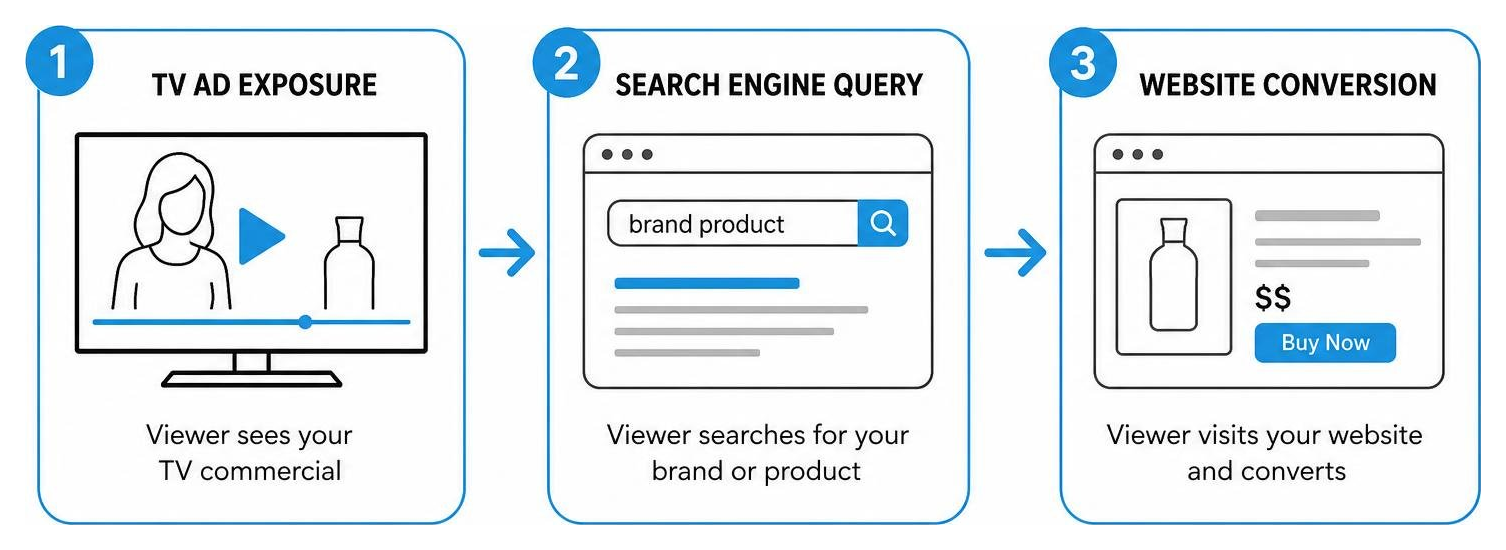
When a viewer sees your commercial, they immediately grab their smartphone to search for your product, look up reviews, or complete a purchase. This turns your offline brand-building asset into a massive driver of online conversions, creating a seamless, multi-platform consumer journey.
6. Advanced Tracking and Digital-Level Accountability
If you still think TV advertising is untrackable, it’s time to update your playbook. The days of relying solely on broad, delayed Nielsen ratings are over. Today, television advertising features digital-level accountability.
Through Automatic Content Recognition (ACR) technology built into millions of smart TVs, we can track exactly which households saw your commercial, down to the exact second. We can then cross-reference this viewing data with digital attribution software to measure:
- Immediate spikes in branded search queries.
- Direct visits to your website or app downloads within a specific window of the ad airing.
- Online conversions, e-commerce transactions, and even physical, in-store foot traffic.
Maximizing the Benefits of TV Ads Through Real-Time Data
By pairing smart TV viewership logs directly with household purchase history and digital app usage, we can move past basic demographic assumptions and focus on true behavioral outcomes.
However, we must also be smart about how we analyze this data. As highlighted in the groundbreaking research, Traditional TV ads are far less effective than believed, according to real-time viewership data – Notre Dame Business Mendoza College of Business , traditional ratings-based tracking methods can overestimate TV ad effectiveness by up to 55% because they fail to isolate pre-existing consumer habits from actual ad influence.
To solve this, we use advanced attribution models that isolate the exact timing of your ad spots. By comparing households that were exposed to the ad against a control group of similar households that were not, we can measure the true, uninflated sales lift. This granular accountability ensures that every dollar of your media spend is optimized for real business growth.
7. Democratized Costs: TV Advertising is No Longer Just for Giants
Perhaps the greatest modern benefit of TV ads is that the barrier to entry has been completely shattered. You no longer need a million-dollar national broadcast budget to get your business on television.
With Connected TV (CTV) and addressable advertising, small and medium-sized businesses can launch highly localized campaigns for as little as $50. If you are a local service provider, a regional retail chain, or a growing e-commerce brand, you can target only the specific ZIP codes, cities, or demographic profiles that make sense for your business, eliminating wasted ad spend.
To see how the options stack up, let’s look at a practical comparison:
| Feature | Linear TV Advertising | Connected TV (CTV) / Streaming |
|---|---|---|
| Audience Reach | Massive, simultaneous reach (ideal for sports & live events) | Highly engaged, on-demand audiences and cord-cutters |
| Targeting Basis | Broad demographics (age, gender), programming, & regions | Precise behavioral, geographic, household, & interest data |
| Minimum Budget | Typically higher upfront commitments | Highly flexible; campaigns can start as low as $50 |
| Ad Delivery | Full-screen, unskippable, premium content | Full-screen, unskippable, with completion rates >94% |
| Attribution | Regional lift, baseline web traffic spikes, & ACR models | Digital-level tracking, direct IP matching, & conversion paths |
Additionally, the cost of commercial production has dropped significantly. Thanks to modern digital editing suites and advanced creative tools, we can repurpose your existing high-quality social video assets, product photography, and digital graphics into stunning, broadcast-compliant TV commercials without the need for an expensive, multi-week on-location shoot.
For a transparent breakdown of what it actually takes to get your brand on air, check out Don’t Break the Bank: What It Really Costs to Run a Commercial on TV and explore our The Complete Guide to OTT and CTV Ad Rates. If you are evaluating different partners to help you launch, we recommend reading A Quick Start Guide to Comparing TV Ad Service Providers.
Frequently Asked Questions about TV Advertising
Does TV advertising still work in the digital age?
Yes, absolutely. TV advertising has evolved into a digital-hybrid channel. While it still offers the massive reach, credibility, and emotional storytelling power of traditional television, it now includes advanced digital targeting and real-time tracking capabilities. It acts as a powerful multiplier that directly increases the performance and conversion rates of your search, social, and email marketing efforts.
How do you measure the ROI of TV advertising?
We measure TV ad ROI by combining traditional media metrics with advanced digital attribution. By using Automatic Content Recognition (ACR) data from smart TVs, we can link ad exposures directly to downstream actions, such as immediate website traffic spikes, increases in branded search volume, app downloads, and direct-to-consumer sales. This allows us to track your return on investment with high precision.
Can small businesses afford television advertising?
Yes. Thanks to Connected TV (CTV) and addressable advertising, small businesses can run highly targeted local campaigns with budgets starting at just $50. You only pay to serve your ads to your exact target audience in your specific service area, making modern TV advertising incredibly cost-effective for businesses of all sizes.
Conclusion
The debate is over: television advertising is not a relic of the past. It is a highly sophisticated, deeply trusted, and incredibly powerful medium that bridges the gap between massive brand awareness and immediate digital action.
When you harness the benefits of TV ads, you give your brand a level of credibility, emotional connection, and market reach that digital-only campaigns simply cannot replicate.
At Max Effect Marketing, we specialize in helping businesses navigate this modern TV landscape. As an AI-powered digital marketing agency, we combine intelligent technology with real human partnerships to design, execute, and optimize data-driven campaigns that deliver an outstanding 5X ROI.
Ready to see your business on the biggest screen in the house without breaking the budget? Explore Don’t Break the Bank: What It Really Costs to Run a Commercial on TV and let’s work together to make your next campaign your most successful yet. Contact us today to get started!