
Is Your Ad Budget Actually Working? Here’s What the Best Programmatic Ad Companies Do Differently
When looking at programmatic ad companies, they generally fall into a few key categories:
| Platform Type | Best For | Typical Minimum Spend |
|---|---|---|
| Enterprise DSPs | Large-scale campaigns, CTV, open web | High ($50K+/month) |
| Ecosystem-Specific DSPs | Platform-specific inventory (search, retail) | Medium to High |
| Mid-Market DSPs | Native ads, mid-sized B2B campaigns | Medium ($10K/month) |
| Niche & ABM Platforms | Account-based B2B targeting | Custom |
| Self-Serve/SMB Platforms | Retargeting, smaller budgets | Low minimums |
By 2026, over 91.1% of US digital display ad dollars are expected to transact programmatically. That’s nearly every banner, video, and native ad you see online – purchased automatically, in milliseconds, through an algorithm.
And yet, automation does not automatically mean efficiency. A slick dashboard can still hide wasted spend, fuzzy attribution, low-quality inventory, and fees that make your media budget look like it went through a paper shredder wearing a tiny ad-tech hoodie.
Opaque dashboards. Mysterious line items. “Trust us” optimization that nobody can clearly explain. Hidden fees that can quietly consume a major share of media spend before a single ad reaches your audience.
If that sounds familiar, you’re not alone. Too many business owners hand over ad budgets and get back a report full of impressions and clicks – but not the one thing leadership actually asked for: growth.
This guide is not a pitch to chase programmatic advertising just because it sounds advanced. For many businesses, the smarter move is to understand how the ecosystem works, when it makes sense, when it does not, and how to evaluate vendors before budget disappears into the machine. More importantly, programmatic is just one piece of the digital marketing puzzle – and it is not always the right piece to start with.
I’m David Bauer, VP at Max Effect Marketing, with 14+ years helping businesses evaluate digital advertising channels across Google, Meta, YouTube, analytics, and broader paid media strategy. In this guide, I’ll cut through the jargon around programmatic ad companies so you can ask better questions, protect your budget, and make smarter marketing decisions – whether that means going programmatic or investing in higher-ROI channels first.
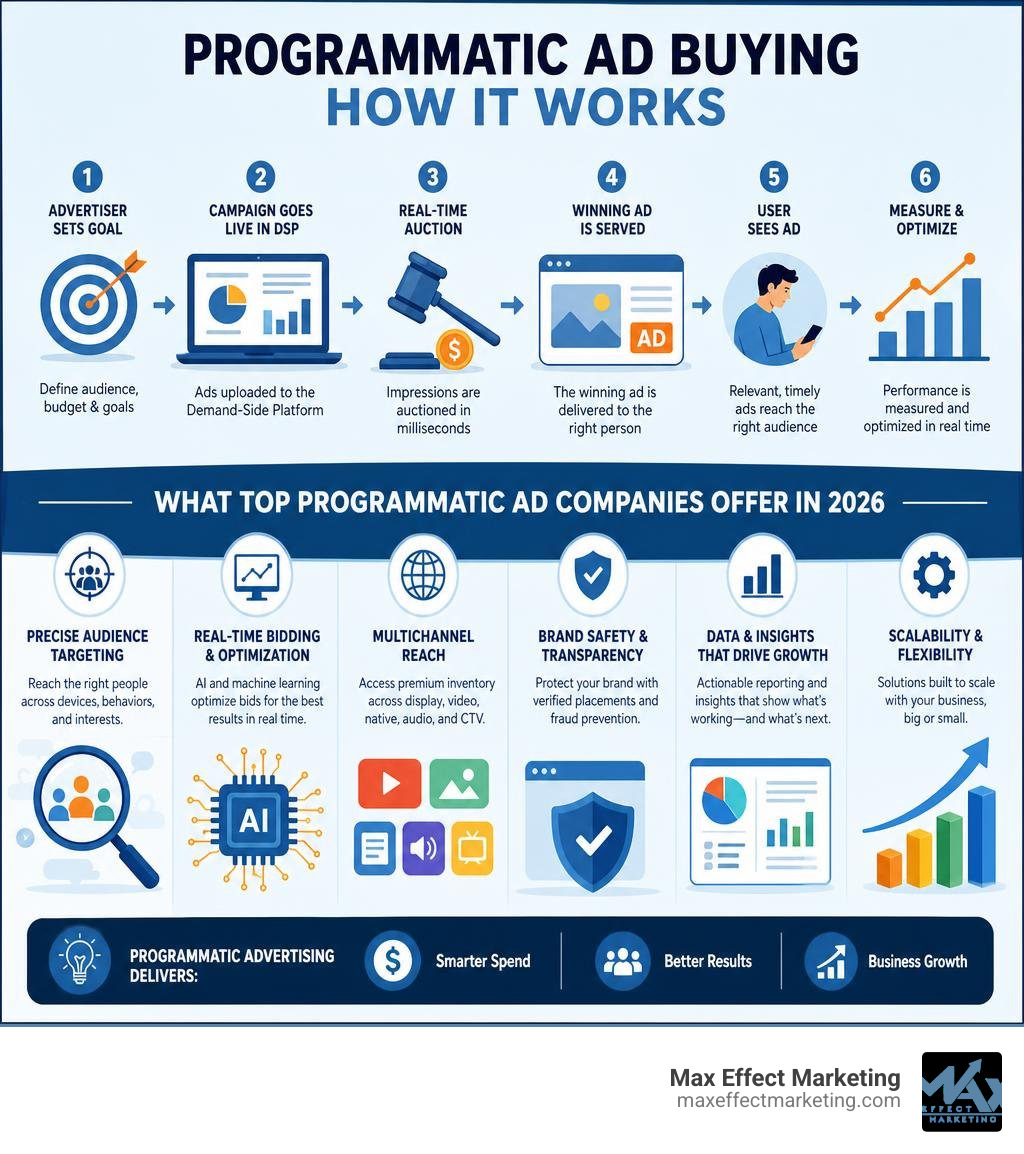
Simple guide to programmatic ad companies terms:
Demystifying the Ecosystem: How Modern Digital Marketing Companies Work
If you have ever tried to read a guide on how modern ad tech works, you probably felt like you needed a PhD in computer science just to buy a banner ad. Let’s strip away the jargon and look at how modern digital marketing companies actually put budget to work.
At its core, programmatic advertising is the automation of buying and selling digital ad space. Instead of a human calling up a publisher, negotiating a price, and manually uploading an ad, software does it in milliseconds.
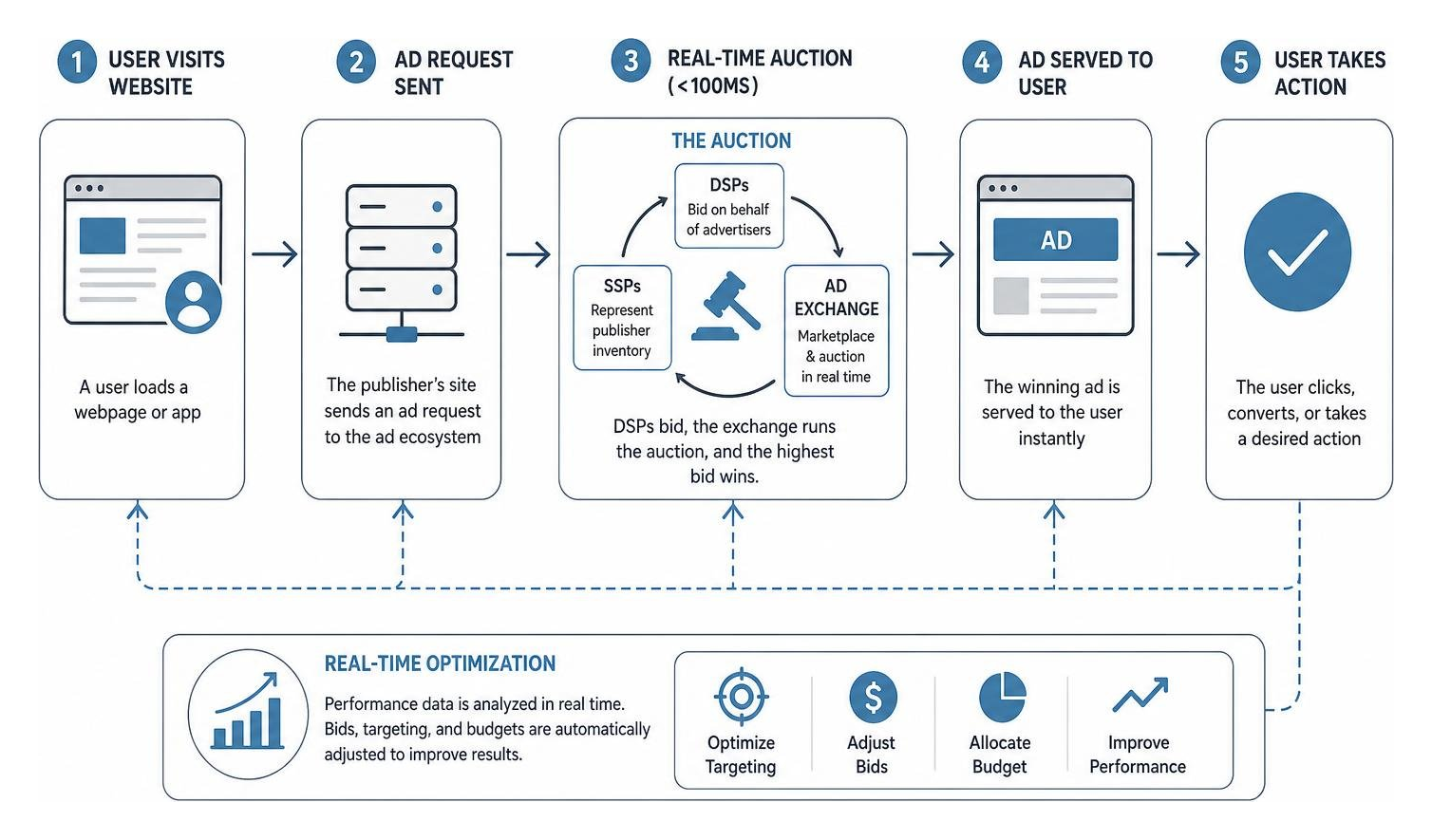
When a user clicks on a webpage, a lightning-fast auction happens behind the scenes. In less than 100 milliseconds, the publisher’s site asks the ad ecosystem: “Who wants to show an ad to this person, on this page, at this moment?”
DSPs, or Demand-Side Platforms, bid on behalf of advertisers. SSPs, or Supply-Side Platforms, represent publishers’ inventory. Ad exchanges act as the marketplace where the transaction happens.
That automation can create highly targeted, data-driven campaigns that adjust bids based on performance signals. However, because the ecosystem has so many moving parts, it is also easy for budget to get diluted by middleman fees, poor inventory quality, and unclear measurement.
That is why education matters. Before choosing a vendor, compare how different companies handle transparency, reporting, audience data, and brand safety. For more context, see The Best Programmatic Digital Advertising Companies That Don’t Waste Your Budget.
The Core Technology Behind High-ROI Ad Campaigns
The magic of modern ad tech is not just automation; it is predictive intelligence. Advanced machine learning algorithms evaluate huge volumes of ad opportunities to estimate which impressions are worth bidding on and which ones should be skipped.
For example, leading enterprise platforms use AI bidding algorithms to improve performance compared with manual optimization. Advanced machine learning bidding systems can also improve CPA over time when campaigns have clean conversion tracking, reliable audience data, and mature Google Analytics 4 (GA4) signals.
Meanwhile, next-generation AI-native ad exchanges like Lumorrow – AI-Native Ad Exchange for Publishers & CTV are rebuilding parts of the auction itself. Instead of bolting AI onto reporting after the fact, these systems use machine learning inside the auction layer to predict fill rates, optimal floor prices, and expected yield in real time.
The important takeaway is simple: technology is only useful when it is tied to business outcomes. Fancy optimization is not impressive if it optimizes toward cheap clicks, irrelevant traffic, or leads your sales team would not touch with oven mitts.
For most businesses, the highest-ROI move is not jumping straight into programmatic. It is making sure your core digital marketing foundations – search campaigns, landing pages, conversion tracking, and audience strategy – are solid first. Programmatic can amplify a strong strategy, but it cannot fix a broken one.
Why B2B Brands Partner with Digital Marketing Agencies
For B2B brands, digital advertising can be a powerful multiplier when it is executed with precision. Unlike broad consumer campaigns, B2B campaigns often need to reach specific decision-makers, buying committees, industries, geographies, and target accounts.
This is where a specialized digital marketing agency can be useful. Instead of chasing cheap impressions or vanity reach, a strong agency prioritizes audience quality, contextual relevance, CRM visibility, and revenue impact. The best partner helps you decide whether programmatic belongs in the mix at all, or whether budget should go toward higher-intent channels first.
But do you actually need a full-service partner? It depends on your internal resources, budget, data quality, and sales cycle. To help you decide, we’ve broken down the pros and cons in our guide: Do You Need a Programmatic Advertising Consultant or a Full Agency?.
A good agency provides pattern recognition, strategic discipline, and technical cleanup that many in-house teams rarely have the time or budget to build from scratch. At Max Effect Marketing, our focus is on data-driven digital marketing strategies – including search, social, video, and paid media – that drive measurable revenue, not just impressions on a dashboard.
Key Advantages and Challenges of Modern Media Buying
In 2026, global programmatic ad spend is expected to surpass $200 billion, accounting for roughly 90% of all global display advertising. The scale and efficiency of this medium are undeniable.

However, with massive scale comes massive complexity. Let’s look at the double-edged sword of modern media buying: the targeting advantages marketers want, and the hidden challenges businesses must understand before committing serious budget.
Precision Targeting and Cookieless Identity Solutions
Digital targeting is changing quickly as privacy rules, browser restrictions, platform policies, and signal loss reshape how marketers reach audiences. The most capable programmatic ad companies are moving toward privacy-first identity solutions rather than relying only on old-school third-party cookies.
One effective strategy is using first-party data responsibly. Customer data can be anonymized, segmented, and modeled to help identify similar audiences without depending on cross-site tracking.
For platforms managing massive datasets, vector databases like Semantic Audience Targeting & Ad Matching for AdTech | Zilliz can help ad platforms handle fast bid-time queries while indexing large volumes of user, content, and contextual signals. This supports semantic audience targeting, which matches ads based on the meaning and context of a page instead of relying only on simple keywords or broad blocklists.
Industry frameworks such as Unified ID 2.0 (UID 2.0) are also used to support addressability in a more privacy-conscious way. The key is not simply whether a platform claims to have an identity graph. The better question is: can it explain how that identity data is collected, governed, measured, and connected to real business outcomes?
Navigating Hidden Costs and Attribution Discrepancies
While precision targeting sounds exciting, managing multiple programmatic platforms introduces real operational challenges.
First, there is the “ad tech tax.” When ads are bought across fragmented platforms, middleman fees can quietly eat up a meaningful portion of budget. Those fees may include platform costs, data costs, verification costs, exchange fees, managed service fees, and other line items that rarely look dramatic individually but add up fast.
Enterprise advertisers also face a multi-platform orchestration problem. Many larger advertisers use multiple DSPs to access different inventory sources, audience data, or video opportunities. That can make sense at scale, but it can also create attribution overlap.
Because each platform wants to claim credit for a sale, multi-platform strategies can suffer from conversion attribution discrepancies. Without unified reporting, clean tracking, and disciplined measurement, you might end up giving multiple platforms credit for the same customer conversion.
That is the part nobody puts on the glossy sales deck. The dashboard says “performance.” Your finance team says, “Please explain why three platforms are high-fiving over one sale.”
How to Choose the Right Marketing Partner for Your Business
Finding the right digital marketing partner is not about choosing the company with the flashiest dashboard. It is about finding a team that aligns with your business goals, understands your budget, and treats your ad spend as if it were their own.
At Max Effect Marketing, our broader approach to Online Campaigns focuses on revenue-driving metrics rather than vanity impressions. Whether a business is evaluating search, social, video, retargeting, analytics, or other paid media options, the goal should be the same: profitable growth. We help businesses figure out which channels deserve budget right now – and programmatic may or may not be one of them.
Here is how to evaluate potential partners so your budget is used effectively.
Evaluating Agencies vs. In-House Platforms
One of the first decisions you’ll face is whether to build an in-house advertising operations team or hire a managed agency.
Taking media buying in-house can be appealing because it gives you more direct control. However, the operational overhead can be steep. Running advanced campaigns effectively may require platform specialists, analysts, creative support, tracking expertise, landing page optimization, and someone brave enough to explain attribution to the executive team without using interpretive dance.
If your annual paid media budget is modest, the cost of hiring specialized talent can quickly exceed the value of the extra control. In that case, a managed agency partner may provide faster access to expertise, cleaner reporting, and a more realistic path to optimization.
A strong agency does not just push one channel because it sounds sophisticated. It helps you decide which channels deserve budget, which ones should wait, and what tracking must be fixed before scaling. That is exactly the approach we take at Max Effect Marketing – we focus on the digital marketing channels that will actually move the needle for your business.
To see how strategic campaign execution can support business growth, take a look at our Portfolio Item: Online Campaigns.
Critical Selection Criteria: Budget, Omnichannel, and Tech Stack
When auditing prospective programmatic ad companies or broader digital marketing partners, use this three-part checklist to ensure they fit your business:
- Budget Tier Alignment: Make sure minimum spend requirements match your realistic budget. If a platform or vendor is built for $50,000/month accounts and your budget is $10,000/month, you may not receive the attention or flexibility you need.
- Omnichannel Fit: Does your audience actually spend time on Connected TV (CTV), digital audio, niche industry sites, search, social, or email? The right mix depends on buyer behavior, not trend-chasing.
- Martech Stack Compatibility: Your advertising and analytics should connect with your CRM, such as HubSpot or Salesforce, and your analytics platform, such as GA4. If the technology does not integrate with your existing stack, you may end up with siloed data and broken attribution.

Frequently Asked Questions About Modern Digital Advertising
What is the difference between self-serve platforms and managed agency services?
Self-serve platforms give your internal team direct access to advertising tools so you can set up, optimize, and manage campaigns yourself. This offers more control but requires technical expertise, time, and disciplined measurement. Managed agency services hand day-to-day strategy, campaign management, creative testing, tracking, and reporting to a team of experts, allowing you to focus on running the business.
How much does it cost to work with digital marketing companies?
Costs vary by channel, targeting depth, creative needs, and management model. Programmatic media buying is often priced on a CPM, or Cost Per Thousand impressions, basis, with rates commonly ranging from lower-cost display inventory to higher-cost premium video or CTV placements. Agencies may charge a percentage of ad spend, a flat monthly management fee, or a project-based fee for audits, strategy, and setup. Always ask what is included, what is passed through as media, and what fees sit between your budget and the actual impression.
How do cookieless identity solutions work in 2026?
As privacy changes reduce reliance on traditional third-party tracking, modern platforms use alternative identity and targeting methods. These may include first-party data, contextual AI targeting, clean rooms, modeled audiences, and authenticated identity frameworks such as Unified ID 2.0 (UID 2.0). The goal is to deliver relevant advertising while respecting user privacy and complying with applicable data regulations.
Conclusion: Stop Wasting Budget and Start Growing Smarter
The digital advertising landscape is faster, smarter, and more complex than ever. But complexity should never be an excuse for wasted budget. You do not need to get lost in fragmented platforms, hidden fees, confusing dashboards, or reports that say “great engagement” while revenue quietly shrugs in the corner.
The smartest move is not always to add another ad platform. Sometimes it is to fix tracking, clarify your offer, improve landing pages, tighten audience strategy, or shift spend toward channels that are already closer to revenue. Programmatic can be a powerful tool in the right context, but it is not the starting point for every business.
At Max Effect Marketing, we combine intelligent technology with real human partnerships to help businesses make better digital marketing decisions and pursue measurable growth. We focus on what actually matters: revenue, transparency, and data-driven campaigns built to support a 5X ROI goal – across search, social, video, paid media, and beyond.
Ready to stop guessing where your ad spend is going and start building a smarter growth engine?