Why Programmatic Advertising Is Changing How Businesses Buy Ads
Programmatic advertising is the automated process of buying and selling digital ad space using software and real-time data — replacing slow, manual negotiations with instant, data-driven decisions.
Quick answer: What is programmatic advertising?
- What it is: Software that automatically buys ad space on websites, apps, and streaming platforms on your behalf
- How it works: When someone loads a webpage, an instant auction runs in milliseconds — your ad bids against others and, if you win, your ad appears
- Who it’s for: Brands and businesses that want to reach specific audiences without wasting budget on the wrong people
- Why it matters: Programmatic campaigns deliver 25% lower CPMs on average and 3x higher return on ad spend compared to traditional direct buys for 70% of advertisers
- The scale: Programmatic already accounts for over 80% of all digital display ad spending in the US
Think about how ads used to get bought. A salesperson called a publisher. They negotiated rates. They signed contracts. They waited weeks. And they had almost no control over who actually saw the ad.
That world is largely gone.
Today, programmatic software handles all of that — in less than a second, for every single impression, across thousands of websites and apps at once. It targets real people based on their behavior, interests, location, and more. And it adjusts bids in real time based on what’s actually working.
For business owners who are tired of throwing money at campaigns that don’t convert, this matters. A lot.
But with new technology comes new complexity — and new risks like ad fraud, privacy rules, and confusing platforms. This guide breaks all of it down in plain language, whether you’re explaining it to your grandma or your boss.
What is Programmatic Advertising and How Does It Work?
To understand programmatic advertising as humanly as possible, imagine you are a retailer selling high-end running shoes.
In the old days, you would buy a banner ad on a popular running blog. You paid a flat, fixed rate to show your ad to every single visitor. It didn’t matter if the visitor was a competitive marathoner looking for shoes, or a casual reader who stumbled onto the page by accident and has zero interest in buying sneakers.
With programmatic advertising, we do things differently. Instead of buying ad space in bulk on a specific website, we use automated media buying to buy access to specific audiences. When a fitness-focused young professional who frequently visits running blogs and uses tracking apps loads a webpage, the programmatic software instantly recognizes them. Within milliseconds, an automated auction runs, a bid is placed, and your personalized shoe ad is displayed.
This process relies heavily on real-time bidding (RTB) and dynamic pricing. Rather than paying a static, flat fee, the price of each ad impression is calculated dynamically based on how valuable that specific viewer is to your business at that exact second.
| Feature | Traditional Display Advertising | Programmatic Advertising |
|---|---|---|
| Buying Process | Manual negotiations, RFPs, and insertion orders | Automated software and algorithmic auctions |
| Pricing Model | Fixed flat-rate CPMs | Dynamic pricing determined in real time |
| Targeting Precision | Broad, site-wide demographics | Highly precise user behavior, intent, and context |
| Execution Speed | Weeks or days of setup and planning | Milliseconds (under 100ms per auction) |
| Inventory Access | Limited to negotiated publishers | Vast global networks, apps, and streaming platforms |
By leveraging this automated infrastructure, we can access premium ad inventory across the web, mobile apps, connected TVs, and digital billboards simultaneously.
The Core Components: DSPs, SSPs, and Ad Exchanges
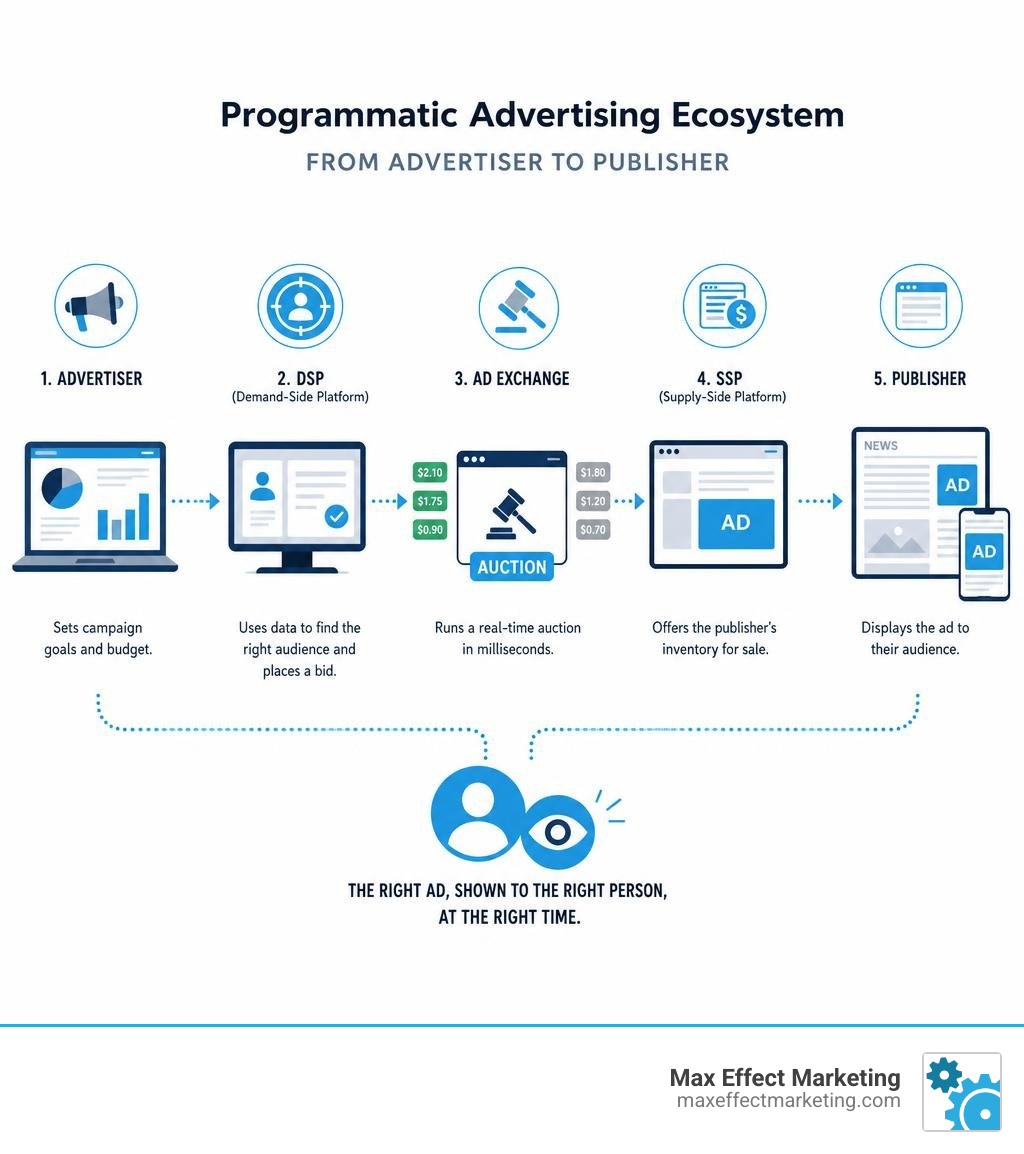
To your boss, the programmatic ecosystem might look like an alphabet soup of acronyms. To your grandma, it is helpful to think of it as a digital housing market. There is a buyer’s agent, a seller’s agent, and a clearinghouse where the deals happen.
Here is how those core components work together:
- Demand-Side Platform (DSPs): This is the advertiser’s tool (the buyer’s agent). Brands use a DSP to set up their campaigns, select their target audiences, upload creatives, and establish bidding parameters. The DSP acts like a stockbroker, automatically purchasing inventory across the web that matches the advertiser’s goals.
- Supply-Side Platform (SSPs): This is the publisher’s tool (the seller’s agent). Website and app owners use an SSP to list their available ad space (inventory), set minimum pricing floors, and open up their impressions to global buyers.
- Ad Exchanges: This is the marketplace where DSPs and SSPs meet. The ad exchange acts as the auctioneer, facilitating the lightning-fast transaction between the buyer and the seller.
- Ad Servers: Once the auction is won, the ad server is the technology that actually delivers the correct creative file to the user’s screen and tracks whether they viewed or clicked it.
For a deeper dive into how this software operates behind the scenes, check out this guide on What is programmatic advertising? to understand platform selection and DSP dynamics.
Real-Time Bidding (RTB) vs. Other Programmatic Buying Methods
While real-time bidding is the most famous form of automated ad buying, it is not the only way transactions happen. Depending on your brand safety needs, budget, and campaign goals, we utilize different buying methods:
- Real-Time Bidding (RTB) / Open Marketplace: This is an open auction where any advertiser can bid on available inventory. It offers the widest reach and the lowest average CPMs, but you have less direct control over exactly which websites your ads appear on.
- Private Marketplace (PMP): An invitation-only auction. Premium publishers (like major news outlets) invite select advertisers to bid on their high-quality inventory. This provides a safer environment for your brand while retaining the efficiency of automation.
- Programmatic Direct / Programmatic Guaranteed: This is a one-on-one deal between an advertiser and a publisher. You negotiate a fixed price for a guaranteed number of impressions. No bidding occurs; the software simply automates the delivery and measurement of the campaign.
- Preferred Deals: Advertisers get first dibs on premium inventory at a negotiated fixed price before it is opened up to the private or open markets.
To understand which of these media-buying frameworks is right for your growth goals, read through What is Programmatic Advertising? The Definitive Guide – Avenga to examine how these transaction paths dictate your overall performance.
The Business Case: Benefits of Programmatic Campaigns
If you are pitching programmatic advertising to your executive team, you need to speak the language of business: efficiency, return on investment (ROI), and transparency.
The traditional media buying process is slow and full of waste. Programmatic campaigns eliminate human negotiation bottlenecks, allowing us to launch, scale, and pivot campaigns instantly. Because you only bid on impressions that match your exact audience criteria, your budget is spent with surgical precision. This is why programmatic ROAS is 3x higher than traditional direct buys for 70% of advertisers.
Furthermore, programmatic offers unprecedented transparency. You can see exactly where your ads are running, how much each impression costs, and which creatives are driving real-world business results.
We run programmatic campaigns across an array of modern digital formats:
- Display Ads: Standard banners, native ads, and rich media that blend seamlessly into web content.
- Video Ads: Pre-roll, mid-roll, and out-stream video assets that capture user attention.
- Connected TV (CTV): High-impact ads delivered on streaming platforms during premium shows.
- Digital Out-of-Home (DOOH): Programmatic billboards in airports, shopping malls, and transit hubs.
- Audio Ads: Targeted spots on popular music streaming apps and podcasts.
To see how these formats fit into a broader multi-channel strategy, explore our breakdown of Online Campaigns to see how we align automated buying with your larger marketing objectives.
Precision Targeting in Programmatic Advertising
Traditional advertising is like shouting through a megaphone in a crowded stadium. Programmatic targeting is like walking up to the exact three people who want to buy your product and having a quiet, relevant conversation.

We use several layered targeting methods to reach the right user at the perfect moment:
- Behavioral Targeting: Reaching users based on their past actions, such as websites visited, links clicked, and purchase history.
- Contextual Targeting: Displaying ads on pages that directly relate to the product. For example, showing hiking boot ads on an article detailing the best trails in Colorado.
- Demographic Targeting: Filtering audiences by age, gender, income bracket, education level, or occupation.
- Retargeting: Serving ads to people who have already visited your website or interacted with your brand, gently nudging them back to complete a purchase.
- First-Party Data Integration: Uploading your own customer lists (from your CRM or email database) to find lookalike audiences who share similar buying behaviors.
Market Size, Adoption Rates, and the Post-Cookie Landscape
The global programmatic market has grown at a staggering pace. In 2022, global programmatic ad spend reached $488 billion. As we look at the landscape in 2026, programmatic has solidified its position, accounting for more than 9 out of every 10 digital display ad dollars spent.
However, the industry is undergoing its most significant shift in a decade: the deprecation of third-party cookies.
Historically, programmatic tracking relied on these cookies to follow users across the web and build behavioral profiles. With major browsers eliminating third-party cookies to protect consumer privacy, the industry has had to adapt. Initially, cookie deprecation was projected to threaten up to 30% of programmatic revenue.
But instead of slowing down, the market has evolved. Advertisers are shifting away from third-party tracking and doubling down on alternative solutions like unified identity frameworks (such as UID2), publisher clean rooms, and advanced contextual AI. Walled gardens (like Google and social networks) continue to hold massive amounts of first-party data, but the open web is fighting back with robust, privacy-compliant targeting methods.
To understand how these spending dynamics are shifting in a cookieless world, read the Programmatic Ad Spending Forecast H1 2024 to see how the industry prepared for this transition.
Emerging Trends and AI in Programmatic Advertising
The future of programmatic is being written by artificial intelligence. We have moved far beyond basic rules-based bidding. Today, we utilize agentic AI and deep machine learning to manage campaigns autonomously.
These modern systems process trillions of data points per second. Instead of a human marketer manually adjusting bids every morning, AI agents can dynamically optimize budgets, test hundreds of creative variations, and predict user viewability in real time.
For example, autonomous systems can analyze weather patterns, live sports scores, and real-time inventory levels to adjust ad copy and bidding strategies on the fly. This level of automation reduces campaign setup times by up to 87% while dramatically improving key performance metrics like conversion rates and cost per acquisition (CPA).
To see how advanced machine learning is driving real-world performance for premium brands, explore the technology behind AI-Powered Ad Tech for Measurable Performance | PubMatic.
Key Challenges, Risks, and Best Practices for Advertisers
While the rewards of programmatic advertising are massive, it is not without its pitfalls. Advertisers who adopt a “set-it-and-forget-it” mentality risk losing significant portions of their budget to operational inefficiencies.

Three primary challenges demand active management:
- Ad Fraud: Sophisticated botnets and invalid traffic (IVT) can inflate impression numbers without delivering real human views. In fact, roughly 55% of global digital ad fraud stems from botnets.
- Brand Safety: Without proper guardrails, automated algorithms might place your ads next to objectionable, controversial, or harmful content. Brand safety incidents historically affected up to 20% of programmatic campaigns before modern verification tools became standard.
- Supply Chain Opacity: With so many intermediaries (DSPs, SSPs, exchanges) taking a cut of the transaction, a portion of your ad spend can get lost in tech fees.
To protect your budget, it is critical to stay informed on the latest industry benchmarks. Review the 120+ Programmatic Advertising Statistics | 2026 Data Report to understand the current rates of invalid traffic, viewability standards, and brand safety trends.
Best Practices for Setting Up and Optimizing Campaigns
To ensure your programmatic budget drives maximum revenue, we recommend following these battle-tested best practices:
- Establish Clear Goals and KPIs First: Decide whether your primary objective is brand awareness (measured by CPM and viewability) or direct-response conversions (measured by CPA and ROAS).
- Implement Supply Path Optimization (SPO): Cut out unnecessary intermediaries. Advertisers who adopt SPO strategies typically achieve 15% to 30% cost savings by buying directly from verified publishers.
- Utilize Pre-Bid Verification Tools: Integrate third-party verification tools (like IAS or DoubleVerify) directly into your DSP to block fraudulent traffic and non-brand-safe placements before your bid is even placed.
- Actively Manage the Automation: Never leave your campaigns on complete autopilot. Regularly review placement reports, exclude underperforming domains, and refresh creative assets to combat ad fatigue.
If you are a smaller business looking to scale your lead generation before jumping into enterprise-grade programmatic suites, our guide on Google Ads for Small Businesses: A Smart Way to Generate More Leads offers an excellent starting point for automated search campaigns.
Frequently Asked Questions about Automated Media Buying
How does automated ad buying differ from display ads?
Display advertising refers to the format of the ad (visual banners, images, or graphics on a website). Programmatic advertising refers to the method of buying those ads. While traditional display ads are bought manually with fixed pricing and static placements, programmatic display ads use automated software, real-time data, and dynamic bidding to show the right creative to the right user.
How much do automated campaigns cost?
Programmatic campaigns are highly flexible and run primarily on a cost-per-thousand-impressions (CPM) pricing model. Your total cost depends on your target audience’s niche, the ad formats you choose (video and CTV command higher CPMs than standard display banners), and the level of competition in the real-time auction. Because there are no rigid contract minimums, you can scale your budget up or down instantly based on performance.
What is the difference between automated ad buying and SEO?
SEO (Search Engine Optimization) is the practice of optimizing your website to rank organically in search engine results pages for free. Programmatic advertising is a paid media strategy where you purchase ad space across the web in real time. While SEO is a long-term play built on content and authority, programmatic delivers instant visibility and immediate traffic.
To learn more about how to build a strong organic foundation alongside your paid campaigns, explore our dedicated services for SEO.
Conclusion
At Max Effect Marketing, we know that modern digital advertising can feel overwhelming. The ecosystem moves fast, technology changes daily, and keeping up with the post-cookie landscape requires constant adaptation.
That is why we don’t just hand you software and walk away. We combine intelligent, AI-powered ad tech with real, human partnerships to build data-driven campaigns that consistently achieve a 5X ROI. We handle the DSPs, the SSPs, the fraud prevention, and the real-time optimizations so you can focus on running your business.
Are you Ready to Grow Your Business? Let us build a custom programmatic strategy that puts your brand in front of the exact people who are looking for what you offer.
Get in touch today to receive a personalized Offer and start turning your ad spend into measurable revenue.