
TV Advertising Is Not Dead — It’s Just Getting Started
The advantages of advertising on television are easy to overlook when every marketing conversation seems to be about TikTok, Meta, or Google. But here’s the thing: a quarter of U.S. adults pay more attention to TV commercials than to any other ad format. That’s not a stat from 2005. That’s now.
Quick answer — the main advantages of TV advertising:
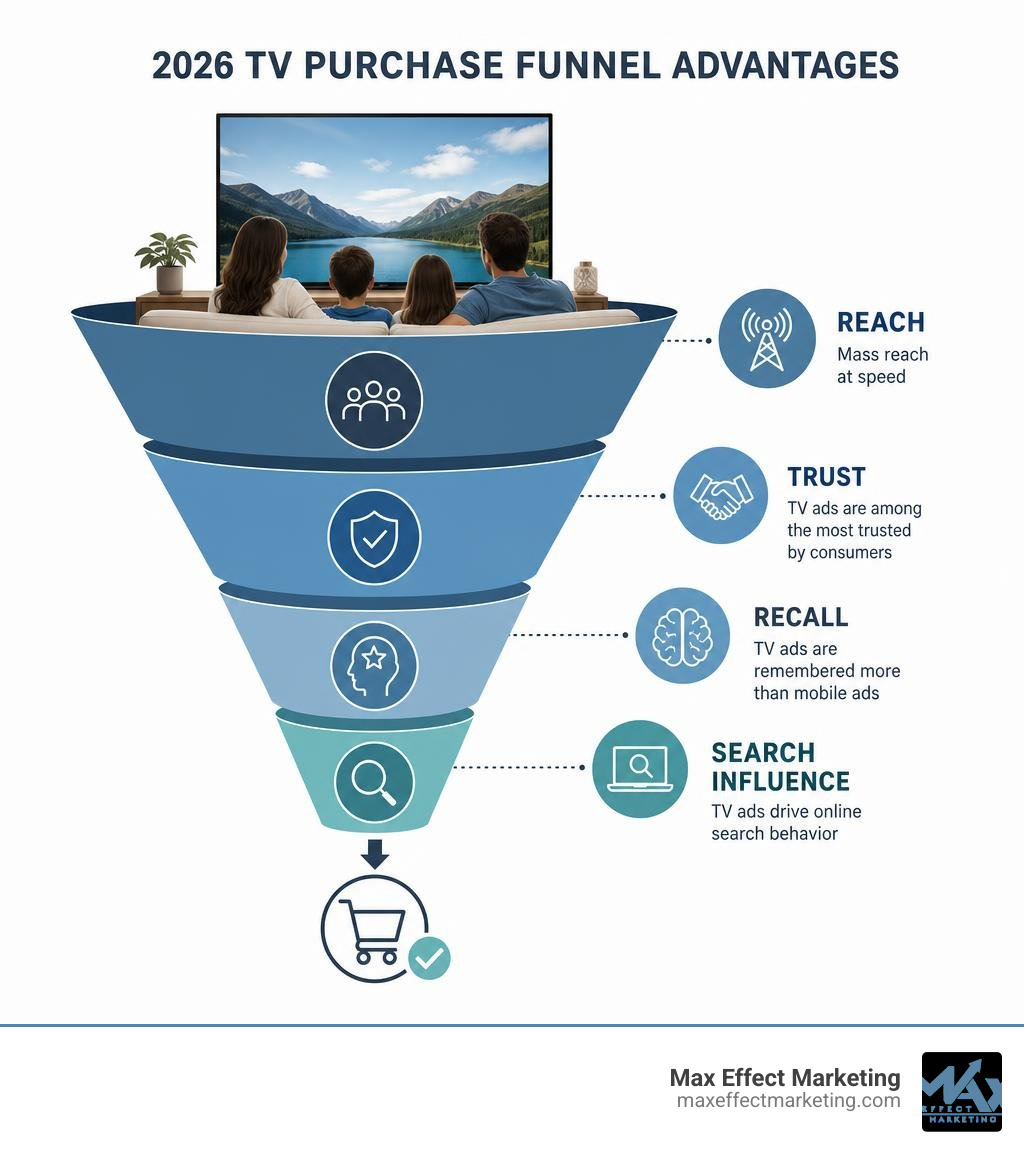
- Mass reach at speed — TV still reaches more people, faster, than almost any other channel
- High credibility — TV ads tie with print as the most trusted ad format among consumers
- Strong ad recall — viewers remember TV ads 40% more often than mobile ads
- Emotional impact — an emotional response to a TV ad increases purchase intent by 3x compared to other formats
- Purchase funnel influence — 89% of viewers say linear TV ads influence their online search behavior
- Attention efficiency — viewers watch 71% of TV ads vs. just 30% of digital mobile ads
- Multiscreen lift — combining TV with digital can deliver +125% higher brand recall
Ask a Gen Xer which fast-food chain once asked “Where’s the beef?” and they’ll answer instantly. That’s what TV does — it burns brands into cultural memory in a way that a skippable pre-roll simply cannot.
If you’re a business owner frustrated by digital campaigns that drain budget without moving the needle, TV advertising — including modern connected TV — might be the missing piece you haven’t seriously considered yet.
I’m David Bauer, VP at Max Effect Marketing, and over my 14+ years running integrated advertising campaigns across TV, Google, and Meta, I’ve seen how understanding the advantages of advertising on television can completely change a brand’s growth trajectory. Let’s break down exactly what makes TV work — and how to use it smartly alongside your strategy.
The Core Advantages of Advertising on Television in 2026

Despite the rapid growth of streaming platforms and social feeds, television remains the gold standard of media. In fact, total video consumption is higher than ever. Broadcast and cable TV together still account for over 44% of all TV usage in the United States, proving that traditional formats retain a massive foothold in American living rooms.
When we talk about the advantages of TV advertising, we have to look at the unique environment it creates. Unlike the solitary, fast-scrolling experience of a smartphone, TV is often a shared experience. This phenomenon, known as co-viewing, means your commercial is frequently watched by multiple people simultaneously—families, couples, or friends relaxing together. This collective viewing amplifies the cultural impact of your brand, turning a 30-second spot into a shared conversational touchpoint.
Furthermore, TV advertising builds long-term brand equity at a scale that pure-play digital channels struggle to match. By presenting your brand on the largest screen in the household, you instantly signal that your business is established, professional, and reliable. This builds a strong foundation of brand awareness that makes all your lower-funnel marketing efforts work significantly harder.
To explore this dynamic deeper, we recommend reading TV Advertising Advantages: What Smart Brands Know, which highlights how smart media planning leverages these core benefits. For local and retail businesses, this brand equity translates directly into physical outcomes. You can see this in action by exploring how regional brands use Convenience Store TV Commercials That Drive Foot Traffic to capture immediate consumer interest and guide them straight to physical locations.
Why the Trust Halo is One of the Key Advantages of Advertising on Television
In an era plagued by deepfakes, clickbait, and endless digital spam, trust has become the most valuable currency in marketing. This is where television truly shines. TV commercials are tied with print as the most credible advertising medium, easily outperforming social media and online video platforms.
This “trust halo” exists because consumers understand that television has a high barrier to entry. Because TV spots require professional production and undergo strict network clearance processes, viewers intuitively perceive TV advertisers as legitimate, reputable, and accountable.
This trust is particularly strong during local programming. According to the 2026 Purchase Funnel Study, local broadcast news is the most trusted media platform for viewers, sitting at an impressive 70% credibility rating. When your commercial airs alongside trusted local news anchors, that credibility is directly transferred to your brand.
This trust is crucial for modern consumer relationships. Consider these key insights:
- Purpose-Driven Loyalty: 94% of global consumers feel it is essential to engage with brands that have a vital purpose.
- The Trust Premium: 76% of consumers say they are far more likely to trust and stay loyal to a company that leads with a clear, positive purpose.
- Search Influence: This deep-seated trust triggers action. The same purchase funnel study revealed that 89% of respondents said linear TV ads directly influence their online search selections.
When viewers trust your message, they don’t just remember it—they actively pull out their phones to look you up.
How Emotional Storytelling Drives the Advantages of Advertising on Television
Television is a fully immersive sensory experience. It combines high-definition visuals, professional sound design, and motion to tell a complete story. This combination creates a powerful psychological effect that static display banners or silent social media feeds simply cannot replicate.
The secret weapon of TV advertising is its ability to evoke a deep emotional response. Whether it is a heartwarming holiday commercial, a humorous local spot, or an inspiring narrative, emotional connection is the ultimate driver of consumer behavior.
An emotional response to a television commercial increases a viewer’s purchase intent by a factor of 3-to-1. This emotional resonance is why TV ads generate 40% higher ad recall than mobile-only video formats.
A large part of this recall comes down to sonic mnemonics—catchy jingles, recognizable voiceovers, or specific sound effects. Think about how easily you can sing a classic brand jingle from your childhood, or how modern brands like Wegovy and Ozempic use memorable songs to stay top-of-mind. Because television is watched with the “sound on” by default, your audio branding has the space to lodge itself in the viewer’s memory for years to come.
TV vs. Digital: Why the Big Screen Still Wins the Attention War
Many digital marketers fall into the trap of looking purely at impressions. But not all impressions are created equal. A digital impression might count as “viewed” if it flashes on a mobile screen for two seconds while a user aggressively scrolls past. A TV impression, however, represents actual, focused attention.
In the attention economy, television is an absolute bargain. Research shows that participants watch 71% of TV ads on their screens, compared to a meager 30% for digital mobile ads. Why? Because TV ads are delivered in a lean-back environment. Viewers are sitting on their couches to relax, making them far more receptive to longer-form, high-quality storytelling.
To put this difference into perspective, let’s look at the actual attention efficiency across different formats:
| Ad Platform / Format | Relative Attention Efficiency (Cost per Attentive Second) | Average Visual Attention Share |
|---|---|---|
| Linear & Connected TV | Baseline (100% / Most Efficient) | 71% of ad duration watched |
| Skippable YouTube Ads | 16% less efficient than TV | 30% to 45% of ad duration watched |
| Facebook Feed Ads | 3.9x more expensive per attentive second | Under 20% of ad duration watched |
| Digital Display Banners | 6.6x more expensive per attentive second | Under 5% of ad duration watched |
Digital channels are fantastic for capturing existing demand—when someone is actively searching for a product, search ads are incredibly effective. But digital is notoriously poor at creating new demand. Social media feeds are crowded, skippable, and suffer from intense ad fatigue.
To understand how these automated digital auctions work compared to premium TV spots, check out our guide on Programmatic Advertising Explained to Your Grandma and Your Boss.
As detailed in Why TV Advertising Is Still Effective, Even in 2026, the smartest approach is not to abandon digital, but to use TV as your primary engine for demand generation. TV builds the awareness, emotional connection, and trust, while your digital channels act as the net that captures and converts that interest.
Measuring TV Ad Effectiveness and ROI in the Modern Era

Historically, the biggest criticism of television advertising was that it was difficult to measure. Marketers had to rely on broad demographic ratings and hope for the best.
In 2026, that is no longer the case. The integration of digital technology has turned television into a highly measurable, performance-driven channel. Modern TV campaigns utilize Automatic Content Recognition (ACR) data pulled directly from millions of smart TVs, alongside digital set-top box data. This allows us to track exactly which households saw your commercial and correlate that exposure with real-world digital actions.
We can now measure TV effectiveness using a variety of sophisticated methods:
- Immediate Digital Spikes: Tracking website traffic lifts, app downloads, and online conversions within a 15-minute window of your ad airing.
- Vanity URLs & Promo Codes: Using custom landing pages or unique discount codes to track direct responses.
- Brand Lift Studies: Measuring changes in brand awareness, favorability, and purchase intent between exposed and unexposed audiences.
- Econometric Modeling: Analyzing how TV spend influences your overall marketing ecosystem.
The findings in the landmark report, Evaluating the Effectiveness of TV Advertising in the Modern Media Landscape, reveal that TV consistently outperforms other media channels. At similar spend levels, TV delivers up to 7x the relative lift of paid search and 5x that of display advertising.
Furthermore, TV creates a powerful cross-product halo effect. When you run a TV ad for one specific product, you will frequently see a lift in sales across your entire product portfolio. In fact, removing TV from a multi-channel campaign can cause an 18% drop in overall campaign ROI, while paid search ROI can drop by 21% without the demand-generation support of TV.
To understand how to budget for these measurable campaigns across different formats, take a look at The Complete Guide to OTT and CTV Ad Rates.
Frequently Asked Questions about TV Advertising
Is TV advertising effective for B2B brands?
Absolutely. While many assume TV is strictly for consumer brands, larger B2B companies in technology, financial services, and professional services use TV to great effect.
For B2B brands, TV is not about reaching millions of casual viewers; it is about building category credibility and establishing executive-level awareness. When a decision-maker sees your brand on a premium business news network or during a major live sporting event, it signals that your company is a major player in your industry. This high-level trust shortens the enterprise sales cycle and makes your outbound sales team’s pitches far more effective.
What budget do you need to make TV advertising work?
The budget required to run a successful TV campaign depends heavily on your geographic targeting and the specific platform you choose.
For traditional linear TV, local spot advertising is highly accessible, with commercials on local cable networks starting as low as $500. On the other end of the spectrum, national prime-time spots on major broadcast networks can easily exceed $100,000 per 30 seconds.
However, Connected TV (CTV) and streaming platforms have completely democratized the space. With programmatic buying, you can launch highly targeted streaming campaigns with modest budgets that were previously reserved only for social media. For a detailed breakdown of streaming ad costs, read The Ultimate Guide to the Cost of Hulu Ads.
How does Connected TV (CTV) differ from traditional linear TV?
Traditional linear TV broadcasts programming scheduled by networks over cable, satellite, or over-the-air signals to a mass audience simultaneously.
Connected TV (CTV) refers to any television set used to stream video content over the internet—whether through smart TV apps, gaming consoles, or streaming sticks. This shift to internet-delivered television allows for addressable targeting. Instead of buying a specific time slot on a network, you can target specific households based on first-party data, demographics, household income, and online behavior.
With ad-supported tiers now accounting for 57% of subscribers across the eight largest streaming platforms, CTV allows you to run high-impact commercials alongside premium content. To see how this works with major streaming services, explore our guide on placing Prime Video Ads: Your Brand Alongside Premium Content.
Conclusion
The landscape of television has evolved, but its core power remains unchanged. The advantages of advertising on television—unmatched credibility, massive emotional impact, high ad recall, and the unique trust halo—make it an essential foundation for any brand looking to scale.
At Max Effect Marketing, we don’t believe in choosing between traditional power and digital precision. We are an AI-powered digital marketing agency that helps businesses generate massive revenue by combining intelligent technology with real human partnerships. By pairing the broad, trust-building reach of television with precision digital targeting, we help our clients achieve an average of 5X ROI.
If you are ready to take your business to the next level without overspending, let’s talk strategy. To understand the real-world economics of getting your brand on the screen, check out our guide, Don’t Break the Bank: What It Really Costs to Run a Commercial on TV.
Let’s build a campaign that gets your brand the attention, trust, and revenue it deserves. Connect with us today!