Why C-Store TV Ads Are One of the Most Overlooked Advertising Channels
TV advertising for convenience stores is one of the fastest-growing segments in out-of-home media — and most brands are still sleeping on it.
Here’s a quick breakdown of what it is and how it works:
| Question | Quick Answer |
|---|---|
| What is it? | Video ads displayed on screens at gas pumps, inside c-stores, on cooler doors, and at checkout |
| Who sees it? | Over 115 million adults per month across 29,000+ fuel retail locations (GSTV) |
| How long do viewers watch? | 3-5 minutes of captive attention at the fuel pump |
| Who buys it? | Brands buy through retail media networks like GSTV, or via programmatic platforms |
| Can you target locally? | Yes — by DMA, state, county, or zip code |
| What results can brands expect? | Increased brand recall, foot traffic, and in-store sales lift |
Think about the last time you stopped for gas. You stood there, phone in your pocket, staring at a screen you didn’t ask for — and you probably watched it anyway. That’s the whole pitch.
Convenience store shoppers are a captive audience in the truest sense. They’re not scrolling past your ad or hitting “skip.” They’re pumping gas, grabbing a snack, or waiting at checkout — and your message is right in front of them at the exact moment they’re deciding what to buy.
The numbers back it up. GSTV alone reaches more than 115 million adults per month, and its weekly audience would rank among the top 10 most-watched primetime TV shows for the 18-49 demographic. That’s not a niche channel — that’s a mainstream reach opportunity hiding in plain sight at your local gas station.
For c-store owners and brands alike, this channel offers something rare: high attention, high frequency, and high purchase intent — all in one place.
I’m David Bauer, VP at Max Effect Marketing, and over my 14+ years running integrated advertising campaigns — including television — I’ve seen how TV advertising for convenience stores can punch well above its weight when it’s planned and executed correctly. In this guide, I’ll walk you through exactly how to make it work.
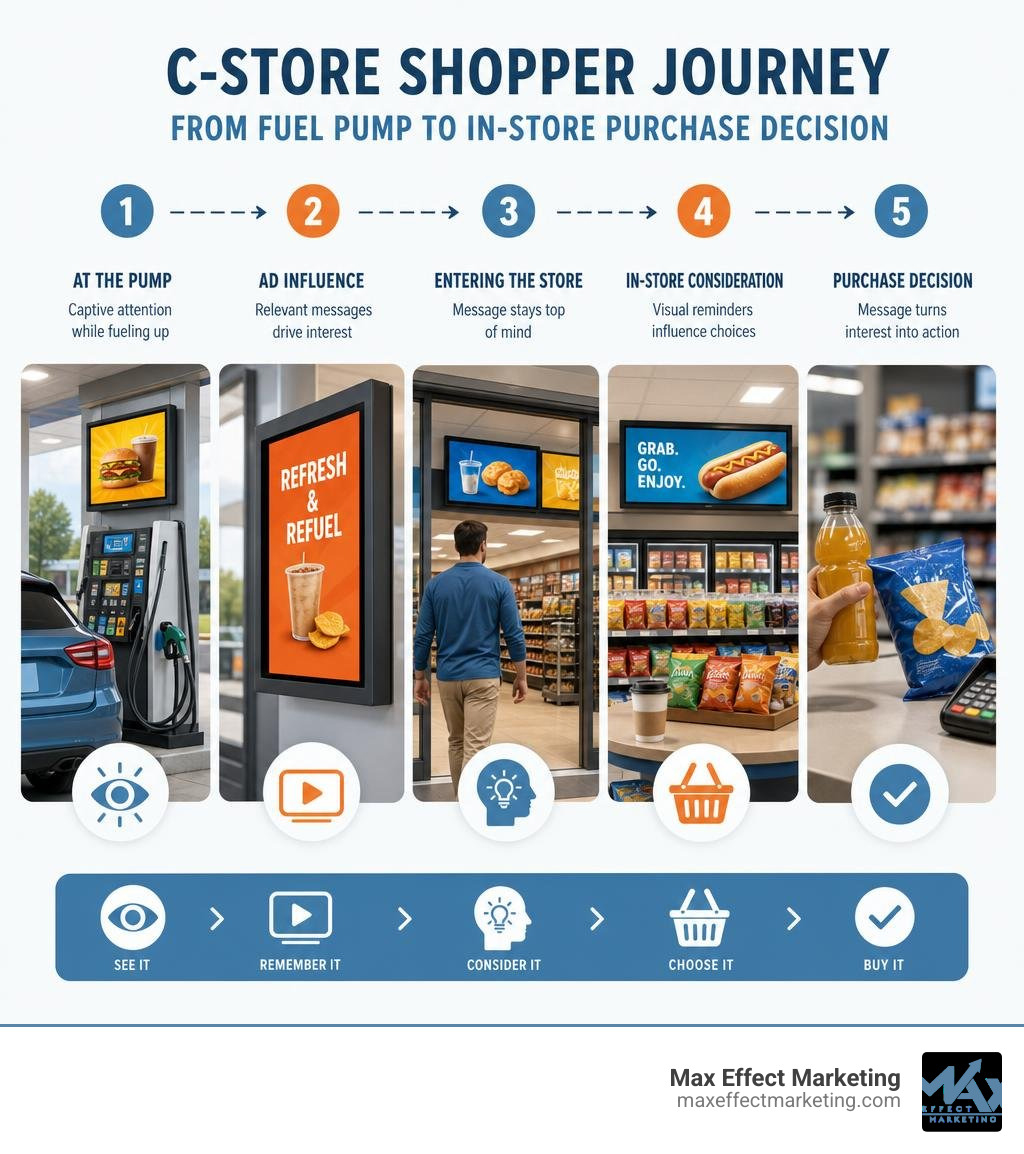
Why TV Advertising for Convenience Stores is a Game-Changer
When we talk about television advertising, most people picture a cozy living room, a couch, and someone fast-forwarding through commercial breaks on their DVR. But there is another kind of TV screen—one that lives out in the wild, right where the cash changes hands.
In-store digital media and gas station TV networks are completely flipping the script on traditional advertising. Instead of trying to catch consumers when they are relaxed and disengaged, we are reaching them when they are active, mobile, and ready to buy.
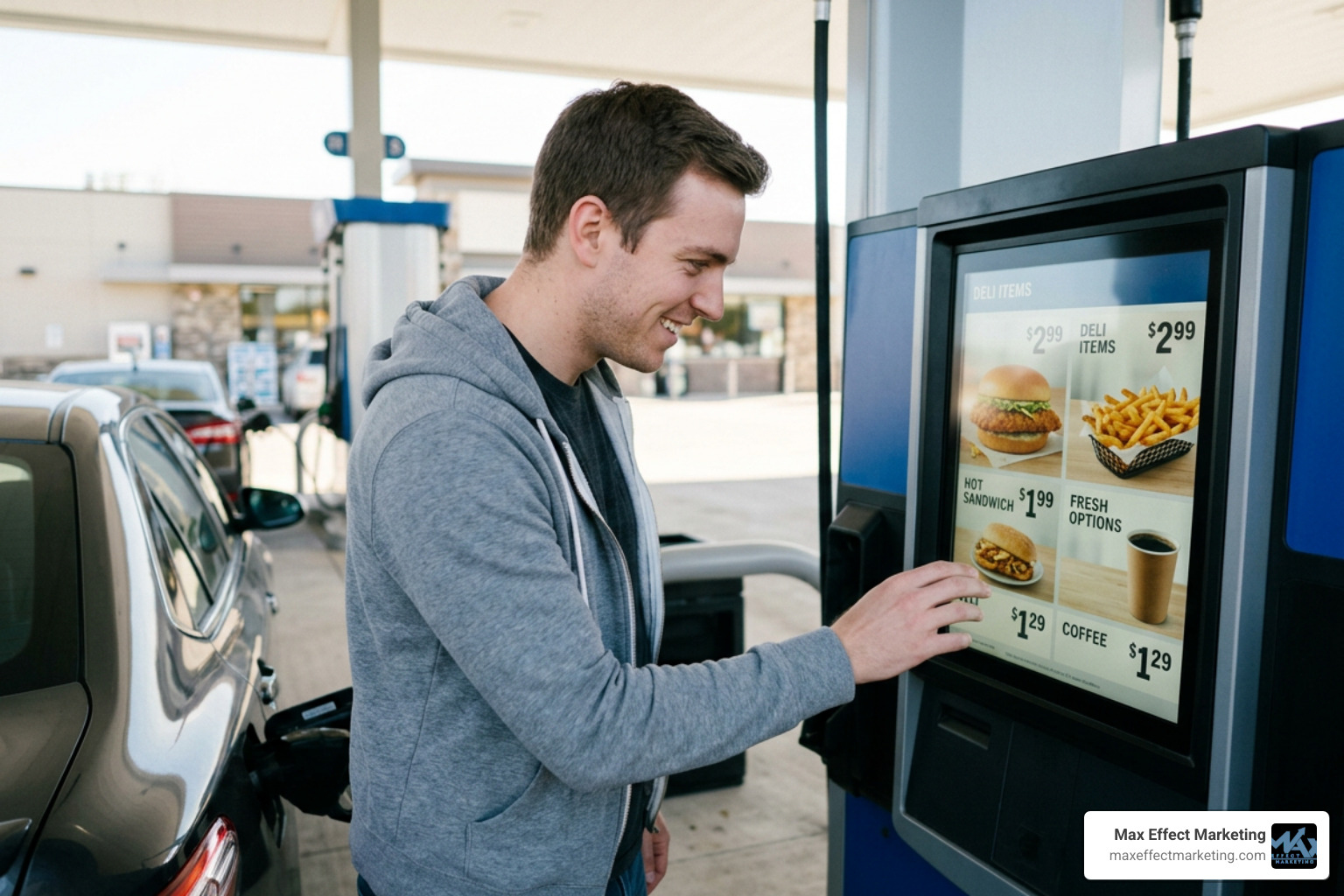
This is the point of purchase. It is the exact moment when a consumer is only feet away from your product. If you show them a mouth-watering clip of a cold beverage or a hot, fresh snack while they are standing at the pump, the distance between “seeing the ad” and “making the purchase” is reduced to a thirty-second walk.
Major global brands have recognized this power for years. For instance, PepsiCo Signs Deal with Gas Station TV to Drive Consumers at Point of Purchase to directly promote high-margin items like sodas and energy drinks. By customizing their existing national creative assets with immediate purchase calls-to-action, they bridged the gap between national brand awareness and immediate retail sales.
Traditional TV vs. In-Store Digital Signage
To understand why this works, we have to look at how traditional TV compares to the modern digital signage landscape.
Traditional broadcast and cable television are great for broad, top-of-funnel awareness. However, they suffer from high ad-skipping rates, fragmentation, and a complete lack of physical proximity to the product.
In contrast, digital signage inside convenience stores and forecourts operates more like digital-out-of-home (DOOH) or Connected TV (CTV). It allows for incredible precision. While you might use The Complete Guide to OTT and CTV Ad Rates to build a highly targeted streaming campaign for living rooms, in-store TV lets you execute programmatic bids that target consumers based on real-world geography, weather patterns, and immediate purchase behaviors.
Furthermore, you can complement these campaigns with other high-impact streaming channels. If you want to expand your video strategy, you can explore Prime Video Ads: Your Brand Alongside Premium Content or read The Ultimate Guide to the Cost of Hulu Ads to build a comprehensive, multi-screen video funnel.
The Power of Forecourt and Pump-Top Screens
The gas station forecourt is one of the last remaining bastions of undivided consumer attention. Think about it: when a driver is fueling their car, they are physically tethered to a 15-gallon tank for three to five minutes. They cannot walk away, and they rarely want to sit in a hot car.
This creates a highly lucrative “natural pause” in their day. During this window, pump-top screens and gas station TV networks capture their attention with short, engaging video segments, weather updates, and targeted promotions.
Major convenience retailers are capitalizing on this attention at a massive scale. A prime example is how Casey’s taps GSTV to drive engagement at the pump | C-Store Dive to build out an expansive retail media network. Once fully rolled out, Casey’s network will feature over 30,000 digital screens across 2,900 locations in 19 states. By delivering branded video content directly to the dispenser, they can drive immediate, impulse-driven foot traffic from the pump straight to the checkout counter.
How to Plan and Buy Your C-Store TV Campaign
If you are a brand or an agency looking to dive into this space, you might be wondering: How complicated is it to buy these ads? Do I have to call 29,000 individual gas stations?
Thankfully, the answer is no. Today’s c-store TV networks are highly sophisticated and fully integrated into the programmatic ecosystem.

Modern campaign planning relies heavily on programmatic digital-out-of-home (pDOOH) buying. This means you can buy, manage, and optimize your convenience store TV campaigns using the exact same demand-side platforms (DSPs) you use for your online display or CTV ads.
You can target your ads by:
- DMA (Designated Market Area): Broaden your reach across more than 100 U.S. DMAs.
- Zip Code: Run hyper-local campaigns to drive traffic to specific storefronts.
- Dayparting: Show breakfast promotions in the morning and energy drinks or quick-service meals during the evening commute.
- Weather Triggering: Automatically serve ads for hot coffee when the temperature drops, or ice-cold sodas during a summer heatwave.
If you are new to the programmatic world, don’t worry. We have broken down the entire process in our guide, Programmatic Advertising Explained to Your Grandma and Your Boss.
Launching Your First Campaign for TV Advertising for Convenience Stores
When launching your first campaign for TV advertising for convenience stores, you need to balance your budget allocation with your creative assets.
Because these ads are viewed on the go, your videos should be short, punchy, and highly visual. The most common ad formats are 15-second and 30-second spots. Because some environments can be noisy, your creative must be able to tell a complete story and deliver a clear call-to-action even if the sound is muted.
If you are wondering how the cost of these campaigns compares to traditional broadcast runs, you can check out our analysis, Don’t Break the Bank: What It Really Costs to Run a Commercial on TV. You will find that c-store TV often provides a much lower barrier to entry and far less waste, making it highly cost-effective for local and regional brands.
Targeting and Attribution Strategies
One of the biggest historical complaints about out-of-home advertising was the lack of clear measurement. Fortunately, in 2026, those days are long gone.
By utilizing location-based marketing data, mobile device IDs, and point-of-sale (POS) integrations, we can now track attribution with incredible accuracy. We can measure:
- Device Exposure: Tracking which mobile devices were in close proximity to a specific screen when an ad played.
- Foot Traffic Lift: Measuring how many of those exposed devices walked into the convenience store or visited a nearby retail partner.
- Sales Conversion: Matching loyalty card data or transaction timestamps to verify if the ad directly resulted in a purchase.
At Max Effect Marketing, we specialize in tying these physical touchpoints back to your broader digital presence. By aligning your physical screen ads with targeted Online Campaigns, we create an omnichannel loop that keeps your brand top-of-mind wherever your customers go.
Creative Strategies That Get Shoppers Inside
You can have the most advanced targeting in the world, but if your creative is boring, shoppers will simply look at their shoes. The secret to a successful c-store TV ad is capturing immediate emotion.
Because gas and pre-packaged snacks look relatively identical from one chain to the next, successful brands win by competing on feeling rather than just price.
A masterclass in this approach is how QuikTrip Sells the Feeling of Summer in Ad Series. Instead of just listing prices for fountain drinks, their “Savor Summerhood” campaign used nostalgic, film-grain visuals to capture classic summer moments like road trips, pool days, and skater meetups.
To take it a step further, they even created sitcom-style commercials and a full 30-minute episode directed by an SNL director, which you can read about in QuikTrip: More Than a Gas Station – Ads of the World™ | Part of The Clio Network. By leaning into pop culture and 90s nostalgia, they turned a quick pit stop into a beloved cultural ritual.
Leveraging Culture and Community
To truly connect with on-the-go consumers, your creative should reflect the diverse subcultures of the communities you serve.
For example, look at how 7-Eleven Launches New ‘Roll-Up & Refuel™’ Campaign Celebrating Culture, Community and Convenience. This multi-channel campaign highlighted real lifestyle subcultures—like skateboarders grabbing hot dogs between afternoon sessions and car enthusiasts meeting up under the bright lights of the parking lot late at night.
By running these highly relatable 15- and 30-second spots across select local markets, they positioned their stores not just as places to buy fuel, but as community hubs where memories are made.
Recharging the Human Battery
Another highly effective creative angle is framing the convenience store visit as an essential “recharge” for the driver, not just the vehicle.
This was the core strategy behind Speedway Stores’ New ‘Fill Up’ Campaign Reminds Customers that Refueling Isn’t Just for Cars. The campaign used humorous and relatable TV spots to remind busy, on-the-go consumers that while their cars need gasoline to run, their bodies and minds need a “roadside reset” to power through the rest of the day.
By showcasing refreshing beverages and quick snacks as the ultimate human fuel, they successfully drove drivers away from the pump and straight to the checkout counter.
Monetization and Operational Setup for Retailers
If you are a convenience store operator, installing a digital screen network is one of the smartest ways to unlock a brand-new, high-margin revenue stream.
By partnering with established retail media networks, you can monetize your existing physical real estate. Here is a breakdown of how different screen formats perform across the shopper journey:
| Screen Format | Typical Location | Average Dwell Time | Primary Ad Goal | Best For |
|---|---|---|---|---|
| Pump-Top / Forecourt | Fuel Dispensers | 3 – 5 Minutes | Drive In-Store Traffic | National CPG, Local QSR, Auto Services |
| Digital Menu Boards | Foodservice Counter | 1 – 2 Minutes | Increase Average Order Value | Daily Specials, Combo Upgrades, High-Margin Food |
| Cooler-Door Displays | Beverage Aisles | 15 – 30 Seconds | Point-of-Purchase Influence | Soda, Energy Drinks, Craft Beer Brands |
| Checkout Screens | Cash Register | 1 – 2 Minutes | Drive Impulse Purchases | Candy, Mints, Gift Cards, Loyalty Sign-Ups |
Technical and Operational Requirements
Setting up an in-store TV network is much easier today than it was even a few years ago. Platforms like Skoop and EZ-AD TV offer plug-and-play media players that can plug directly into any commercial-grade smart TV via HDMI.
To get started, store operators typically need:
- Hardware: Reliable commercial displays and media players.
- Connectivity: A stable Wi-Fi or Ethernet connection to push real-time updates.
- Cloud-Based Management: A centralized dashboard to schedule vendor ad loops, update digital menu boards in seconds, and track programmatic ad impressions.
- POS Integration: Connecting your screens to your point-of-sale system allows you to run automated promotions based on real-time inventory levels.
Measuring the ROI of TV Advertising for Convenience Stores
For both retailers and brands, measuring the return on investment of TV advertising for convenience stores comes down to three key metrics:
- Sales Lift: Tracking the percentage increase in promotional item sales during the campaign flight compared to a baseline period.
- Brand Recall: Utilizing third-party verification services (like Nielsen) to measure how well consumers remember your ad after their visit.
- Foot Traffic Conversion: Measuring the percentage of fuel pump customers who actually walk through the front doors to make an additional purchase inside.
Frequently Asked Questions about C-Store TV Ads
What is the average dwell time for gas station TV ads?
The average dwell time at a fuel pump is 3 to 5 minutes. Because drivers are physically tied to their vehicles during this window, they represent a highly captive, undistracted audience with exceptionally high ad recall rates.
How do retailers monetize their in-store digital screens?
Retailers monetize their screens by dedicating a percentage of their screen time to programmatic ad networks, hosting paid vendor playlists for major CPG brands, and running internal promotions to drive loyalty program sign-ups and high-margin foodservice sales.
Can small businesses run local TV ads in convenience stores?
Absolutely! Thanks to hyper-local programmatic buying and precise zip code targeting, local businesses like auto repair shops, urgent cares, and family restaurants can run highly affordable, targeted video campaigns on local c-store screens.
If you are a local business owner looking to scale your local reach even further, you can pair your TV campaign with our strategies for Google Ads for Small Businesses: A Smart Way to Generate More Leads.
Conclusion
The convenience store is no longer just a place to grab a quick gallon of gas or a pack of gum—it has evolved into a highly sophisticated, high-impact digital advertising arena. Whether you are a national brand looking to capture point-of-purchase sales or a local retailer wanting to maximize your in-store revenue, TV advertising for convenience stores offers an unparalleled opportunity to reach real people during the natural pauses of their day.
At Max Effect Marketing, we are an AI-powered digital marketing agency dedicated to helping businesses generate real, measurable revenue. Our unique selling proposition is combining intelligent technology with real human partnerships to help our clients achieve an incredible 5X ROI.
Ready to stop wasting your ad budget on skipped commercials and start driving real foot traffic? Let’s build a high-converting video campaign together. To see how we can optimize your media mix without blowing your budget, check out our guide on Don’t Break the Bank: What It Really Costs to Run a Commercial on TV and let’s get started today!