
What Does It Cost to Advertise on YouTube TV?
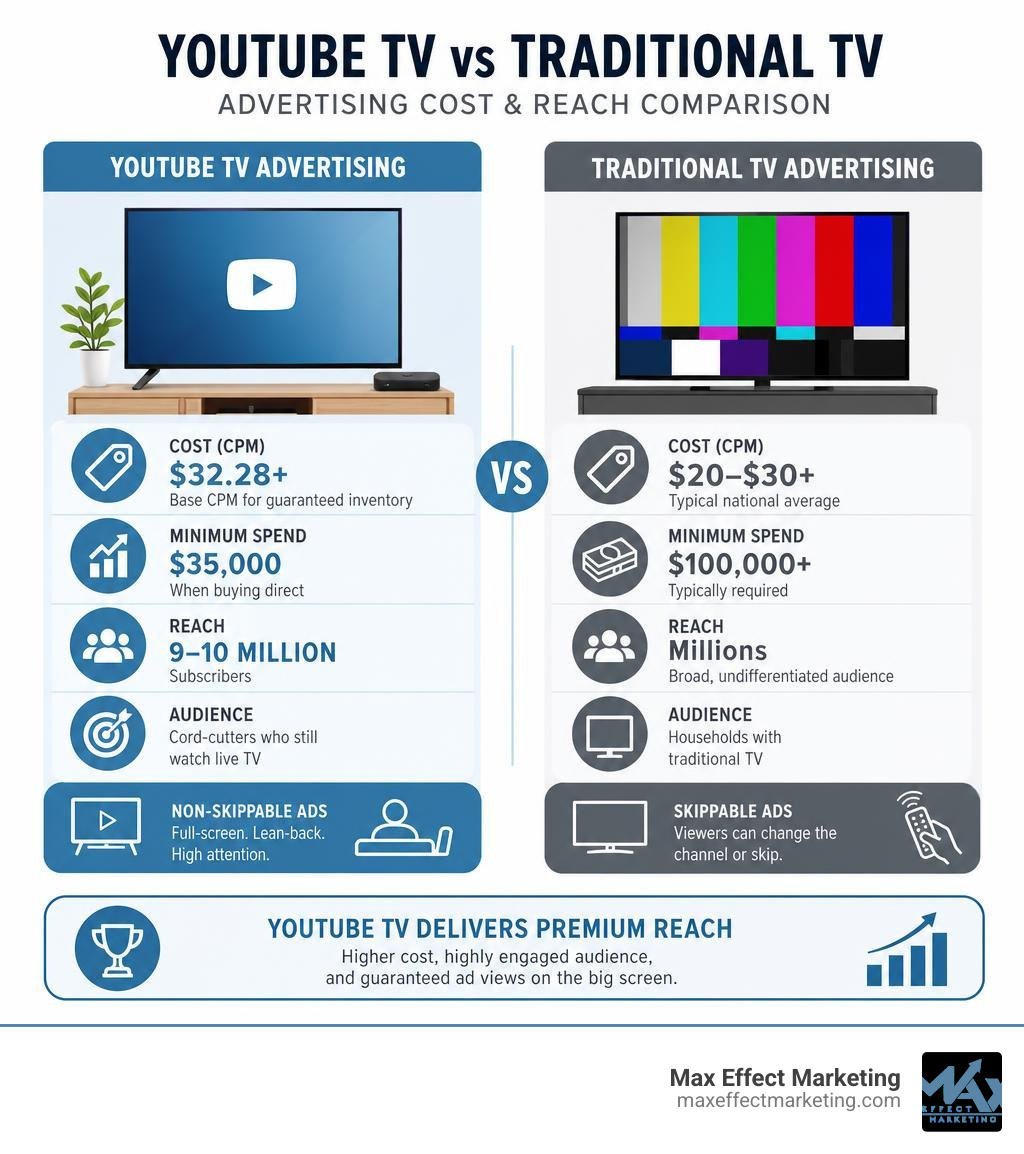
YouTube TV advertising cost starts at a base CPM of $32.28 for guaranteed inventory, with a $35,000 minimum spend required when buying direct through Google. Here’s a quick breakdown:
| Buying Method | CPM Range | Minimum Budget |
|---|---|---|
| Google Direct (Guaranteed) | $32.28+ (add $5 per targeting overlay) | $35,000 |
| Google Ads Auction | $35–$65+ | No Minimum |
These numbers put YouTube TV firmly in the premium streaming TV category — more expensive than regular YouTube ads ($5–$25 CPM), but in a completely different league in terms of viewer attention and ad completion.
Why does that matter? Because YouTube TV ads are non-skippable. Viewers watch in a lean-back, full-screen environment on their televisions — not on a phone while scrolling. That changes everything about how your ad performs.
Streaming now accounts for roughly 45% of all U.S. TV viewing, and YouTube TV leads the pack among live TV streaming services with an estimated 9–10 million subscribers. If you’re trying to reach cord-cutters — people who ditched cable but kept live TV — this is where they are.
I’m David Bauer, Vice President at Max Effect Marketing, and I’ve spent over 14 years managing advertising campaigns across television, digital, and streaming platforms, including navigating youtube tv advertising cost and strategy for businesses of all sizes. In this guide, I’ll break down exactly what you’ll pay, what you’ll get, and whether it’s the right move for your budget.
Youtube tv advertising cost basics:
Demystifying the YouTube TV Advertising Cost
When you transition from traditional digital marketing to television-style streaming platforms, the pricing language changes. You are no longer bidding on pennies per click. Instead, your youtube tv advertising cost is calculated using CPM, or “Cost Per Mille” (the cost to reach 1,000 viewers).
Because YouTube TV is a premium, live-TV streaming environment, its inventory is highly sought after. Unlike standard YouTube, where users might watch a 10-second clip of a cat playing the piano on their phones, YouTube TV users are sitting on their couches, watching premium networks like ESPN, HGTV, or AMC on a massive flat screen.
This premium environment means you are buying ad-supported viewing that behaves exactly like traditional cable television, but with the added benefit of digital tracking. Understanding the baseline value of these premium environments is key to structuring your campaigns effectively.
Understanding the Base YouTube TV Advertising Cost
The absolute starting point for a direct, guaranteed buy through Google’s reservation system is a base CPM of $32.28. This means for every 1,000 times your ad is shown on a screen, you pay $32.28.
However, this base rate is just the foundation. If you want to secure guaranteed inventory—meaning your ads are locked in to run during specific timeframes or high-demand programming—you must be prepared for Google’s direct-buy minimum budget. Google requires a $35,000 minimum spend to purchase guaranteed inventory directly.
This high entry barrier makes careful budget planning absolutely crucial. If you are trying to understand where this fits into the broader landscape of streaming media, our resource on The Complete Guide to OTT and CTV Ad Rates provides an excellent breakdown of rates across the entire Connected TV (CTV) ecosystem.
How Targeting Overlays Affect Your YouTube TV Advertising Cost
Here is where the math gets interesting. The $32.28 base CPM is for “run-of-network” ads with no specific targeting applied. In other words, your ad could be shown to anyone, anywhere, watching any channel.
Since most businesses want to reach a specific audience, you will need to apply targeting overlays. Google charges a flat $5.00 surcharge on your CPM for each targeting layer you add.
For example:
- Base CPM: $32.28
- Add Demographic Layer (e.g., Household Income over $100k): +$5.00
- Add Geographic Layer (e.g., Denver DMA): +$5.00
- Total CPM: $42.28
If you layer on too many filters, your CPM can quickly climb past $50 or $60. To keep your youtube tv advertising cost under control, we recommend starting with broader targeting—such as geographic location and basic age/gender demographics—before layering on highly specific interest groups. For the official technical breakdown of how these targeting rules and eligibility requirements work, refer to the YouTube TV ads FAQs.
YouTube TV vs. Traditional TV and Regular YouTube Ads

To understand whether the youtube tv advertising cost is worth it for your business, it helps to compare it to your other video advertising options.
Traditional linear TV (cable and broadcast) has long been the king of reach, but it lacks precision. You buy a spot on a local news broadcast, and you pay for everyone in that geographic area—whether they are a potential customer or not. On the other end of the spectrum, standard YouTube ads are highly targeted and incredibly cheap, but they suffer from low engagement because users can easily hit the “Skip Ad” button after five seconds.
YouTube TV sits comfortably in the middle, combining the highly engaged, big-screen viewing of traditional TV with the digital tracking of standard YouTube. To see how these costs compare on a practical scale, look at the table below:
| Feature | YouTube TV | Regular YouTube | Traditional TV (Cable/Broadcast) |
|---|---|---|---|
| Average CPM | $35 – $65+ | $5 – $25 | $10 – $35 |
| Minimum Budget | $35,000 (Direct) | No Minimum | Varies (Often $5,000+ local) |
| Ad Skippability | Non-Skippable | Skippable (mostly) | Skippable (via DVR) |
| Typical Screen | Smart TV / Connected TV | Mobile / Desktop | Living Room TV |
| Completion Rate | 90%+ | 30% – 40% | High (but easily ignored) |
For a deeper dive into what it costs to produce and run a standard television spot, see our guide on Don’t Break the Bank: What It Really Costs to Run a Commercial on TV.
Why YouTube TV Commands a Premium CPM
You might look at that table and ask, “Why would I pay a $45 CPM for YouTube TV when I can get a $10 CPM on regular YouTube?”
The answer comes down to two words: attention and environment.
On standard YouTube, ads have a typical completion rate of 30% to 40%. Most people are hovering their mouse or thumb over the bottom right corner of the video, counting down the seconds until they can click “Skip.”
On YouTube TV, the ads are non-skippable and occur during natural commercial breaks. Because of this, YouTube TV ads boast an incredible 90%+ completion rate. Furthermore, because viewers are watching professional, long-form content (like live sports or prime-time dramas), they are in a “lean-back” state of mind, making them far more receptive to high-quality brand messages. If you want to explore the psychological advantages of this TV-style viewing environment, read A Practical Guide to Advantages of Advertising on Television.
Comparing Streaming TV Rates Across Platforms
The virtual Multichannel Video Programming Distributor (vMVPD) market is highly competitive. YouTube TV is currently the giant in this space with 9 to 10 million subscribers, but it isn’t the only option.
Platforms like Hulu + Live TV, Sling TV, and FuboTV also offer live-streamed television ad inventory. Hulu, in particular, is a major competitor. While Hulu’s ad rates are highly competitive, they operate on different minimum spend structures and ad manager platforms. To compare how YouTube TV’s pricing stacks up against other major streaming players, take a look at The Ultimate Guide to the Cost of Hulu Ads.
Factors That Drive Your YouTube TV Ad Spend

Just like buying a billboard in Times Square costs more than a billboard in rural Nebraska, several real-world variables will cause your youtube tv advertising cost to fluctuate.
- Seasonality: Q4 (the holiday shopping season) always sees a massive surge in ad demand, which drives up CPMs. Similarly, major sporting events like the NFL playoffs or the NCAA March Madness tournament command massive premiums.
- Geographic Target: Advertising in highly competitive, high-income markets like New York, Los Angeles, or San Francisco will always carry a higher CPM than advertising in smaller media markets.
- Audience Specificity: As mentioned, every demographic or behavioral filter you add to your campaign adds a $5.00 surcharge to your base CPM.
Ad Formats and Their Impact on Pricing
The format of your video creative also plays a major role in your overall campaign cost. YouTube TV supports three primary ad formats:
- Bumper Ads (6 Seconds): These ultra-short, non-skippable ads are built for quick brand awareness. Because they are short, they are highly affordable and have minimal impact on viewer fatigue.
- Non-Skippable In-Stream Ads (15 to 30 Seconds): These are the standard television-style commercials. They run during natural ad breaks and are ideal for telling a story or explaining a complex product.
- Skippable In-Stream Ads: While less common on YouTube TV compared to standard YouTube, these can occasionally appear during Video-on-Demand (VOD) content.
Choosing the right format is essential for maximizing your budget and ensuring your creative assets align perfectly with your campaign goals.
Bidding Strategies and Inventory Access
When setting up your campaigns in Google Ads, you will primarily use tCPM (Target CPM) bidding. With tCPM, you tell Google the average amount you are willing to pay for every 1,000 impressions, and Google’s AI optimizes your bids to get as many impressions as possible within that target.
For certain video campaigns, you may also utilize CPV (Cost Per View) bidding, where you only pay if a viewer interacts with your ad or watches at least 30 seconds of it. However, because YouTube TV is designed for non-skippable, large-screen viewing, tCPM is almost always the standard choice for professional TV-style campaigns.
Minimum Budgets and How to Buy YouTube TV Ads
Now that we’ve covered the costs, let’s talk about how you actually get your commercial onto the platform.
Historically, buying television ads required calling up network executives, signing complex upfront contracts, and committing hundreds of thousands of dollars. Today, Google has brought digital accessibility to the TV screen, though the entry barriers for guaranteed inventory remain high.
Direct Reservation vs. Auction Buying
If you want to buy guaranteed, premium inventory directly from Google, you must go through the Google Reservation flow. This method guarantees that your ad will run on specific channels or premium lineups (like YouTube Select). However, as we’ve established, this route requires a $35,000 minimum budget and is typically managed by advertising agencies.
If you don’t have $35,000 to spend on a single campaign, you are not locked out of the living room. You can access YouTube TV inventory through non-guaranteed auction buys within Google Ads, provided your campaign meets specific technical and content eligibility criteria.
To help visualize this process, let’s look at the standard workflow for launching a YouTube TV campaign:
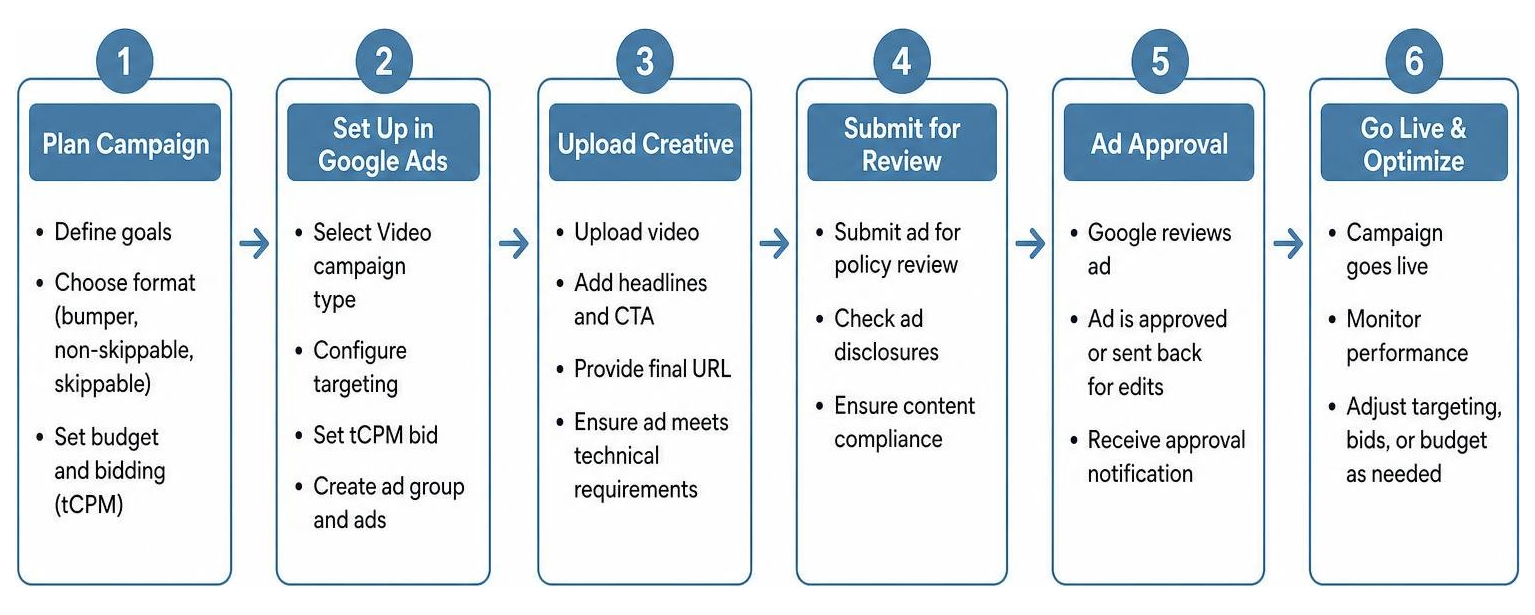
This allows you to navigate these buying options and structure high-converting campaigns that fit your budget.
Frequently Asked Questions About YouTube TV Ad Rates
What is the average CPM for YouTube TV ads?
While the base CPM starts at $32.28, most advertisers should expect a practical planning benchmark of $35 to $65+ CPM. The final cost depends heavily on the geographic location you are targeting, the time of year, and how many audience targeting filters you apply.
Can small businesses advertise on YouTube TV with a smaller budget?
Yes, but with caveats. While the direct-buy reservation system requires a $35,000 minimum, small businesses can access non-guaranteed YouTube TV inventory through local targeting in Google Ads with smaller daily budgets. However, because TV-style advertising relies on frequency and reach to build trust, we generally recommend a minimum monthly budget of $2,500 to $5,000 to see meaningful local results.
How does YouTube TV billing work for skipped or fast-forwarded ads?
YouTube TV bills on a “first-frame” basis. If your ad is served, you are charged. However, because the vast majority of ads on YouTube TV are non-skippable, fast-forwarding is generally restricted during live broadcasts. For Cloud DVR content where fast-forwarding is allowed, Google’s system is smart enough to detect viewability, meaning you are highly unlikely to be charged if a viewer successfully skips past the first frame of your commercial.
Conclusion
Navigating television advertising can feel overwhelming, but the shift toward streaming has opened up incredible opportunities for businesses to reach highly engaged, affluent cord-cutters on the biggest screen in the house. While the youtube tv advertising cost is premium, the reward is an un-skippable, high-impact format that builds massive brand authority.
At Max Effect Marketing, we are an AI-powered digital marketing agency that combines intelligent technology with real human partnerships. We don’t believe in guesswork. We design, optimize, and manage highly targeted video campaigns designed to drive real revenue and achieve a 5X ROI.
Ready to put your business on the big screen without wasting your budget? Grow Your Business with Max Effect Marketing Services and let’s build a high-converting TV campaign together.