Your Customers Are Searching Locally Right Now — Can They Find You?
Local search advertising is the practice of running paid ads that appear when nearby customers search for your products or services on Google, Maps, and other platforms. Here’s what you need to know at a glance:
- What it is: Paid ads targeting customers in your city, neighborhood, or service area
- Where ads appear: Google Search results, Google Maps, and Waze
- Main formats: Local Services Ads (pay-per-lead) and traditional Google Ads (pay-per-click)
- Who it’s for: Any local or service-area business that wants more calls, visits, or bookings
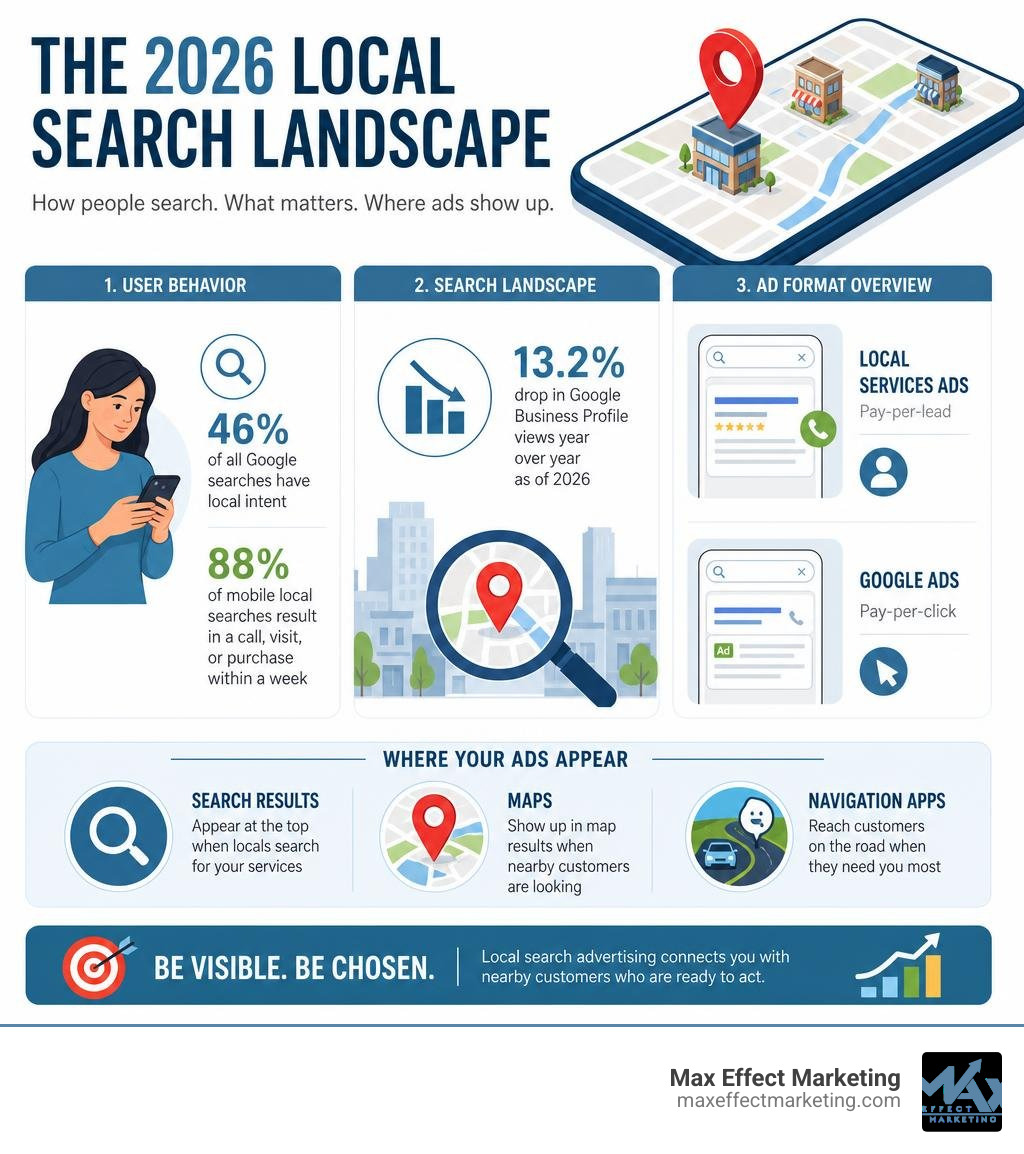
- Why it works: 46% of all Google searches have local intent, and 88% of mobile local searches result in a call, visit, or purchase within a week
Think about the last time you searched for a plumber, dentist, or restaurant on your phone. You probably clicked one of the first two or three results — and so does everyone else.
That’s the problem for local businesses right now. Your customers are already searching. But if your business isn’t showing up at the top, you’re invisible — and someone else is getting the call.
It gets harder. Google Business Profile views dropped 13.2% year over year as of 2026. Organic visibility is shrinking. Meanwhile, the businesses running smart local search ads are picking up the gap.
The good news? Local search advertising levels the playing field. A small local business can outrank a national chain simply because it’s closer, more relevant, and more trusted in the eyes of Google.
I’m David Bauer, Vice President at Max Effect Marketing, and I’ve been running local search advertising campaigns since Google first launched its advertising platform — helping businesses across dozens of industries generate real leads without burning their budgets. In this guide, I’ll walk you through everything you need to know to stop being invisible and start winning local customers.
What is Local Search Advertising and Why Does It Matter?

To put it simply, local search advertising is your shortcut to the top of Google. It is a highly targeted digital marketing strategy designed to place your business directly in front of consumers who are ready to buy right now in your specific geographic area.
When someone searches for “emergency AC repair” or “best family dentist near me,” they aren’t window shopping. They have high-intent needs, and they want a local solution immediately. Research shows that 72% of mobile users who search for a business nearby visit a store within five miles. If your business isn’t there, you are actively giving away revenue to your competitors.
Historically, businesses relied entirely on organic Local SEO to get into the “Local Pack”—the block of three Google Map results that appears at the top of local searches. While the Local Pack remains incredibly popular, with 68% of online searchers preferring to click on it, securing an organic spot takes time.
Furthermore, the organic landscape is shifting rapidly. Recent data from 2026 reveals that total Google Business Profile views fell 13.2% year over year, Maps views dropped 13.0%, and organic Search views declined 13.4%.
Does this mean people are searching less? Not at all. In fact, direction clicks rose 6.4% year over year, showing that user intent to visit businesses is stronger than ever. The drop in views simply means Google is prioritizing paid local placements and interactive elements at the very top of the Search Engine Results Page (SERP). Local search ads earn 13.8% of local SERP clicks, making them an essential tool to capture that high-converting traffic.
Local Search Advertising vs. Traditional Google Ads
Many business owners ask us, “Isn’t local search advertising just regular Google Ads?” Not exactly. While they both live under the Google ecosystem, they operate on entirely different frameworks.
Traditional Google Ads run on a Pay-Per-Click (PPC) model. You bid on specific keywords, write custom ad copy, and pay every single time someone clicks on your ad—regardless of whether they call you, buy from you, or clicked by mistake. It requires continuous keyword research, landing page optimization, and ad copy testing. For a deeper dive into how this works, check out our guide on Google Ads for Small Businesses: A Smart Way to Generate More Leads.
In contrast, Google’s Local Services Ads (LSAs) operate on a Pay-Per-Lead (PPL) model. Instead of paying for empty clicks, you only pay when a customer takes a direct action to contact you, such as calling your business, sending a text, or booking an appointment directly through the ad. Google automatically matches your ad to relevant searches based on the services you select and your location, eliminating the need to manage complex keyword lists.
| Feature | Local Services Ads (LSA) | Traditional Google Ads (PPC) |
|---|---|---|
| Payment Model | Pay-Per-Lead (Phone calls, bookings, texts) | Pay-Per-Click (Website visits, ad clicks) |
| Keywords | Automated matching based on services offered | Manual keyword selection and bidding |
| Ad Placement | Absolute top of the page (above traditional PPC) | Below LSAs, above organic results |
| Trust Badges | Google Guaranteed or Google Verified | Ad extensions, no official trust badge |
| Dispute Process | Yes, you can dispute spam or invalid leads | No, you pay for all clicks |
How Local Ads Appear on Search, Maps, and Beyond
Local ads are designed to meet users wherever they are looking for local services. Depending on the campaign type you run, your ads can appear across several key touchpoints:
- Google Search: Your ads appear at the absolute top of the page. Under the Local Services Ads program, they display as clean, structured cards featuring your business name, star rating, service hours, and phone number.
- Google Maps: When users search for nearby services directly within the Google Maps app or desktop site, promoted local ads appear with highlighted pins. These ads promote critical information like open hours, address, reviews, and call-to-action buttons. To understand how these results are structured technically, developers use tools like the Google Ads Local Results API – SerpApi to parse sponsored local listings, extracting fields like ratings, service areas, and operational hours.
- Waze (US Only): For businesses trying to drive physical foot traffic, local ads can serve on Waze via Performance Max for store goals campaigns. Drivers see branded logo pins on their route, encouraging them to navigate directly to your storefront.
To learn more about how Google distributes these formats across its network, you can explore the official documentation on About Local Ads – Google Ads Help.
The Power of Google Local Services Ads (LSA)
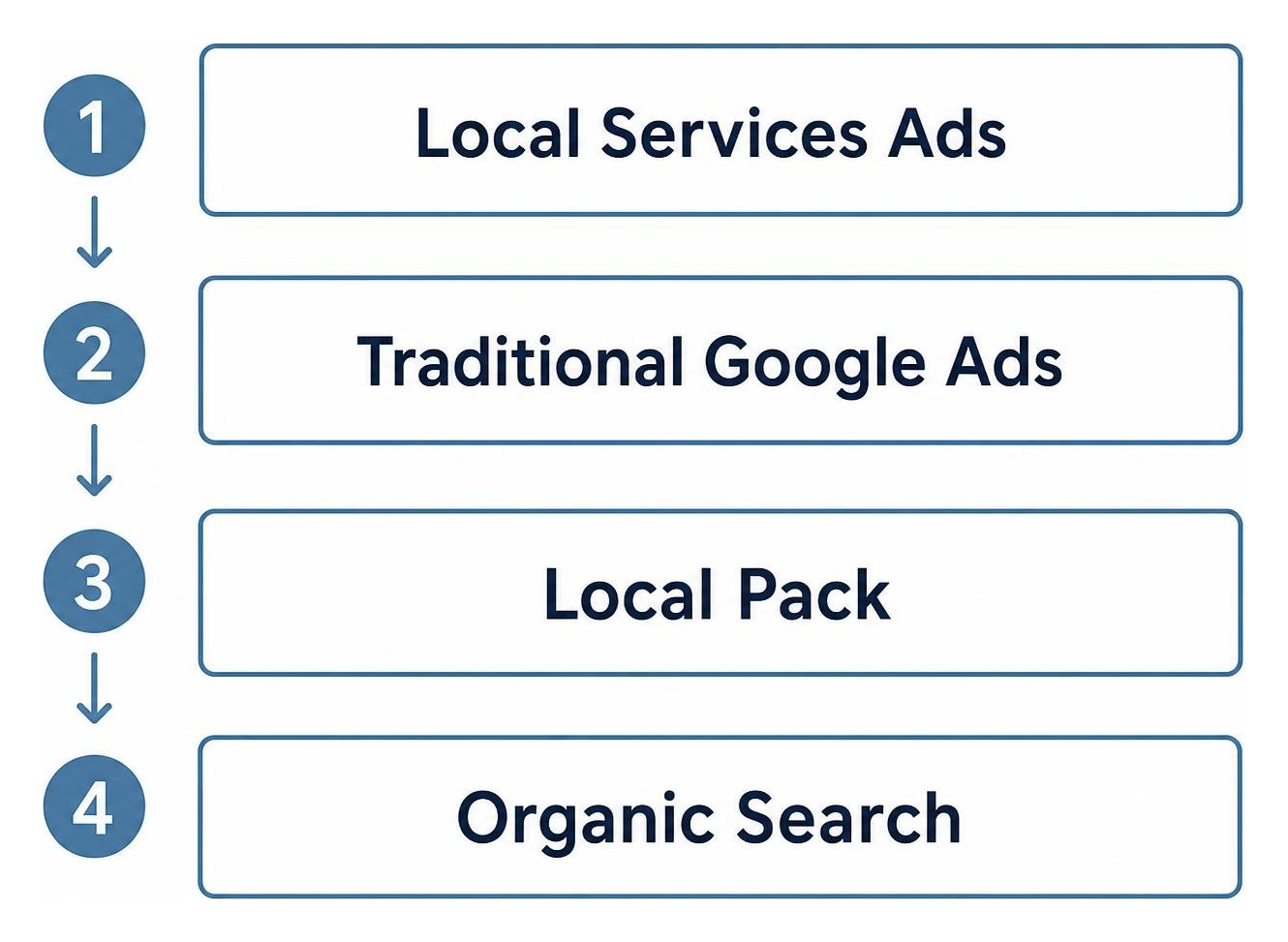
If you are a service-based business, Google Local Services Ads are the single most powerful tool in your marketing arsenal. Because they sit at the very top of the search results—even above traditional PPC ads—they are the first thing a user sees.
Beyond prime real estate, the true power of LSAs lies in the psychology of trust. When you pass Google’s rigorous screening process, your ad is displayed with a bright green badge: either Google Guaranteed (for home services) or Google Verified (for professional and healthcare services).
This badge acts as an immediate trust signal. When consumers are naturally skeptical of online businesses, seeing that Google officially backs your business dramatically increases conversion rates.
How the Pay-Per-Lead Model Protects Your Budget
The biggest fear local business owners have with online advertising is wasting money. We have all heard horror stories of businesses spending thousands of dollars on clicks that resulted in zero phone calls.
The pay-per-lead model solves this problem. When you run LSAs, you only pay when a customer initiates contact. If someone clicks on your ad to read your reviews but doesn’t call or message you, you pay absolutely nothing.
What happens if you get a spam call, a telemarketer, or a customer calling from outside your service area? Google allows you to dispute invalid leads directly inside your dashboard. If Google agrees the lead was irrelevant or fraudulent, they credit the cost of that lead back to your account. This makes LSAs one of the most cost-effective, low-risk ways to market your business. You can explore more about setting up these budgets directly through Reach Local Customers with Local Service Ads – Google Ads.
Eligible Industries and the Coveted Google Verified Badges
While LSAs are incredibly effective, they are not available to every business type. Google has rolled out this program to industries where trust and safety are paramount.
To earn the Google Guaranteed or Google Verified badge, business owners and their field employees must pass comprehensive background checks, license verifications, and insurance checks.
- Home Services (Google Guaranteed): Plumbers, electricians, HVAC technicians, roofers, landscapers, pest control, house cleaners, and handymen.
- Professional Services (Google Verified): Lawyers, accountants, financial planners, real estate agents, and tax advisors.
- Healthcare & Wellness (Google Verified): Dentists, acupuncturists, chiropractors, physical therapists, and dermatologists.
- Other Local Services: Automotive repair, learning/tutoring services, pet care, and beauty services.
Launching Your Campaign: Setup, Budgets, and Verification

Ready to claim your spot at the top of Google? Setting up a local search campaign requires careful planning. While Google makes the interface user-friendly, the verification process is strict, and your targeting must be precise to avoid wasting ad spend.
Getting Started with Local Search Advertising
To launch your first LSA campaign, you must complete the following steps:
- Check Eligibility: Enter your ZIP code and business category to confirm Google offers LSAs for your industry in your area.
- Create Your Profile: Input your exact business details, including operating hours, phone number, and website.
- Define Your Service Area: Use precise geo-fencing. Instead of targeting an entire metropolitan area, you can prioritize specific ZIP codes where your highest-value customers live.
- Select Your Services: Check off the exact jobs you perform (e.g., “water heater repair” instead of just “plumbing”). Google uses this to automatically match you to search queries.
- Submit Verification Documents: Provide your business license, proof of general liability insurance, and complete the required background checks through Google’s third-party verification partners.
Maximizing ROI with Professional Local Search Advertising Management
While the DIY route is possible, managing local search ads can quickly become a full-time job. Monitoring lead quality, disputing bad leads, adjusting budgets, and ensuring your team responds to inquiries fast enough to maintain your ad ranking takes consistent effort.
That is where professional management makes a massive difference. At Max Effect Marketing, we combine intelligent AI technology with real human expertise to optimize your campaigns daily. By aligning your campaigns with specific Key Performance Indicators (KPIs), we consistently deliver outstanding results for our clients:
- 50% Increase in Impressions and Leads by refining service areas and targeting.
- 25% Decrease in Cost-Per-Lead (CPL) through aggressive lead disputing and bid optimization.
- 98% Budget Spend Monthly, ensuring your ad dollars are fully utilized on high-quality opportunities without overspending.
Integrating Paid Local Ads with Your Organic SEO Strategy
Paid ads do not exist in a vacuum. To build a dominant online presence, your paid local search advertising must work hand-in-hand with your organic search engine optimization (SEO) efforts.
When you combine both, you occupy multiple spots on the first page of Google: the LSA at the top, the traditional PPC ad below it, the organic Local Pack in the middle, and your website in the organic listings. This “real estate dominance” makes your business the obvious choice for searchers. To understand how to build this foundation, read our guide on Local SEO for Small Businesses: Why It Matters in 2026 or explore our core SEO services.
Aligning Google Business Profile with Paid Campaigns
Your Google Business Profile (GBP) is the anchor of your local online presence. When you run local ads, Google pulls your reviews, star ratings, and location data directly from your GBP.
To ensure maximum performance, keep your Name, Address, and Phone (NAP) information 100% consistent across your website, GBP, social media profiles, and local directories.
Furthermore, Google’s algorithm in 2026 heavily favors review recency over sheer volume. A business with 30 fresh reviews from the last two months will often outrank a business with 300 reviews from three years ago. Building a routine where your team asks for reviews immediately after completing a job is critical.
Tracking Metrics and Campaign Reporting That Actually Matter
We believe in absolute transparency. You should never have to guess whether your marketing is working. When running local search campaigns, we track and report on metrics that directly impact your bottom line:
- Total Leads Generated: The exact number of phone calls, texts, or bookings driven by your ads.
- Cost-Per-Lead (CPL): Exactly how much you paid for each qualified contact.
- Call Tracking Reports: Recorded calls so you can monitor lead quality and evaluate how well your team converts callers into paying customers.
- Store Visits & Direction Clicks: For brick-and-mortar locations, tracking how many people clicked to navigate to your physical storefront.
Frequently Asked Questions About Local Search Ads
What are the most common mistakes businesses make with local search ads?
The biggest mistake is slow response times. For LSAs, Google tracks how quickly you answer phone calls and respond to messages. If you repeatedly miss calls or let messages sit, Google will lower your ad ranking and show your competitors instead.
Other common mistakes include setting too narrow of a service area (limiting your reach), having inconsistent NAP data across the web, and failing to ask customers for reviews, which directly impacts your ad’s trust rating.
How much does local search advertising cost on average?
Because of the pay-per-lead model, you do not pay for impressions or clicks. The cost-per-lead varies based on your industry and geographic location. For example, a highly competitive service like water damage restoration in a major city will have a higher cost-per-lead than a house cleaning service in a small suburb. Across directories and local networks, the average cost per call hovers around $17, making it an incredibly affordable way to acquire high-intent customers.
Can small businesses compete with national chains using local ads?
Absolutely. In fact, local search is one of the few marketing channels where small businesses have a structural advantage. Google’s local algorithm heavily weighs distance (how close you are to the searcher), relevance (how specifically your services match the query), and prominence (your local reputation and reviews). A national chain with a massive budget cannot bypass the physical distance factor, meaning your neighborhood business can easily claim the top spot.
Conclusion: Put Your Business on the Map Today
In 2026, relying solely on word-of-mouth or outdated marketing tactics is a recipe for invisibility. Your customers are actively searching for your services on their phones right now. If you aren’t at the top of those local search results, you are handing those jobs directly to your competitors.
Local search advertising is the fastest, most reliable way to put your business on the map, build instant trust with verified badges, and pay only when real customers contact you.
At Max Effect Marketing, we combine cutting-edge, AI-powered digital marketing with real human partnerships. We don’t just set up ads and walk away; we actively manage, optimize, and fight for your budget to deliver a 5X ROI.
Stop being invisible. Let’s get your phones ringing. Claim Your Free Local Search Consultation with our team today, and let’s build a campaign designed to grow your business.