
Why Most Ad Budgets Are Being Wasted Right Now (And How to Fix It)
Programmatic advertising companies are the fastest-growing segment of digital marketing, and for good reason. The right partner or platform setup can help you reach better audiences, reduce wasted spend, and turn automated media buying into measurable revenue.
Here are the main programmatic options worth understanding in 2026:
| Option | Best For | Type |
|---|---|---|
| Enterprise ecosystem DSPs | Large brands, premium video, advanced analytics | DSP Platform |
| Open-web omnichannel DSPs | Display, CTV, native, audio, transparency | DSP Platform |
| Retail media DSPs | E-commerce brands and purchase-intent targeting | DSP Platform |
| Mid-market programmatic platforms | Faster onboarding and lower complexity | DSP Platform |
| Max Effect Marketing | AI-powered campaigns and 5X ROI | Agency |
Let’s be honest. If you’ve ever run digital ads and stared at a dashboard wondering where your budget actually went, you’re not alone.
Global programmatic ad spend is surpassing $200 billion in 2026 – accounting for roughly 90% of all digital display advertising. That’s nearly every display ad you see online, bought and sold automatically in milliseconds.
But here’s the problem: speed and scale don’t automatically mean results.
The programmatic ecosystem is powerful. It’s also complex, opaque, and full of budget traps – from ad fraud to attribution overlap to platforms that optimize for their own metrics instead of yours.
The difference between wasting money and generating real ROI often comes down to which companies and platforms you choose, and whether you have the expertise to use them correctly.
I’m David Bauer, VP at Max Effect Marketing, with 14+ years running performance-driven campaigns across Google, Meta, and programmatic advertising companies of all sizes. In that time, I’ve seen what separates the platforms and agencies that actually move the needle from the ones that just move money around.
Let me walk you through exactly what to look for – so you can stop donating to the internet and start scaling.
Demystifying the Tech: What is Programmatic Advertising?
If you ask five different digital marketers to define programmatic advertising, you will likely get five highly technical, jargon-filled answers that make you want to close your laptop and take a long nap.
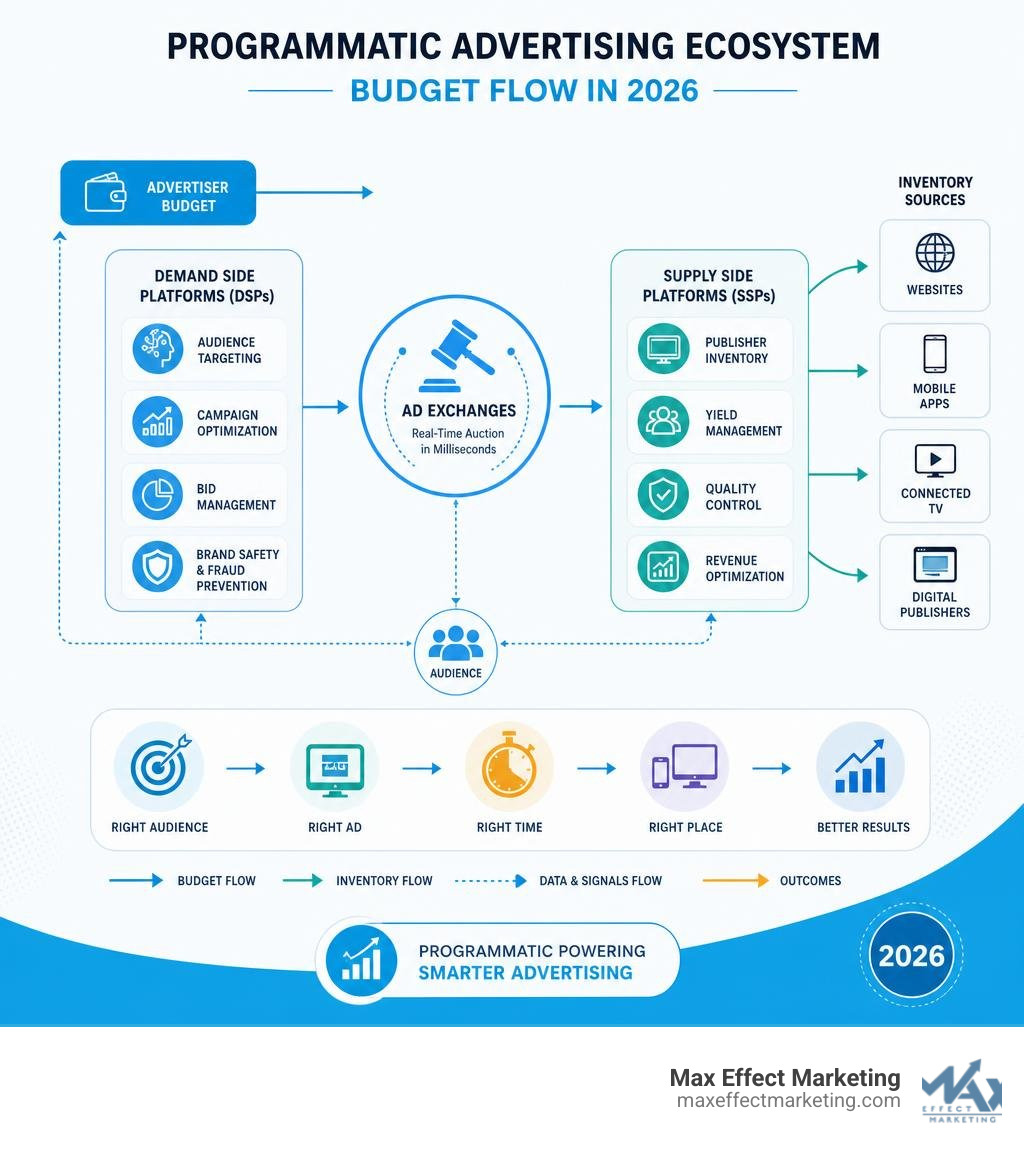
Let’s strip away the fluff. At its absolute core, programmatic advertising is the automated buying and selling of digital ad space in real time. Instead of humans negotiating ad placements over lunch or exchanging endless emails, software does the heavy lifting in milliseconds.
Think of it as the stock market, but for ad space. Every time a user loads a webpage, an instantaneous auction occurs behind the scenes. Multiple advertisers bid on that specific impression based on data points like location, browsing behavior, and interests. The highest bidder wins, and their ad is instantly displayed.
To understand how this ecosystem runs, you need to know the primary players:
- Demand-Side Platforms (DSPs): The software that advertisers and agencies use to buy ad space, target specific audiences, and manage campaigns.
- Supply-Side Platforms (SSPs): The software that publishers (websites, apps, streaming services) use to list their available ad space and maximize their revenue.
- Ad Exchanges: The virtual marketplace where DSPs and SSPs meet to conduct the real-time bidding (RTB) auctions.
By automating these connections, businesses can launch highly sophisticated, multi-layered Online Campaigns that reach the right people at precisely the right moment.
How Programmatic Differs from Traditional Digital Advertising
To appreciate programmatic, it helps to look at how we used to do things. In the early days of digital marketing, buying an ad space was incredibly manual. It involved reaching out directly to a publisher’s sales team, negotiating pricing, signing physical insertion orders (essentially the fax machines of marketing), and manually uploading creatives.
This traditional model restricted advertisers to buying entire bulks of inventory on specific websites, regardless of who was actually looking at the screen. You bought space, not audiences.
Programmatic completely flips this script. Instead of buying a blanket spot on a single website, you buy access to specific user profiles across millions of websites.
Automation replaces manual negotiation, enabling unprecedented efficiency and scale. This shift is so profound that in 2026, 91.2% of US digital display ads are purchased programmatically. It has evolved from a high-tech luxury for enterprise brands into the standard operating system for digital media.
The Core Benefits of Partnering with Programmatic Advertising Companies
Why should your brand care about programmatic? Because when executed correctly, it offers advantages that traditional ad channels simply cannot match:
- Laser-Targeted Precision: You aren’t just guessing who might see your ad. Programmatic allows you to layer demographic, behavioral, geographic, and contextual data to target highly specific niche audiences.
- Unmatched Scale: Through global ad networks, you gain instant access to premium inventory across millions of websites, mobile apps, connected TV (CTV) screens, and streaming audio platforms.
- Real-Time Optimization: Instead of waiting for a monthly report to see what worked, programmatic platforms allow you to adjust bids, swap out creative assets, and shift budgets on the fly based on live performance data.
- Efficient Budget Allocation: By utilizing advanced machine learning algorithms, modern programmatic platforms automatically bid higher for high-value impressions and ignore low-value placements, keeping your ads away from bots and in front of real, engaged humans.
How Modern Programmatic Advertising Companies Drive ROI
Navigating this complex highway of platforms, algorithms, and publishers requires specialized expertise. That is where professional programmatic advertising companies and agencies enter the equation.
Think of a top-tier programmatic agency as a master chef. The DSPs, data segments, and ad formats are the high-quality ingredients, but without the chef’s seasoned technique, recipe knowledge, and precise timing, you will still end up with a messy, expensive meal.
An experienced agency handles everything from strategic planning and audience building to continuous optimization, ensuring that your programmatic efforts align seamlessly with other channels, such as search engine marketing. If you are curious about combining these strategies, check out our guide on Google Ads for Small Businesses: A Smart Way to Generate More Leads.
The Main Types of Programmatic Ad Formats and Campaign Goals
Programmatic is far more than just annoying banner ads. In 2026, the medium spans a rich variety of highly engaging, interactive ad formats designed to guide users through every stage of the marketing funnel:
- Display Ads: The foundational banner and sidebar ads found on websites. These are excellent for cost-effective brand awareness and retargeting campaigns.
- Video Ads: Pre-roll, mid-roll, and post-roll video placements on publishers and platforms. Video is highly effective for driving emotional engagement and brand recall.
- Connected TV (CTV): Ads served on streaming services (like Hulu, Roku, or Peacock) watched on actual television screens. CTV merges the massive impact of traditional TV advertising with the precise targeting of digital media.
- Native Ads: Sponsored content that matches the visual form, function, and feel of the surrounding editorial content. Native ads are less intrusive and yield exceptionally high click-through rates.
- Programmatic Audio: Ads integrated into podcasts, digital radio, and music streaming platforms like Spotify or Pandora. This format is perfect for capturing the undivided attention of mobile listeners.
- Digital Out-of-Home (DOOH): Programmatically purchased digital billboards, transit screens, and elevator displays. This bridges the gap between digital targeting and real-world physical presence.
Services Offered by Top Programmatic Advertising Companies in 2026
When you partner with a leading programmatic agency, they do not just push a button and walk away. They deliver a suite of sophisticated, ongoing services designed to maximize performance:
- Audience Segmentation & Modeling: Building custom, high-intent audience profiles by combining your first-party CRM data with premium third-party behavioral and demographic data.
- Dynamic Creative Optimization (DCO): Utilizing AI to automatically alter elements of an ad (like headlines, images, or calls-to-action) in real time to match the specific profile of the person viewing it.
- Premium Inventory Access: Leveraging direct publisher relationships and private marketplace (PMP) deals to secure highly coveted ad placements that are not available on the open exchange.
- Brand Safety & Verification Setup: Implementing rigorous pre-bid filters and verification tools to guarantee that your ads only appear on reputable, high-quality websites, protecting your brand’s reputation.
These programmatic workflows are often paired with comprehensive digital growth strategies, including high-impact SEO and targeted paid search, to construct a cohesive, unstoppable lead-generation machine.
Navigating the Challenges: Transparency, Fraud, and Cookieless Identity
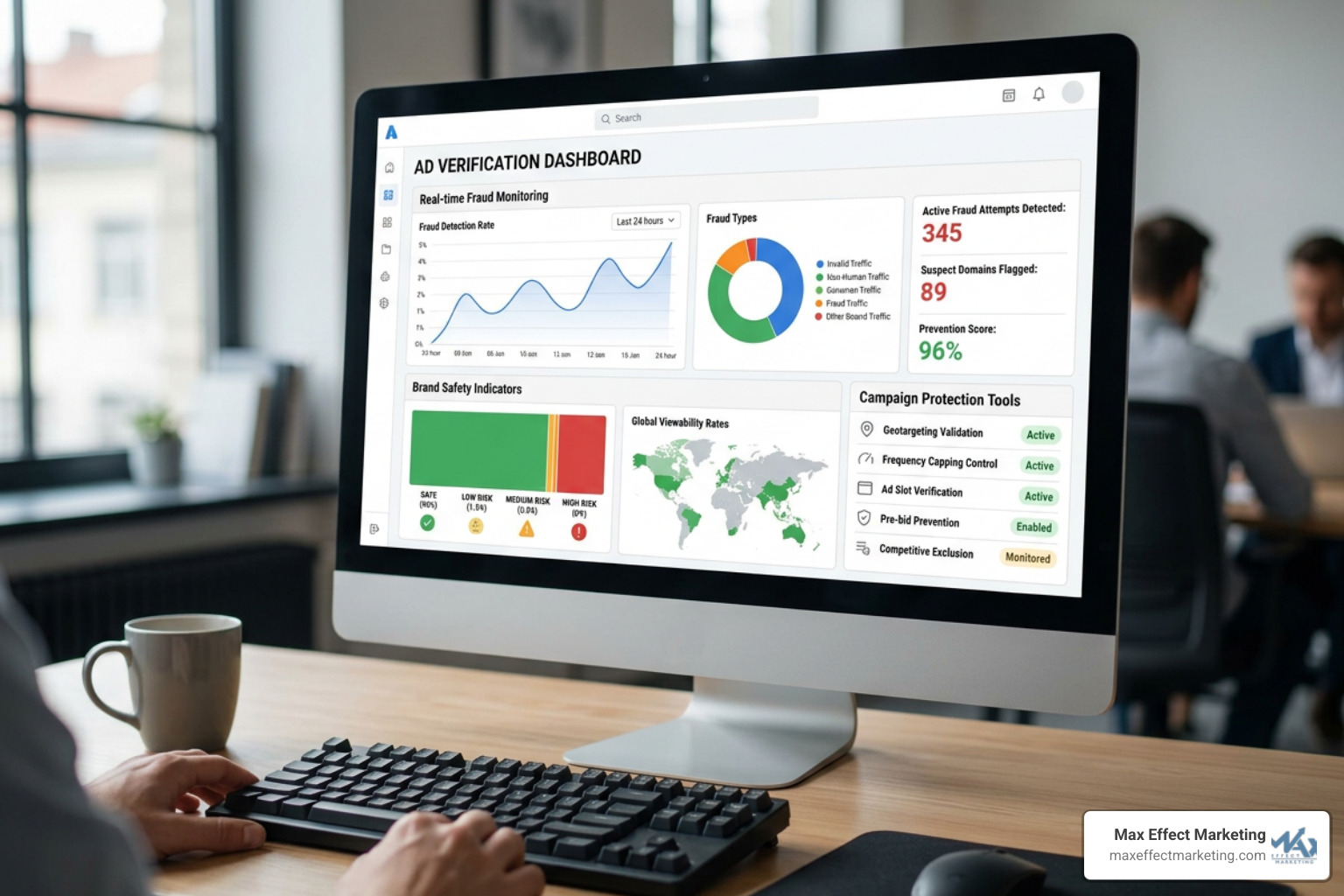
While programmatic advertising offers incredible opportunities, it is not without its pitfalls. The open nature of the web means that advertisers must actively defend their budgets against bad actors and structural inefficiencies.
To run successful campaigns in 2026, you must understand these challenges and know how top-tier programmatic partners actively shield your ad spend from them.
Tackling Ad Fraud, Transparency, and Multi-Platform Attribution Overlap
The digital ad landscape has a transparency problem. Sophisticated ad fraud, such as bot traffic, domain spoofing, and invisible pixel stuffing, can quietly drain your budget if left unchecked. Furthermore, running campaigns across multiple DSPs simultaneously can create a massive headache known as attribution overlap.
Because 73% of enterprise advertisers run three or more DSPs at once to access different inventory, they frequently experience a 15% to 30% variance in reported metrics. This happens because multiple platforms will claim credit for the exact same conversion, leading to highly inflated performance reports.
Additionally, teams running multi-platform programmatic without a unified measurement infrastructure can spend 12 to 18 hours per week manually reconciling these reporting discrepancies.
To solve this, we implement unified tracking, rigorous frequency management, and pre-bid verification tools to ensure your ads are only served to real, human eyes. We manage your frequency caps across all platforms so you do not annoy your prospects or pay for the same click twice.
First-Party Data, Contextual Targeting, and Cookieless Identity Solutions
The marketing world has officially entered the post-cookie era. With third-party cookies deprecated, relying solely on old-school tracking methods is a recipe for rapidly shrinking audience pools and skyrocketing acquisition costs.
To thrive, modern programmatic advertisers must pivot to privacy-first identity solutions. This involves utilizing advanced contextual targeting and cookieless frameworks like Unified ID 2.0 (UID 2.0).
Statistics show that advertisers who proactively implement UID 2.0 maintain 70% to 85% addressability post-cookie deprecation, compared to a dismal 40% to 50% addressability for brands relying solely on outdated probabilistic tracking methods.
To dive deeper into how sophisticated systems match ad creatives to page meaning at scale without relying on invasive cookies, you can explore the technical infrastructure behind Semantic Audience Targeting & Ad Matching for AdTech | Zilliz . By targeting the actual meaning of a page rather than just keywords, you can recapture premium inventory that traditional keyword blocklists mistakenly ignore.
The Leading Demand-Side Platforms (DSPs) and AI Ad Tech of 2026
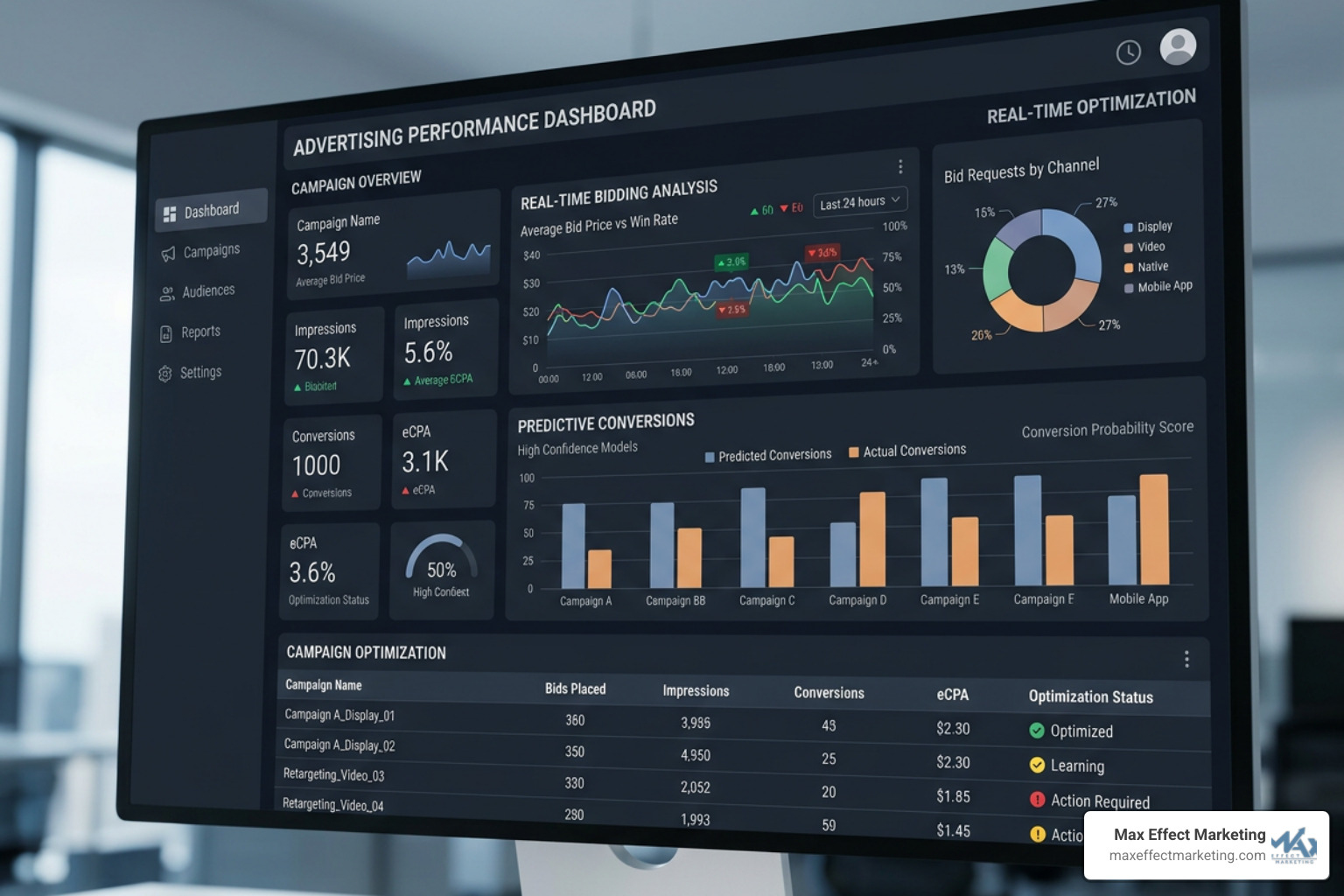
To win the programmatic game, you need the right tools. Demand-Side Platforms (DSPs) are the core engines that power your campaigns, giving us the ability to buy inventory across the open web, specialized private marketplaces, premium publisher environments, retail media networks, and walled gardens.
How DSPs Work and the Top Platform Categories We Leverage for Your Campaigns
Different DSP categories serve different business sizes, budget tiers, and campaign goals. Instead of choosing a platform because it sounds shiny in a sales deck, the smart move is matching the tool to your revenue target, audience, data maturity, and media budget.
Here is a practical breakdown of the leading DSP categories in 2026:
- Enterprise ecosystem DSPs: These are built for large-scale campaigns that require advanced analytics, premium video inventory, robust audience integrations, and deep measurement capabilities. They can be powerful, but they also require careful setup so your budget does not disappear faster than free snacks in a conference room.
- Independent open-web DSPs: These are strong choices for omnichannel campaigns across display, native, video, audio, and connected TV. They are especially useful when transparency, inventory control, and cross-channel reach are priorities.
- Retail media DSPs: These platforms are valuable for e-commerce and retail brands because they can use purchase-intent and shopping behavior signals. However, brands outside traditional retail categories should evaluate costs carefully, as premium retail media inventory can come with significantly higher CPMs.
- Mid-market DSPs: These platforms are often more approachable for growing brands. They typically offer faster onboarding, simpler workflows, and lower complexity, making them a strong entry point for businesses that want programmatic performance without enterprise-level friction.
Navigating these platforms requires deep expertise. Setting up an enterprise-grade DSP incorrectly can lead to rapid budget depletion, misconfigured tracking, poor placements, and the kind of reporting spreadsheet that makes everyone suddenly remember they have another meeting.
How AI and Machine Learning are Transforming Programmatic Bidding
The days of manual optimization are officially behind us. In 2026, advanced artificial intelligence and machine learning are doing the heavy lifting of bidding and creative matching in real time.
Modern AI bidding systems can analyze conversion signals, audience behavior, device context, creative performance, and inventory quality far faster than any human trader could. For campaigns with mature conversion tracking and clean data, AI-assisted bidding can often produce meaningful CPA improvements within 60 to 90 days. Independent platform benchmarks also commonly show 20% to 30% performance lifts compared to purely manual optimization when the campaigns are structured correctly.
The key phrase there is structured correctly. AI is powerful, but it is not magic. If you feed it messy conversion data, weak creative, poor audience signals, or broken attribution, it will simply optimize your budget into a very expensive learning experience.
To see how AI-powered ad serving and real-time verification are scaling globally, you can read about the core technology behind omnichannel, omnifunnel ad platform infrastructure and explore AI-powered ad tech for measurable performance. These systems process trillions of bids daily, using autonomous AI agents to optimize campaigns within the tight 80 to 120-millisecond real-time bidding window.
How to Choose the Right Programmatic Platform or Agency for Your Budget
Choosing how to execute your programmatic strategy is a major business decision. Should you build an in-house team and license a self-serve DSP, or should you partner with a fully managed programmatic agency?
| Feature | Self-Serve Programmatic | Managed Agency Service |
|---|---|---|
| Best For | Enterprise brands with internal ad ops teams | Small-to-mid market brands seeking maximum ROI |
| Minimum Budget | Typically high (often $50K+/month platform minimums) | Flexible; tied to campaign goals and media spend |
| Staffing Required | Min. 1 FTE Programmatic Specialist + 0.5 FTE Data Analyst | None; the agency acts as your dedicated team |
| Onboarding Time | 30 to 90 days for contract setup and training | 7 to 14 days to launch |
| Optimization | Manual and platform-AI dependent | Continuous human oversight + advanced agency AI |
To ensure that your programmatic leads flow smoothly into your sales pipeline, it is vital to pair your ad campaigns with a robust CRM system that tracks user journeys from first programmatic impression to closed deal.
Self-Serve vs. Managed Programmatic Services: Which is Best for Your Business Size?
For massive enterprise organizations with multi-million dollar annual ad budgets, investing in a self-serve DSP model can make sense. However, for most mid-market brands and growing businesses, running self-serve programmatic is a recipe for operational headaches.
To run self-serve successfully, you must employ at least one full-time, highly specialized programmatic trader and half of a data analyst’s time. Without this dedicated human oversight, you run a high risk of misconfiguring campaigns, overpaying for inventory, and failing to catch fraudulent traffic.
Partnering with a managed programmatic agency gives you instant access to enterprise-grade DSPs, direct publisher deals, and advanced AI optimization tools without the overhead of hiring an internal team.
Typical Costs, Pricing Models, and Key KPIs to Measure Success
Programmatic pricing is highly flexible but is primarily transacted on a CPM (Cost Per Thousand impressions) basis.
On average, CPM rates for programmatic advertising range from $2.50 to $25, with highly targeted, premium CTV or interactive video campaigns reaching as high as $50 or more. Native ads tend to sit on the lower end of the cost spectrum, while premium, long-form video and connected TV sit on the higher end.
When measuring the success of your programmatic campaigns, look past basic vanity metrics like impressions. Instead, focus on the KPIs that directly impact your bottom line:
- Viewability Rate: The percentage of your ads that were actually visible on screen to a human user (aim for 70%+).
- Effective Cost Per Acquisition (eCPA): How much it actually costs to drive a valuable action or lead through your programmatic funnel.
- Return on Ad Spend (ROAS): The direct revenue generated compared to every dollar spent on media.
- Click-Through Rate (CTR) & Conversion Rate: To evaluate how effectively your creative assets and landing pages are engaging your audience.
Frequently Asked Questions about Programmatic Advertising
To help you navigate this fast-moving landscape, we have compiled answers to the most common questions businesses ask when looking at programmatic advertising companies.
What is the average cost of programmatic advertising?
The average cost is highly variable and depends on your targeting criteria, ad formats, and choice of platform. Most campaigns transact on a CPM basis, ranging from $2.50 to $25. While some platforms claim to have “no minimum spend,” a meaningful, optimized campaign typically requires a minimum investment of a few thousand dollars to gather enough data for the algorithms to optimize effectively.
How do programmatic advertising companies prevent ad fraud?
Top programmatic companies prevent fraud by implementing a multi-layered defense. This includes pre-bid verification tools (like IAS, DoubleVerify, or MOAT) that filter out invalid traffic (IVT) before a bid is even placed. Additionally, we use strict publisher whitelists, ads.txt verification, and semantic brand safety tools to ensure your ads only run on reputable, high-quality websites.
Can small businesses benefit from programmatic advertising?
Absolutely! While enterprise brands dominate the massive CTV and global display space, small and mid-sized businesses can use programmatic for highly localized geofencing, event targeting, and high-impact retargeting. By pairing programmatic with a high-converting Web Design, smaller brands can achieve enterprise-level targeting precision on a local budget.
Conclusion
At the end of the day, programmatic advertising is not a “set-it-and-forget-it” channel. It is a highly dynamic, incredibly powerful engine that requires the perfect blend of cutting-edge artificial intelligence and experienced human strategy to run successfully.
At Max Effect Marketing, we don’t believe in black-box dashboards or mysterious optimization algorithms that drain your budget on low-quality placements. As an AI-powered digital marketing agency, our unique strength lies in combining intelligent technology with real human partnerships to help our clients achieve an outstanding 5X ROI.
We handle the complexity, eliminate the attribution overlap, and ensure that every single ad dollar you spend is actively working to drive real, measurable revenue for your business.
Stop donating your hard-earned budget to the internet gods. Let’s build a transparent, high-performing campaign that actually scales your brand.